

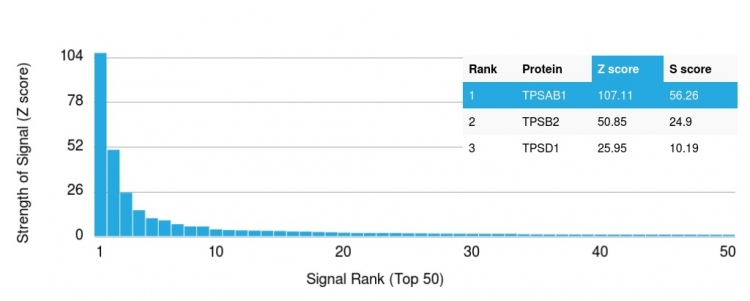
Analysis of Protein Array containing more than 19,000 full-length human proteins using Tryptase Mouse Monoclonal Antibody (TPSAB1/1961). Z- and S- Score: The Z-score represents the strength of a signal that a monoclonal antibody produces when binding to a particular protein on the HuProtTM array. Z-scores are described in units of standard deviations (SD’s) above the mean value of all signals generated on that array. If targets on HuProtTM are arranged in descending order of the Z-score, the S-score is the difference (also in units of SD’s) between the Z-score. S-score therefore represents the relative target specificity of a Monoclonal Antibody to its intended target. A Monoclonal Antibody is considered to specific to its intended target if the Monoclonal Antibody has an S-score of at least 2.5. For example, if a Monoclonal Antibody binds to protein X with a Z-score of 43 and to protein Y with a Z-score of 14, then the S-score for the binding of that Monoclonal Antibody to protein X is equal to 29.
![IHC-P analysis of human tonsil tissue using GTX17823 Mast cell tryptase antibody [TPSAB1/1961].](https://www.genetex.com/upload/website/prouct_img/normal/GTX17823/GTX17823_20200115_IHC-P_1415_w_23060620_578.webp "IHC-P analysis of human tonsil tissue using GTX17823 Mast cell tryptase antibody [TPSAB1/1961].")
Analysis of Protein Array containing more than 19,000 full-length human proteins using Tryptase Mouse Monoclonal Antibody (TPSAB1/1961). Z- and S- Score: The Z-score represents the strength of a signal that a monoclonal antibody produces when binding to a particular protein on the HuProtTM array. Z-scores are described in units of standard deviations (SD’s) above the mean value of all signals generated on that array. If targets on HuProtTM are arranged in descending order of the Z-score, the S-score is the difference (also in units of SD’s) between the Z-score. S-score therefore represents the relative target specificity of a Monoclonal Antibody to its intended target. A Monoclonal Antibody is considered to specific to its intended target if the Monoclonal Antibody has an S-score of at least 2.5. For example, if a Monoclonal Antibody binds to protein X with a Z-score of 43 and to protein Y with a Z-score of 14, then the S-score for the binding of that Monoclonal Antibody to protein X is equal to 29.
Mast cell tryptase antibody [TPSAB1/1961]
GTX17823

ApplicationsImmunoHistoChemistry, ImmunoHistoChemistry Paraffin, Other Application
Product group Antibodies
ReactivityHuman
TargetTPSAB1
Overview
- SupplierGeneTex
- Product NameMast cell tryptase antibody [TPSAB1/1961]
- Delivery Days Customer9
- Application Supplier NoteIHC-P: 1-2microg/ml for 30 minutes at RT. *Optimal dilutions/concentrations should be determined by the researcher.Not tested in other applications.
- ApplicationsImmunoHistoChemistry, ImmunoHistoChemistry Paraffin, Other Application
- CertificationResearch Use Only
- ClonalityMonoclonal
- Clone IDTPSAB1/1961
- Concentration0.2 mg/ml
- ConjugateUnconjugated
- Gene ID7177
- Target nameTPSAB1
- Target descriptiontryptase alpha/beta 1
- Target synonymsTPS1, TPS2, TPSB1, TPSB2, Tryptase-2, tryptase alpha/beta-1, Tryptase II, Tryptase beta-2, epididymis secretory sperm binding protein, mast cell alpha II tryptase, mast cell beta I tryptase, mast cell tryptase, tryptase alpha II, tryptase alpha-1, tryptase beta I, tryptase beta-1, tryptase-1, tryptase-I, tryptase-III
- HostMouse
- IsotypeIgG1
- Protein IDP15157
- Protein NameTryptase alpha/beta-1
- Scientific DescriptionTryptases comprise a family of trypsin-like serine proteases, the peptidase family S1. Tryptases are enzymatically active only as heparin-stabilized tetramers, and they are resistant to all known endogenous proteinase inhibitors. Several tryptase genes are clustered on chromosome 16p13.3. These genes are characterized by several distinct features. They have a highly conserved 3 UTR and contain tandem repeat sequences at the 5 flank and 3 UTR which are thought to play a role in regulation of the mRNA stability. These genes have an intron immediately upstream of the initiator Met codon, which separates the site of transcription initiation from protein coding sequence. This feature is characteristic of tryptases but is unusual in other genes. The alleles of this gene exhibit an unusual amount of sequence variation, such that the alleles were once thought to represent two separate genes, alpha and beta 1. Beta tryptases appear to be the main isoenzymes expressed in mast cells; whereas in basophils, alpha tryptases predominate. Tryptases have been implicated as mediators in the pathogenesis of asthma and other allergic and inflammatory disorders. [provided by RefSeq, Jul 2008]
- ReactivityHuman
- Storage Instruction-20°C or -80°C,2°C to 8°C
- UNSPSC41116161
Datasheet
Related products

Product group Antibodies

Anti-TPSAB1 Antibody144-65451
ApplicationsImmunoFluorescence, Western Blot
ReactivityHuman, Mouse
TargetTPSAB1
- SizePrice
Product group Antibodies

Anti-TPSAB1 AntibodyA30554
ApplicationsImmunoFluorescence, Western Blot, ImmunoHistoChemistry
ReactivityHuman, Mouse, Rat
- SizePrice

Product group Antibodies

Mast Cell Tryptase Recombinant AntibodyBSM-52533R
ApplicationsImmunoFluorescence, Western Blot, ImmunoHistoChemistry, ImmunoHistoChemistry Frozen, ImmunoHistoChemistry Paraffin
ReactivityHuman, Mouse, Rat
TargetTPSAB1
- SizePrice
Product group Antibodies

Tpsb2 Polyclonal AntibodyCAC08942
ApplicationsWestern Blot, ELISA, ImmunoHistoChemistry
ReactivityMouse, Rat
TargetTPSAB1
- SizePrice
Product group Antibodies

TPSB2 AntibodyCSB-PA024128LA01HU
ApplicationsWestern Blot, ELISA, ImmunoHistoChemistry
ReactivityHuman, Mouse, Rat
TargetTPSAB1
- SizePrice
![IHC-P analysis of human tonsil tissue using GTX22378 Mast cell tryptase antibody [AA1].](https://www.genetex.com/upload/website/prouct_img/normal/GTX22378/GTX22378_20191203_IHC-P_98_w_23060620_641.webp)
Product group Antibodies
References
ApplicationsImmunoHistoChemistry, ImmunoHistoChemistry Paraffin
ReactivityHuman
TargetTPSAB1
- SizePrice
Product group Antibodies
ApplicationsImmunoHistoChemistry, ImmunoHistoChemistry Paraffin
ReactivityHuman
TargetTPSAB1
- SizePrice
![IHC-P analysis of human skin using GTX01964 Mast cell tryptase antibody [10D11]. Note cytoplasmic staining of mast cells.](https://www.genetex.com/upload/website/prouct_img/normal/GTX01964/GTX01964_20200811_IHC-P_109_w_23053121_992.webp)
Product group Antibodies
ApplicationsImmunoHistoChemistry, ImmunoHistoChemistry Paraffin
ReactivityHuman
TargetTPSAB1
- SizePrice
![IHC analysis of human tonsil tissue using GTX75011 Mast cell tryptase antibody [AA1].](https://www.genetex.com/upload/website/prouct_img/normal/GTX75011/GTX75011_4901_IHC-P_w_23061322_490.webp)
Product group Antibodies
ApplicationsImmunoFluorescence, Western Blot, ELISA, ImmunoCytoChemistry, ImmunoHistoChemistry, ImmunoHistoChemistry Frozen, ImmunoHistoChemistry Paraffin
ReactivityCanine, Feline, Human, Monkey, Rat
- SizePrice