

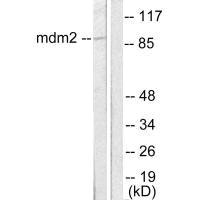
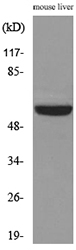
Western blot analysis of extracts from SKOV3 cells, using MDM2 antibody.
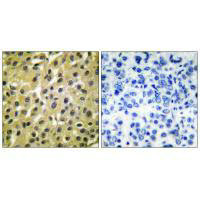
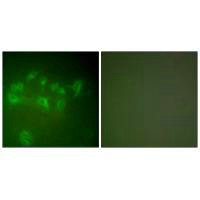
Western blot analysis of extracts from SKOV3 cells, using MDM2 antibody.
MDM2 Antibody
CSB-PA891046

ApplicationsImmunoFluorescence, Western Blot, ELISA, ImmunoHistoChemistry
Product group Antibodies
ReactivityHuman, Rat
TargetMDM2
Overview
- SupplierCusabio
- Product NameMDM2 Antibody
- Delivery Days Customer20
- ApplicationsImmunoFluorescence, Western Blot, ELISA, ImmunoHistoChemistry
- CertificationResearch Use Only
- ClonalityPolyclonal
- ConjugateUnconjugated
- Gene ID4193
- Target nameMDM2
- Target descriptionMDM2 proto-oncogene
- Target synonymsACTFS, HDMX, LSKB, hdm2, E3 ubiquitin-protein ligase Mdm2, MDM2 oncogene, E3 ubiquitin protein ligase, MDM2 proto-oncogene, E3 ubiquitin protein ligase, Mdm2, p53 E3 ubiquitin protein ligase homolog, Mdm2, transformed 3T3 cell double minute 2, p53 binding protein, double minute 2, human homolog of; p53-binding protein, oncoprotein Mdm2
- HostRabbit
- IsotypeIgG
- Protein IDQ00987
- Protein NameE3 ubiquitin-protein ligase Mdm2
- Scientific DescriptionE3 ubiquitin-protein ligase that mediates ubiquitination of p53/TP53, leading to its degradation by the proteasome. Inhibits p53/TP53- and p73/TP73-mediated cell cycle arrest and apoptosis by binding its transcriptional activation domain. Also acts as a ubiquitin ligase E3 toward itself and ARRB1. Permits the nuclear export of p53/TP53. Promotes proteasome-dependent ubiquitin-independent degradation of retinoblastoma RB1 protein. Inhibits DAXX-mediated apoptosis by inducing its ubiquitination and degradation. Component of the TRIM28/KAP1-MDM2-p53/TP53 complex involved in stabilizing p53/TP53. Also component of the TRIM28/KAP1-ERBB4-MDM2 complex which links growth factor and DNA damage response pathways. Mediates ubiquitination and subsequent proteasome degradation of DYRK2 in nucleus. Ubiquitinates IGF1R and SNAI1 and promotes them to proteasomal degradation. Jer-Yen Yang, Mol. Cell. Biol., Oct 2006; 26: 7269 - 7282. Lubing Gu, Blood, May 2002; 99: 3367 - 3375. Hongyan Zhu, J. Biol. Chem., Dec 2003; 278: 49286 - 49292. Tatiana Dilla, Endocrinology, Jan 2000; 141: 420.
- ReactivityHuman, Rat
- Storage Instruction-20°C or -80°C
- UNSPSC41116161
Related products

Product group Antibodies
MDM2 AntibodyCSB-PA003212
ApplicationsImmunoFluorescence, Western Blot, ELISA, ImmunoHistoChemistry
ReactivityHuman, Monkey, Mouse
TargetMDM2
- SizePrice
Product group Antibodies

MDM2 Polyclonal AntibodyCAC15788
ApplicationsWestern Blot, ELISA, ImmunoHistoChemistry
TargetMDM2
- SizePrice

Product group Antibodies

Anti-MDM2 Antibody Picoband(r)A00054-2-CARRIER-FREE
ApplicationsWestern Blot
ReactivityHuman, Mouse, Rat
TargetMDM2
- SizePrice
Product group Antibodies

Anti-MDM2 AntibodyA101381
ApplicationsWestern Blot, ELISA
ReactivityHuman
- SizePrice
Product group Antibodies

Anti-MDM2 Antibody144-60282
ApplicationsWestern Blot
ReactivityHuman, Mouse, Rat
TargetMDM2
- SizePrice

Product group Antibodies

Goat anti-MDM2 (isoform)EB06990
ApplicationsWestern Blot, ELISA
ReactivityBovine, Canine, Feline, Human, Porcine, Rat
TargetMDM2
- SizePrice
Product group Antibodies

MDM2 Antibody (C-Terminus)LS-C368433
ApplicationsWestern Blot
ReactivityBovine, Canine, Human, Mouse, Rat
TargetMDM2
- SizePrice
Product group Antibodies

ApplicationsFlow Cytometry, ImmunoFluorescence, Western Blot, ELISA, ImmunoCytoChemistry, ImmunoHistoChemistry, ImmunoHistoChemistry Frozen, ImmunoHistoChemistry Paraffin
ReactivityEquine, Human, Mouse, Rabbit, Rat
TargetMDM2
- SizePrice