MRP4 Antibody / ABCC4
ORB2636467

ApplicationsImmunoHistoChemistry, ImmunoHistoChemistry Paraffin
Product group Antibodies
ReactivityHuman
TargetABCC4
Overview
- SupplierBiorbyt
- Product NameMRP4 Antibody / ABCC4
- Delivery Days Customer10
- Application Supplier NoteOptimal dilution of the ABCC4 antibody should be determined by the researcher.
- ApplicationsImmunoHistoChemistry, ImmunoHistoChemistry Paraffin
- Applications SupplierImmunohistochemistry (FFPE): 1-2ug/ml IHC-P
- CertificationResearch Use Only
- ClonalityMonoclonal
- Clone IDABCC4/9018
- ConjugateUnconjugated
- Gene ID10257
- Target nameABCC4
- Target descriptionATP binding cassette subfamily C member 4 (PEL blood group)
- Target synonymsMOAT-B, MOATB, MRP4, ATP-binding cassette sub-family C member 4, MRP/cMOAT-related ABC transporter, bA464I2.1 (ATP-binding cassette, sub-family C (CFTR/MRP), member 4), canalicular multispecific organic anion transporter (ABC superfamily), multi-specific organic anion transporter B, multidrug resistance-associated protein 4
- HostMouse
- IsotypeIgG2b
- Protein IDO15439
- Protein NameATP-binding cassette sub-family C member 4
- Scientific DescriptionThe two members of the large family of ABC transporters known to confer multidrug resistance in human cancer cells are the Mdr-1 P-glycoprotein and the multidrug-resistance protein MRP1. MRP1 is an integral membrane protein that contains an MDR-like core, an N-terminal membrane-bound region and a cytoplasmic linker, and it is expressed in various cerebral cells, as well as in lung, testis and peripheral blood. The MRP gene family also includes MRP2, which is alternatively designated cMOAT (for canalicular multispecific organic anion transporter), and MRP3, which are both conjugate export pumps expressed predominantly in hepatocytes. MRP2 localizes exclusively to the apical membrane and is constitutively expressed at a high level in normal liver cells. Conversely, MRP3 localizes to the basolateral membrane where it also mediates the transport of the organic anion S-(2,4-dinitrophenyl-) glutathione toward the basolateral side of the membrane. MRP3 is normally expressed at comparatively lower levels than MRP2 and increases only when secretion across the apical membrane by MRP2 is impaired. MRP6 is highly expressed in liver and kidney, whereas MRP4 and MRP5 are detected in various tissues, yet at much lower levels of expression.
- ReactivityHuman
- Storage Instruction-20°C,2°C to 8°C
- UNSPSC12352203
Related products
Product group Antibodies

Anti-ABCC4 Antibody144-02198
ApplicationsImmunoFluorescence, Western Blot, ImmunoHistoChemistry
ReactivityHuman, Mouse, Rat
TargetABCC4
- SizePrice

Product group Antibodies

Anti-MRP4/ABCC4 Antibody Picoband(r)A01596-CARRIER-FREE
ApplicationsFlow Cytometry, ImmunoFluorescence, Western Blot, ImmunoCytoChemistry, ImmunoHistoChemistry
ReactivityHuman, Mouse, Rat
TargetABCC4
- SizePrice
Product group Antibodies

ApplicationsImmunoPrecipitation, Western Blot, ImmunoCytoChemistry, ImmunoHistoChemistry
ReactivityMouse, Rat
TargetABCC4
- SizePrice
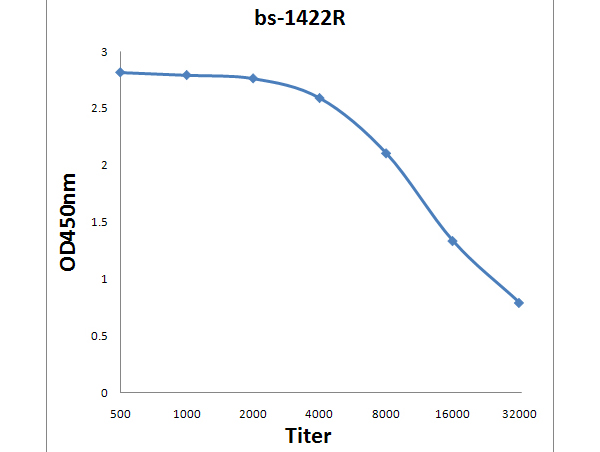
Product group Antibodies

MRP4/ABCC4 Polyclonal AntibodyBS-1422R
ApplicationsImmunoFluorescence, ELISA, ImmunoHistoChemistry, ImmunoHistoChemistry Frozen, ImmunoHistoChemistry Paraffin
ReactivityBovine, Chicken, Equine, Guinea Pig, Human, Mouse, Porcine, Rabbit, Rat, Other Species
TargetABCC4
- SizePrice

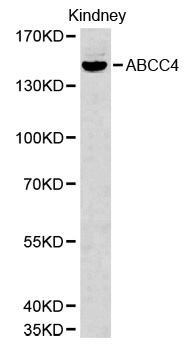
Product group Antibodies

Anti-ABCC4 AntibodyA37588
ApplicationsWestern Blot, ImmunoHistoChemistry
ReactivityHuman, Mouse, Rat
- SizePrice
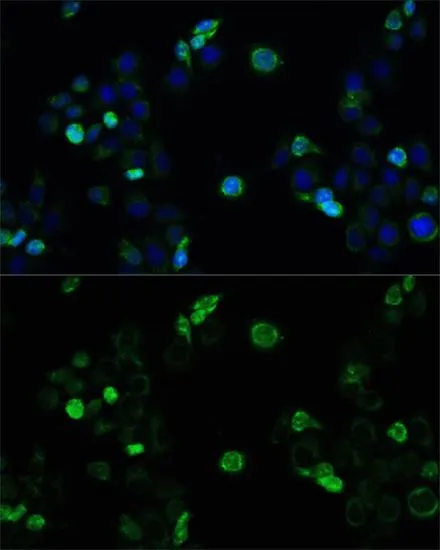
Product group Antibodies

MRP4 antibodyGTX30016
ApplicationsImmunoFluorescence, Western Blot, ImmunoCytoChemistry, ImmunoHistoChemistry, ImmunoHistoChemistry Paraffin
ReactivityHuman, Mouse, Rat
TargetABCC4
- SizePrice
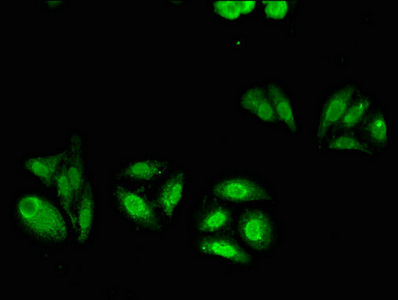
Product group Antibodies

ABCC4 AntibodyCSB-PA001063LA01HU
ApplicationsImmunoFluorescence, ELISA
ReactivityHuman
TargetABCC4
- SizePrice
Product group Antibodies
References

Goat anti-ABCC4 / MRP4EB06538
ApplicationsELISA, ImmunoHistoChemistry
ReactivityHuman, Mouse, Rat
TargetABCC4
- SizePrice