

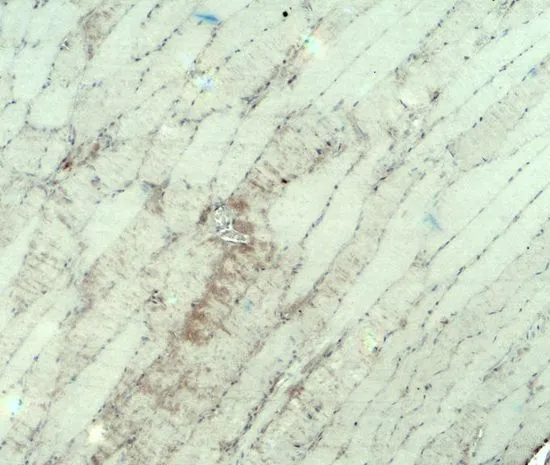
IHC-P analysis of mouse skeletal muscle tissue using GTX32147 MYH3 antibody. Working concentration : 5 μg/ml
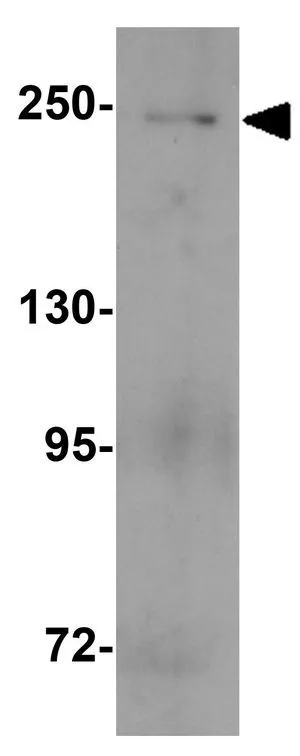
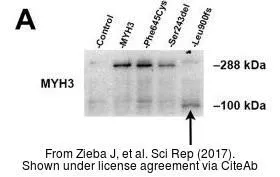
IHC-P analysis of mouse skeletal muscle tissue using GTX32147 MYH3 antibody. Working concentration : 5 μg/ml
MYH3 antibody
GTX32147

ApplicationsWestern Blot, ELISA, ImmunoHistoChemistry, ImmunoHistoChemistry Paraffin
Product group Antibodies
ReactivityHuman, Mouse, Rat
TargetMYH3
Overview
- SupplierGeneTex
- Product NameMYH3 antibody
- Delivery Days Customer9
- Application Supplier NoteWB: 1 microg/mL. IHC-P: 5 microg/mL. *Optimal dilutions/concentrations should be determined by the researcher.Not tested in other applications.
- ApplicationsWestern Blot, ELISA, ImmunoHistoChemistry, ImmunoHistoChemistry Paraffin
- CertificationResearch Use Only
- ClonalityPolyclonal
- Concentration1 mg/ml
- ConjugateUnconjugated
- Gene ID4621
- Target nameMYH3
- Target descriptionmyosin heavy chain 3
- Target synonymsCPSFS1A, CPSFS1B, CPSKF1A, CPSKF1B, DA2A, DA2B, DA2B3, DA8, HEMHC, MYHC-EMB, MYHSE1, SMHCE, myosin-3, myosin heavy chain, fast skeletal muscle, embryonic, myosin, heavy chain 3, skeletal muscle, embryonic, myosin, heavy polypeptide 3, skeletal muscle, embryonic, myosin, skeletal, heavy chain, embryonic 1
- HostRabbit
- IsotypeIgG
- Protein IDP11055
- Protein NameMyosin-3
- Scientific DescriptionMyosin is a major contractile protein which converts chemical energy into mechanical energy through the hydrolysis of ATP. Myosin is a hexameric protein composed of a pair of myosin heavy chains (MYH) and two pairs of nonidentical light chains. This gene is a member of the MYH family and encodes a protein with an IQ domain and a myosin head-like domain. Mutations in this gene have been associated with two congenital contracture (arthrogryposis) syndromes, Freeman-Sheldon syndrome and Sheldon-Hall syndrome. [provided by RefSeq, Jul 2008]
- ReactivityHuman, Mouse, Rat
- Storage Instruction2°C to 8°C
- UNSPSC12352203
References
- Vaiman A, Fritz S, Beauvallet C, et al. Mutation of the MYH3 gene causes recessive cleft palate in Limousine cattle. Genet Sel Evol. 2022,54(1):71. doi: 10.1186/s12711-022-00762-2Read this paper
- Zieba J, Zhang W, Chong JX, et al. A postnatal role for embryonic myosin revealed by MYH3 mutations that alter TGFβ signaling and cause autosomal dominant spondylocarpotarsal synostosis. Sci Rep. 2017,7:41803. doi: 10.1038/srep41803Read this paper
Datasheet
Related products
Product group Antibodies

Anti-MYH3 Antibody101-11047
ApplicationsWestern Blot, ELISA
TargetMYH3
- SizePrice
Product group Antibodies

ApplicationsImmunoPrecipitation, Western Blot, ImmunoCytoChemistry, ImmunoHistoChemistry
TargetMYH3
- SizePrice
Product group Antibodies

MYH3 AntibodyPACO46042
ApplicationsImmunoFluorescence, ELISA, ImmunoHistoChemistry
ReactivityHuman
TargetMYH3
- SizePrice
Product group Antibodies

MYH3 AntibodyCSB-PA015297LA01HU
ApplicationsImmunoFluorescence, ELISA, ImmunoHistoChemistry
ReactivityHuman
TargetMYH3
- SizePrice
Product group Antibodies

MYH3 AntibodyLS-C678722
ApplicationsImmunoFluorescence, ELISA, ImmunoHistoChemistry, ImmunoHistoChemistry Paraffin
ReactivityHuman
TargetMYH3
- SizePrice

Product group Antibodies

Anti-MYH3 AntibodyHPA021808
ApplicationsImmunoHistoChemistry
ReactivityHuman
TargetMYH3
- SizePrice

Product group Antibodies

Anti-heavy chain Myosin/MYH3 Antibody Picoband(r)A02697-2-CARRIER-FREE
ApplicationsFlow Cytometry, Western Blot, ELISA
ReactivityHuman, Mouse, Rat
TargetMYH3
- SizePrice