

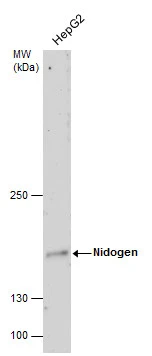
Nidogen antibody detects Nidogen protein by western blot analysis. Whole cell extracts (30 μg) was separated by 5 % SDS-PAGE, and blotted with Nidogen antibody (GTX102897) diluted by 1:500
Nidogen antibody detects Nidogen protein by western blot analysis. Whole cell extracts (30 μg) was separated by 5 % SDS-PAGE, and blotted with Nidogen antibody (GTX102897) diluted by 1:500
Nidogen 1 antibody [C1C3]
GTX102897

ApplicationsWestern Blot
Product group Antibodies
ReactivityHuman
TargetNID1
Overview
- SupplierGeneTex
- Product NameNidogen 1 antibody [C1C3]
- Delivery Days Customer9
- Application Supplier NoteWB: 1:500-1:3000. *Optimal dilutions/concentrations should be determined by the researcher.Not tested in other applications.
- ApplicationsWestern Blot
- CertificationResearch Use Only
- ClonalityPolyclonal
- Concentration1 mg/ml
- ConjugateUnconjugated
- Gene ID4811
- Target nameNID1
- Target descriptionnidogen 1
- Target synonymsNID, nidogen-1, NID-1, enactin, entactin, epididymis secretory sperm binding protein
- HostRabbit
- IsotypeIgG
- Protein IDP14543
- Protein NameNidogen-1
- Scientific DescriptionThis gene encodes a member of the nidogen family of basement membrane glycoproteins. The protein interacts with several other components of basement membranes, and may play a role in cell interactions with the extracellular matrix. [provided by RefSeq]
- ReactivityHuman
- Storage Instruction-20°C or -80°C,2°C to 8°C
- UNSPSC41116161
Datasheet
Related products

Product group Antibodies

Anti-NID1 AntibodyA98008
ApplicationsWestern Blot, ELISA
ReactivityHuman, Mouse, Rat
- SizePrice
Product group Antibodies

Anti-NID1 Antibody144-08349
ApplicationsWestern Blot, ImmunoHistoChemistry
ReactivityHuman
TargetNID1
- SizePrice
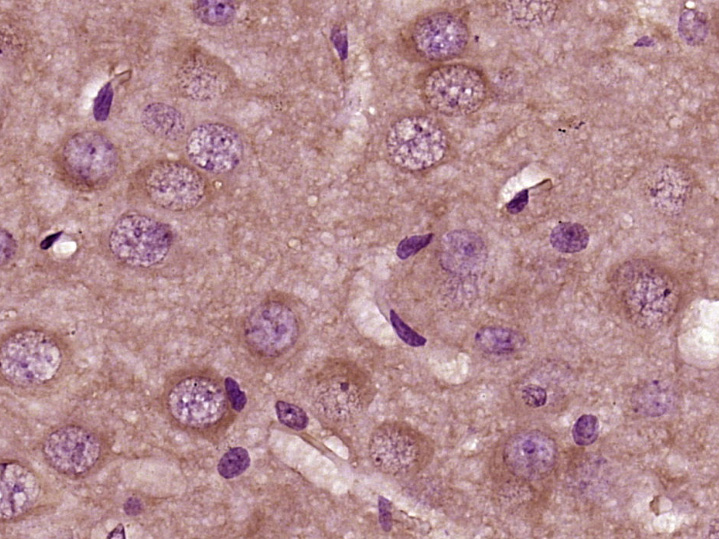
Product group Antibodies

Nidogen Polyclonal AntibodyBS-6911R
ApplicationsImmunoFluorescence, ELISA, ImmunoCytoChemistry, ImmunoHistoChemistry, ImmunoHistoChemistry Frozen, ImmunoHistoChemistry Paraffin
ReactivityBovine, Human, Mouse, Rabbit, Rat
TargetNID1
- SizePrice
Product group Antibodies

ApplicationsImmunoPrecipitation, Western Blot, ImmunoCytoChemistry, ImmunoHistoChemistry
ReactivityMouse, Rat
TargetNID1
- SizePrice
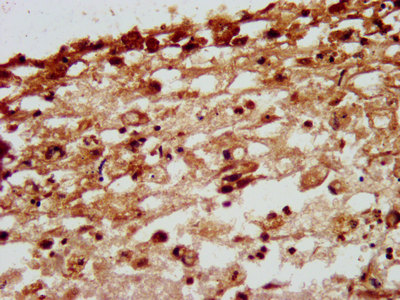
Product group Antibodies

NID1 AntibodyCSB-PA015802LA01HU
ApplicationsELISA, ImmunoHistoChemistry
ReactivityHuman
TargetNID1
- SizePrice
Product group Antibodies

ApplicationsImmunoPrecipitation, Western Blot
ReactivityHuman, Mouse, Rat
TargetNID1
- SizePrice
Product group Antibodies
ApplicationsWestern Blot, ELISA
ReactivityHuman, Mouse
TargetNID1
- SizePrice
Product group Antibodies
ApplicationsWestern Blot, ELISA
ReactivityHuman, Mouse
TargetNID1
- SizePrice
Product group Antibodies
ApplicationsWestern Blot, ELISA
ReactivityHuman, Mouse
TargetNID1
- SizePrice
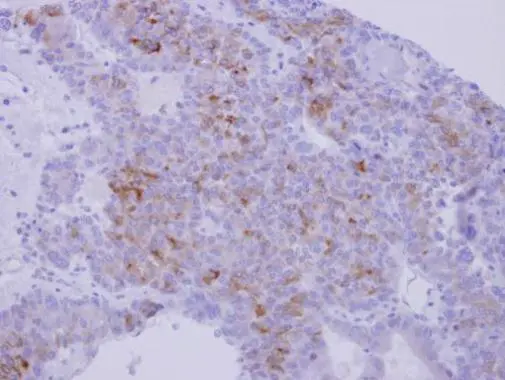
Product group Antibodies
Nidogen 1 antibodyGTX114587
ApplicationsWestern Blot, ImmunoHistoChemistry, ImmunoHistoChemistry Paraffin
ReactivityHuman
TargetNID1
- SizePrice