

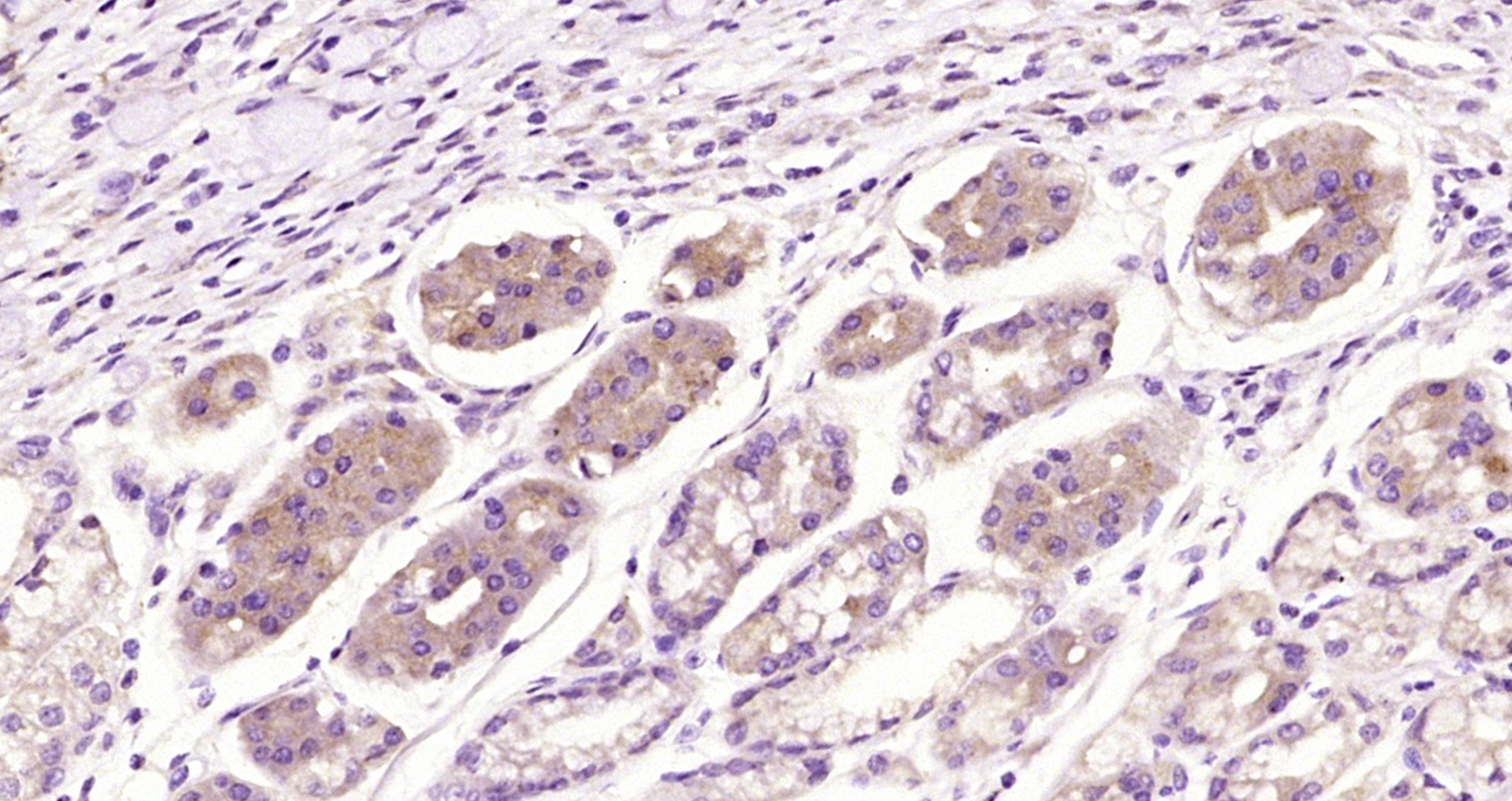
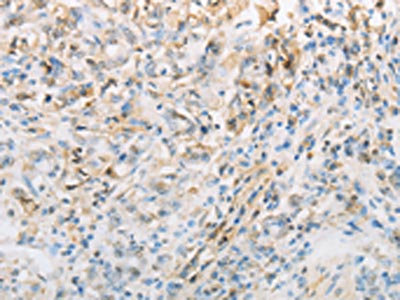
Immunohistochemistry of paraffin-embedded Human gasrtic cancer tissue using NPPC Polyclonal Antibody at dilution 1:70
Immunohistochemistry of paraffin-embedded Human gasrtic cancer tissue using NPPC Polyclonal Antibody at dilution 1:70
NPPC Polyclonal Antibody
E-AB-16009

Product group Antibodies
Overview
- SupplierElabscience
- Product NameNPPC Polyclonal Antibody
- Delivery Days Customer12
- Applications SupplierELISA IHC
- CertificationResearch Use Only
- Concentration0.6mg/ml
- Scientific DescriptionThis gene encodes a member of the Notch family. Members of this Type 1 transmembrane protein family share structural characteristics including an extracellular domain consisting of multiple epidermal growth factor-like (EGF) repeats, and an intracellular domain consisting of multiple, different domain types. Notch family members play a role in a variety of developmental processes by controlling cell fate decisions. The Notch signaling network is an evolutionarily conserved intercellular signaling pathway which regulates interactions between physically adjacent cells. In Drosophilia, notch interaction with its cell-bound ligands (delta, serrate) establishes an intercellular signaling pathway that plays a key role in development. Homologues of the notch-ligands have also been identified in human, but precise interactions between these ligands and the human notch homologues remain to be determined. This protein is cleaved in the trans-Golgi network, and presented on the cell surface as a heterodimer. This protein functions as a receptor for membrane bound ligands, and may play a role in vascular, renal and hepatic development. This gene may be associated with susceptibility to schizophrenia in a small portion of cases. An alternative splice variant has been described but its biological nature has not been determined.
- UNSPSC12352203
Related products
Product group Antibodies

ApplicationsWestern Blot, ImmunoHistoChemistry
ReactivityMouse
TargetNPPC
- SizePrice
Product group Antibodies

Anti-CNP-22 Antibody130-10443
ApplicationsWestern Blot, ELISA
TargetNPPC
- SizePrice
Product group Antibodies

ApplicationsImmunoFluorescence, Western Blot, ELISA, ImmunoCytoChemistry, ImmunoHistoChemistry, ImmunoHistoChemistry Frozen, ImmunoHistoChemistry Paraffin
TargetNPPC
- SizePrice
Product group Antibodies

Anti-NPPC AntibodyA28567
ApplicationsWestern Blot
ReactivityHuman, Mouse, Rat
- SizePrice

Product group Antibodies

NPPC Antibody (Preservative Free)LS-C743782
ApplicationsWestern Blot, ELISA
ReactivityHuman
TargetNPPC
- SizePrice
Product group Antibodies

CNP antibodyGTX55996
ApplicationsWestern Blot
ReactivityHuman, Mouse, Rat
TargetNPPC
- SizePrice
Product group Antibodies

Anti-NPPC AntibodyHPA035362
ApplicationsImmunoHistoChemistry
ReactivityHuman
TargetNPPC
- SizePrice
Product group Antibodies

NPPC AntibodyCSB-PA136609
ApplicationsELISA, ImmunoHistoChemistry
ReactivityHuman, Mouse, Rat
TargetNPPC
- SizePrice