

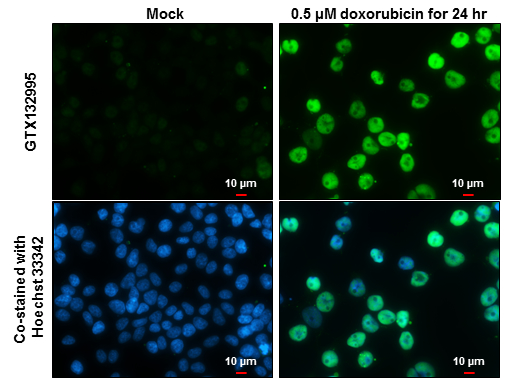
p53 (phospho Ser15) antibody detects p53 (phospho Ser15) protein at nucleus by immunofluorescent analysis. Sample: Mock and treated 293T cells were fixed in 4% paraformaldehyde at RT for 15 min. Green: p53 (phospho Ser15) protein stained by p53 (phospho Ser15) antibody (GTX132995) diluted at 1:2000. Blue: Hoechst 33342 staining. Scale bar = 10 μm.
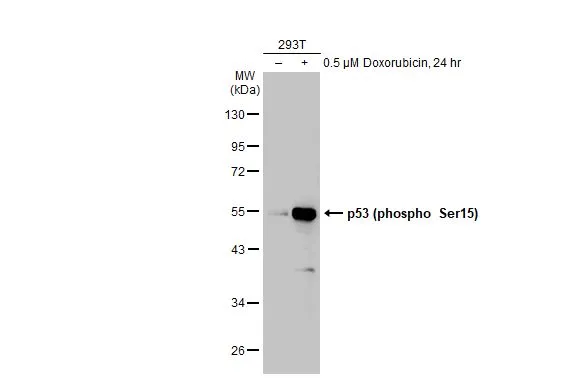
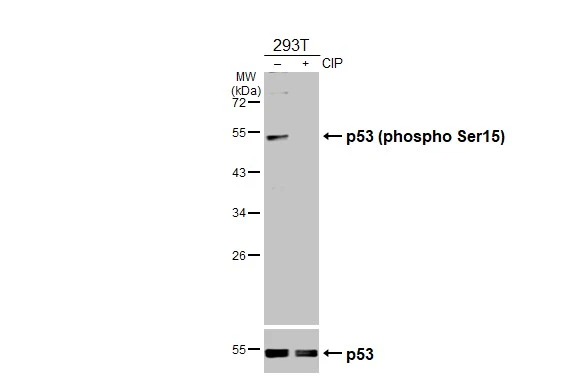
p53 (phospho Ser15) antibody detects p53 (phospho Ser15) protein at nucleus by immunofluorescent analysis. Sample: Mock and treated 293T cells were fixed in 4% paraformaldehyde at RT for 15 min. Green: p53 (phospho Ser15) protein stained by p53 (phospho Ser15) antibody (GTX132995) diluted at 1:2000. Blue: Hoechst 33342 staining. Scale bar = 10 μm.
p53 (phospho Ser15) antibody
GTX132995

ApplicationsImmunoFluorescence, Western Blot, ImmunoCytoChemistry
Product group Antibodies
ReactivityHuman
TargetTP53
Overview
- SupplierGeneTex
- Product Namep53 (phospho Ser15) antibody
- Delivery Days Customer9
- Application Supplier NoteWB: 1:500-1:3000. ICC/IF: 1:100-1:1000. *Optimal dilutions/concentrations should be determined by the researcher.Not tested in other applications.
- ApplicationsImmunoFluorescence, Western Blot, ImmunoCytoChemistry
- CertificationResearch Use Only
- ClonalityPolyclonal
- Concentration0.23 mg/ml
- ConjugateUnconjugated
- Gene ID7157
- Target nameTP53
- Target descriptiontumor protein p53
- Target synonymsBCC7, BMFS5, LFS1, P53, TRP53, cellular tumor antigen p53, antigen NY-CO-13, mutant tumor protein 53, phosphoprotein p53, transformation-related protein 53, tumor protein 53, tumor supressor p53
- HostRabbit
- IsotypeIgG
- Protein IDP04637
- Protein NameCellular tumor antigen p53
- Scientific DescriptionThis gene encodes tumor protein p53, which responds to diverse cellular stresses to regulate target genes that induce cell cycle arrest, apoptosis, senescence, DNA repair, or changes in metabolism. p53 protein is expressed at low level in normal cells and at a high level in a variety of transformed cell lines, where its believed to contribute to transformation and malignancy. p53 is a DNA-binding protein containing transcription activation, DNA-binding, and oligomerization domains. It is postulated to bind to a p53-binding site and activate expression of downstream genes that inhibit growth and/or invasion, and thus function as a tumor suppressor. Mutants of p53 that frequently occur in a number of different human cancers fail to bind the consensus DNA binding site, and hence cause the loss of tumor suppressor activity. Alterations of this gene occur not only as somatic mutations in human malignancies, but also as germline mutations in some cancer-prone families with Li-Fraumeni syndrome. Multiple p53 variants due to alternative promoters and multiple alternative splicing have been found. These variants encode distinct isoforms, which can regulate p53 transcriptional activity. [provided by RefSeq]
- ReactivityHuman
- Storage Instruction-20°C or -80°C,2°C to 8°C
- UNSPSC12352203
References
- Wang YY, Xiao LY, Wu PC, et al. Orabase-formulated gentian violet effectively improved oral potentially malignant disorder in vitro and in vivo. Biochem Pharmacol. 2020,171:113713. doi: 10.1016/j.bcp.2019.113713Read this paper
Datasheet
Related products


Product group Antibodies

Anti-p53 AntibodyAMAB90956
ApplicationsWestern Blot, ImmunoCytoChemistry, ImmunoHistoChemistry
ReactivityHuman
TargetTP53
- SizePrice
Product group Antibodies

Anti-p53 [PAb421]Ab00142-2.0
ApplicationsImmunoFluorescence, ImmunoPrecipitation, Western Blot, ELISA, ImmunoHistoChemistry, ImmunoHistoChemistry Frozen, ImmunoHistoChemistry Paraffin, Other Application
ReactivityHuman, Monkey, Mouse, Rabbit, Rat
TargetTP53
- SizePrice

Product group Antibodies
References
p53 (phospho Ser46) antibodyGTX132996
ApplicationsImmunoFluorescence, Western Blot, ImmunoCytoChemistry
ReactivityHuman
TargetTP53
- SizePrice
Product group Antibodies
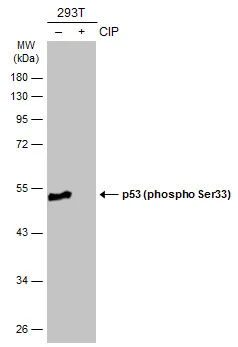
p53 (phospho Ser33) antibodyGTX133902
ApplicationsWestern Blot
ReactivityHuman
TargetTP53
- SizePrice
Product group Antibodies
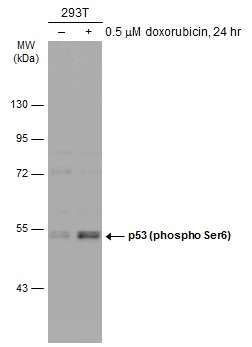
p53 (phospho Ser6) antibodyGTX133905
ApplicationsWestern Blot
ReactivityHuman
TargetTP53
- SizePrice
Product group Antibodies
References
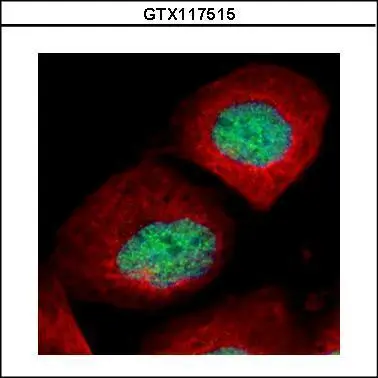
p53 (mono-methyl Lys372) antibodyGTX117515
ApplicationsImmunoFluorescence, Western Blot, ImmunoCytoChemistry, ImmunoHistoChemistry, ImmunoHistoChemistry Paraffin
ReactivityAmphibian, Human, Mammals
TargetTP53
- SizePrice
![ICC/IF analysis of HeLa cells treated with 100 nM Doxorubicin for 24 hrs using GTX00675 p53 (Acetyl Lys120) antibody [10E5]. Red : Primary antibody Green : DAPI Dilution : 1:1000 Fixation : 4% PFA, overnight Permeabilization : 0.25% Triton X-100 in PBS for 10 min](https://www.genetex.com/upload/website/prouct_img/normal/GTX00675/GTX00675_20191104_ICC-IF_w_23053121_863.webp)
Product group Antibodies
References
ApplicationsFlow Cytometry, ImmunoFluorescence, ImmunoPrecipitation, Western Blot, ELISA, ImmunoCytoChemistry
ReactivityHuman
TargetTP53
- SizePrice
![IHC-P analysis of Human stomach cancer tissue section using GTX00678 p53 (phospho Ser315) antibody [#18].](https://www.genetex.com/upload/website/prouct_img/normal/GTX00678/GTX00678_20191104_IHC-P_w_23053121_607.webp)
Product group Antibodies
References
ApplicationsImmunoFluorescence, Western Blot, ELISA, ImmunoCytoChemistry, ImmunoHistoChemistry, ImmunoHistoChemistry Paraffin
ReactivityHuman
TargetTP53
- SizePrice