

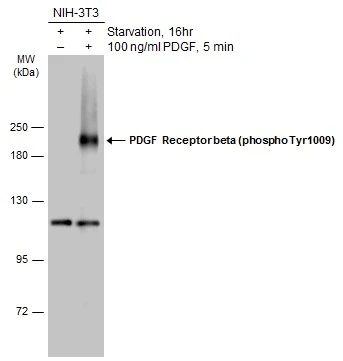
Untreated (–) and treated (+) NIH-3T3 whole cell extracts (30 μg) were separated by 7.5% SDS-PAGE, and the membrane was blotted with PDGF Receptor beta (phospho Tyr1009) antibody (GTX133453) diluted at 1:1000. The HRP-conjugated anti-rabbit IgG antibody (GTX213110-01) was used to detect the primary antibody.
Untreated (–) and treated (+) NIH-3T3 whole cell extracts (30 μg) were separated by 7.5% SDS-PAGE, and the membrane was blotted with PDGF Receptor beta (phospho Tyr1009) antibody (GTX133453) diluted at 1:1000. The HRP-conjugated anti-rabbit IgG antibody (GTX213110-01) was used to detect the primary antibody.
PDGF Receptor beta (phospho Tyr1009) antibody
GTX133453

ApplicationsWestern Blot
Product group Antibodies
ReactivityHuman, Mouse
TargetPDGFRB
Overview
- SupplierGeneTex
- Product NamePDGF Receptor beta (phospho Tyr1009) antibody
- Delivery Days Customer9
- Application Supplier NoteWB: 1:500-1:3000. *Optimal dilutions/concentrations should be determined by the researcher.Not tested in other applications.
- ApplicationsWestern Blot
- CertificationResearch Use Only
- ClonalityPolyclonal
- Concentration0.78 mg/ml
- ConjugateUnconjugated
- Gene ID5159
- Target namePDGFRB
- Target descriptionplatelet derived growth factor receptor beta
- Target synonymsCD140B, IBGC4, IMF1, JTK12, KOGS, OPDKD, PDGFR, PDGFR-1, PDGFR1, PENTT, platelet-derived growth factor receptor beta, Activated tyrosine kinase PDGFRB, CD140 antigen-like family member B, NDEL1-PDGFRB, PDGF-R-beta, PDGFR-beta, beta-type platelet-derived growth factor receptor, platelet-derived growth factor receptor 1, platelet-derived growth factor receptor, beta polypeptide
- HostRabbit
- IsotypeIgG
- Protein IDP09619
- Protein NamePlatelet-derived growth factor receptor beta
- Scientific DescriptionThis gene encodes a cell surface tyrosine kinase receptor for members of the platelet-derived growth factor family. These growth factors are mitogens for cells of mesenchymal origin. The identity of the growth factor bound to a receptor monomer determines whether the functional receptor is a homodimer or a heterodimer, composed of both platelet-derived growth factor receptor alpha and beta polypeptides. This gene is flanked on chromosome 5 by the genes for granulocyte-macrophage colony-stimulating factor and macrophage-colony stimulating factor receptor; all three genes may be implicated in the 5-q syndrome. A translocation between chromosomes 5 and 12, that fuses this gene to that of the translocation, ETV6, leukemia gene, results in chronic myeloproliferative disorder with eosinophilia. [provided by RefSeq]
- ReactivityHuman, Mouse
- Storage Instruction-20°C or -80°C,2°C to 8°C
- UNSPSC41116161
Datasheet
Related products
Product group Antibodies

Anti-PDGFR beta AntibodyA94537
ApplicationsImmunoFluorescence, Western Blot, ELISA, ImmunoHistoChemistry
ReactivityHuman, Mouse, Rat
- SizePrice


Product group Antibodies

Anti-PDGFR beta Antibody144-65494
ApplicationsImmunoFluorescence, Western Blot, ImmunoHistoChemistry
ReactivityHuman, Mouse, Rat
TargetPDGFRB
- SizePrice

Product group Antibodies

Anti-PDGF Receptor beta/PDGFRB Antibody Picoband(r)A00096-1-CARRIER-FREE
ApplicationsWestern Blot, ELISA, ImmunoHistoChemistry
ReactivityHuman, Mouse, Rat
TargetPDGFRB
- SizePrice
Product group Antibodies

ApplicationsImmunoFluorescence, Western Blot, ELISA, ImmunoCytoChemistry, ImmunoHistoChemistry, ImmunoHistoChemistry Frozen, ImmunoHistoChemistry Paraffin
ReactivityBovine, Canine, Human, Mouse, Rat
TargetPDGFRB
- SizePrice
Product group Antibodies

PDGFRB AntibodyCSB-PA003726
ApplicationsImmunoFluorescence, Western Blot, ELISA, ImmunoHistoChemistry
ReactivityHuman, Mouse, Rat
TargetPDGFRB
- SizePrice
Product group Antibodies

ApplicationsImmunoPrecipitation, Western Blot, ImmunoCytoChemistry, ImmunoHistoChemistry
TargetPDGFRB
- SizePrice
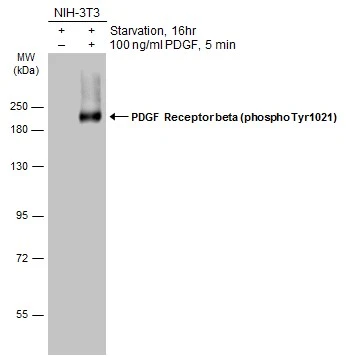
Product group Antibodies
ApplicationsWestern Blot
ReactivityHuman, Mouse
TargetPDGFRB
- SizePrice
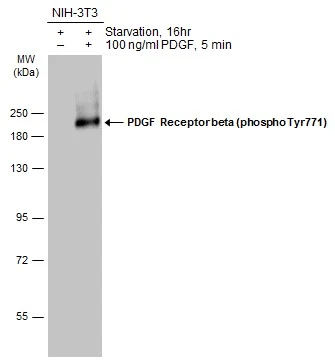
Product group Antibodies
ApplicationsWestern Blot
ReactivityHuman, Mouse
TargetPDGFRB
- SizePrice