

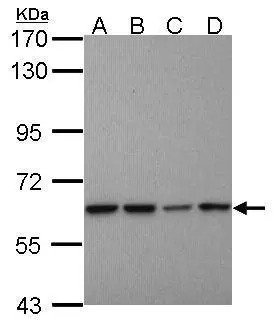
Sample (30 ug of whole cell lysate) A: A431 (GTX27909) B: H1299 C: Hela D: Hep G2 (GTX27900) 7.5% SDS PAGE GTX102291 diluted at 1:1000
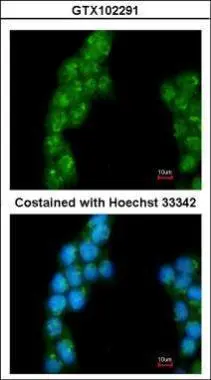
Sample (30 ug of whole cell lysate) A: A431 (GTX27909) B: H1299 C: Hela D: Hep G2 (GTX27900) 7.5% SDS PAGE GTX102291 diluted at 1:1000
Proteasome 26S S3 antibody [C1C3]
GTX102291

ApplicationsImmunoFluorescence, Western Blot, ImmunoCytoChemistry
Product group Antibodies
ReactivityHuman, Mouse
TargetPSMD3
Overview
- SupplierGeneTex
- Product NameProteasome 26S S3 antibody [C1C3]
- Delivery Days Customer9
- Application Supplier NoteWB: 1:500-1:3000. ICC/IF: 1:100-1:1000. *Optimal dilutions/concentrations should be determined by the researcher.Not tested in other applications.
- ApplicationsImmunoFluorescence, Western Blot, ImmunoCytoChemistry
- CertificationResearch Use Only
- ClonalityPolyclonal
- Concentration0.97 mg/ml
- ConjugateUnconjugated
- Gene ID5709
- Target namePSMD3
- Target descriptionproteasome 26S subunit, non-ATPase 3
- Target synonymsP58, RPN3, S3, TSTA2, 26S proteasome non-ATPase regulatory subunit 3, 26S proteasome regulatory subunit RPN3, 26S proteasome regulatory subunit S3, proteasome (prosome, macropain) 26S subunit, non-ATPase, 3, proteasome subunit p58, tissue specific transplantation antigen 2
- HostRabbit
- IsotypeIgG
- Protein IDO43242
- Protein Name26S proteasome non-ATPase regulatory subunit 3
- Scientific DescriptionThe 26S proteasome is a multicatalytic proteinase complex with a highly ordered structure composed of 2 complexes, a 20S core and a 19S regulator. The 20S core is composed of 4 rings of 28 non-identical subunits; 2 rings are composed of 7 alpha subunits and 2 rings are composed of 7 beta subunits. The 19S regulator is composed of a base, which contains 6 ATPase subunits and 2 non-ATPase subunits, and a lid, which contains up to 10 non-ATPase subunits. Proteasomes are distributed throughout eukaryotic cells at a high concentration and cleave peptides in an ATP/ubiquitin-dependent process in a non-lysosomal pathway. An essential function of a modified proteasome, the immunoproteasome, is the processing of class I MHC peptides. This gene encodes one of the non-ATPase subunits of the 19S regulator lid. [provided by RefSeq]
- ReactivityHuman, Mouse
- Storage Instruction-20°C or -80°C,2°C to 8°C
- UNSPSC41116161
Datasheet
Related products
Product group Antibodies

Anti-PSMD3 AntibodyA95804
ApplicationsWestern Blot, ELISA, ImmunoHistoChemistry
ReactivityHuman, Mouse, Rat
- SizePrice

Product group Antibodies

Anti-PSMD3 Antibody144-02790
ApplicationsWestern Blot, ImmunoHistoChemistry
ReactivityHuman, Mouse, Rat
TargetPSMD3
- SizePrice

Product group Antibodies

ApplicationsFlow Cytometry, Western Blot, ImmunoHistoChemistry, ImmunoHistoChemistry Paraffin
ReactivityBovine, Human, Mouse
TargetPSMD3
- SizePrice
Product group Antibodies

ApplicationsImmunoFluorescence, Western Blot, ImmunoHistoChemistry, ImmunoHistoChemistry Paraffin
ReactivityBovine, Canine, Chicken, Equine, Human, Mouse, Porcine, Rat, Sheep
TargetPSMD3
- SizePrice
Product group Antibodies

PSMD3 AntibodyCSB-PA040036
ApplicationsWestern Blot, ELISA, ImmunoHistoChemistry
ReactivityHuman, Mouse, Rat
TargetPSMD3
- SizePrice
![Whole cell extract (30 μg) was separated by 7.5% SDS-PAGE, and the membrane was blotted with Proteasome 26S S3 antibody [N1N3] (GTX102290) diluted at 1:500. The HRP-conjugated anti-rabbit IgG antibody (GTX213110-01) was used to detect the primary antibody.](https://www.genetex.com/upload/website/prouct_img/normal/GTX102290/GTX102290_39694_20211008_WB_M_w_23060100_583.webp)
Product group Antibodies
Proteasome 26S S3 antibody [N1N3]GTX102290
ApplicationsWestern Blot, ImmunoHistoChemistry, ImmunoHistoChemistry Paraffin
ReactivityHuman, Mouse
TargetPSMD3
- SizePrice
Product group Antibodies

p58 / PSMD3 AntibodyLS-C332248
ApplicationsWestern Blot, ImmunoHistoChemistry
ReactivityHuman, Mouse, Rat
TargetPSMD3
- SizePrice

Product group Antibodies

Anti-PSMD3 AntibodyHPA048972
ApplicationsImmunoCytoChemistry, ImmunoHistoChemistry
ReactivityHuman
TargetPSMD3
- SizePrice
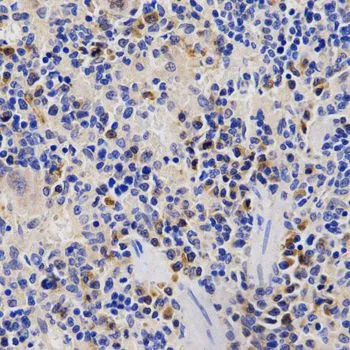
Product group Antibodies
Proteasome 26S S3 antibodyGTX33430
ApplicationsWestern Blot, ImmunoHistoChemistry, ImmunoHistoChemistry Paraffin
ReactivityHuman, Rat
TargetPSMD3
- SizePrice