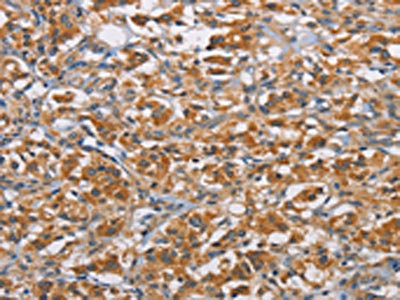
The image on the left is immunohistochemistry of paraffin-embedded Human thyroid cancer tissue using CSB-PA108659(RICTOR Antibody) at dilution 1/40, on the right is treated with fusion protein. (Original magnification: x200)
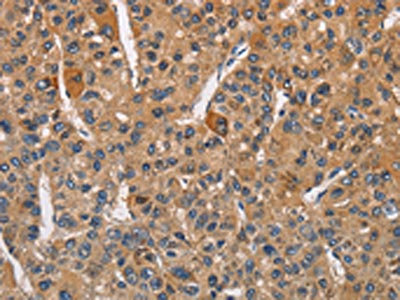
The image on the left is immunohistochemistry of paraffin-embedded Human thyroid cancer tissue using CSB-PA108659(RICTOR Antibody) at dilution 1/40, on the right is treated with fusion protein. (Original magnification: x200)
RICTOR Antibody
CSB-PA108659

ApplicationsELISA, ImmunoHistoChemistry
Product group Antibodies
ReactivityHuman, Mouse
TargetRICTOR
Overview
- SupplierCusabio
- Product NameRICTOR Antibody
- Delivery Days Customer20
- ApplicationsELISA, ImmunoHistoChemistry
- CertificationResearch Use Only
- ClonalityPolyclonal
- ConjugateUnconjugated
- Gene ID253260
- Target nameRICTOR
- Target descriptionRPTOR independent companion of MTOR complex 2
- Target synonymsAVO3, PIA, hAVO3, rapamycin-insensitive companion of mTOR, AVO3 homolog, TORC2-specific protein AVO3, pianissimo
- HostRabbit
- IsotypeIgG
- Protein IDQ6R327
- Protein NameRapamycin-insensitive companion of mTOR
- Scientific DescriptionRapamycin-insensitive companion of mTOR is a protein that in humans is encoded by the RICTOR gene. RICTOR and MTOR are components of a protein complex that integrates nutrient- and growth factor-derived signals to regulate cell growth. Subunit of mTORC2, which regulates cell growth and survival in response to hormonal signals. mTORC2 is activated by growth factors, but, in contrast to mTORC1, seems to be nutrient-insensitive. mTORC2 seems to function upstream of Rho GTPases to regulate the actin cytoskeleton, probably by activating one or more Rho-type guanine nucleotide exchange factors.
- ReactivityHuman, Mouse
- Storage Instruction-20°C or -80°C
- UNSPSC41116161
Related products

Product group Antibodies

Anti-RICTOR Antibody Picoband(r)A03195-1-CARRIER-FREE
ApplicationsFlow Cytometry, ImmunoFluorescence, Western Blot, ELISA, ImmunoCytoChemistry, ImmunoHistoChemistry
ReactivityHuman
TargetRICTOR
- SizePrice
Product group Antibodies

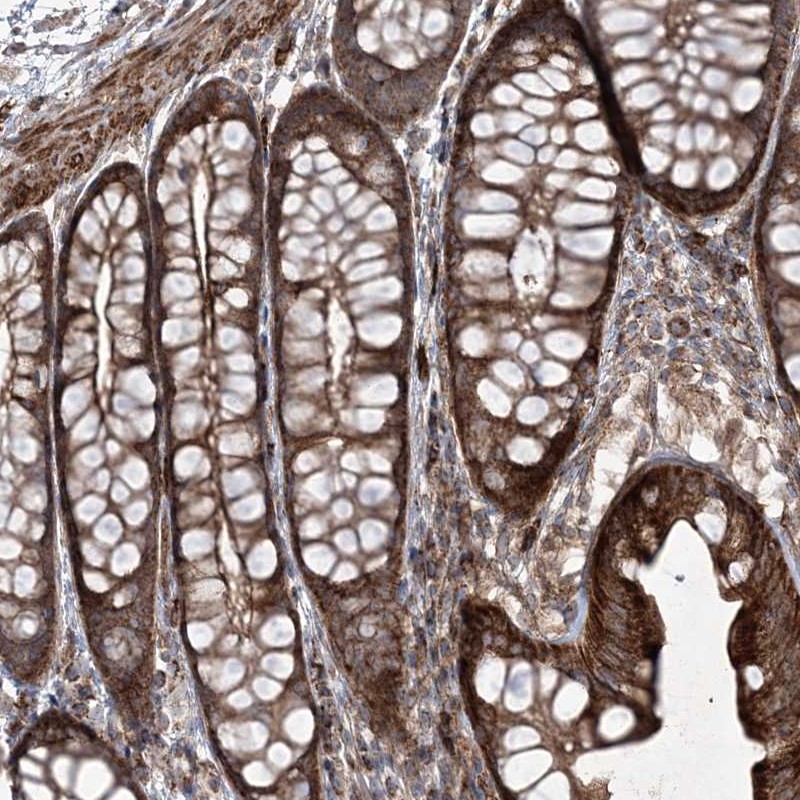
Anti-RICTOR AntibodyHPA037803
ApplicationsImmunoHistoChemistry
ReactivityHuman
TargetRICTOR
- SizePrice
Product group Antibodies

RICTOR AntibodyLS-C401351
ApplicationsELISA, ImmunoHistoChemistry
ReactivityHuman, Mouse
TargetRICTOR
- SizePrice
![WB analysis of HeLa (1), PANC-1 (2), MOLT4 (3), and HepG2 (4) cell lysate using GTX82786 RICTOR antibody [4H5].](https://www.genetex.com/upload/website/prouct_img/normal/GTX82786/GTX82786_20170912_WB_w_23061322_116.webp)
Product group Antibodies

RICTOR antibody [4H5]GTX82786
ApplicationsWestern Blot, ELISA
ReactivityHuman, Monkey, Mouse
TargetRICTOR
- SizePrice
Product group Antibodies

Anti-RICTOR Antibody144-66055
ApplicationsWestern Blot
ReactivityHuman, Mouse, Rat
TargetRICTOR
- SizePrice