

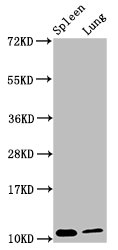
Western Blot Positive WB detected in: Mouse spleen tissue, Mouse lung tissue All lanes: S100a8 antibody at 3.8microg/ml Secondary Goat polyclonal to rabbit IgG at 1/50000 dilution Predicted band size: 11 kDa Observed band size: 11 kDa
Western Blot Positive WB detected in: Mouse spleen tissue, Mouse lung tissue All lanes: S100a8 antibody at 3.8microg/ml Secondary Goat polyclonal to rabbit IgG at 1/50000 dilution Predicted band size: 11 kDa Observed band size: 11 kDa
S100a8 Antibody
CSB-PA020641DA01MO

ApplicationsWestern Blot, ELISA
Product group Antibodies
ReactivityMouse
TargetS100a8
Overview
- SupplierCusabio
- Product NameS100a8 Antibody
- Delivery Days Customer20
- ApplicationsWestern Blot, ELISA
- CertificationResearch Use Only
- ClonalityPolyclonal
- ConjugateUnconjugated
- Gene ID20201
- Target nameS100a8
- Target descriptionS100 calcium binding protein A8 (calgranulin A)
- Target synonyms60B8Ag, B8Ag, CFAg, CP-10, Caga, MRP8, p8, protein S100-A8, MRP-8, S100 calcium-binding protein A8, calgranulin-A, chemotactic S100 protein, chemotactic cytokine CP-10, leukocyte L1 complex light chain, migration inhibitory factor-related protein 8, pro-inflammatory S100 cytokine
- HostRabbit
- IsotypeIgG
- Protein IDP27005
- Protein NameProtein S100-A8
- Scientific DescriptionS100A8 is a calcium- and zinc-binding protein which plays a prominent role in the regulation of inflammatory processes and immune response. It can induce neutrophil chemotaxis and adhesion. Predominantly found as calprotectin (S100A8/A9) which has a wide plethora of intra- and extracellular functions. The intracellular functions include: facilitating leukocyte arachidonic acid trafficking and metabolism, modulation of the tubulin-dependent cytoskeleton during migration of phagocytes and activation of the neutrophilic NADPH-oxidase. Activates NADPH-oxidase by facilitating the enzyme complex assembly at the cell membrane, transferring arachidonic acid, an essential cofactor, to the enzyme complex and S100A8 contributes to the enzyme assembly by directly binding to NCF2/P67PHOX. The extracellular functions involve proinfammatory, antimicrobial, oxidant-scavenging and apoptosis-inducing activities. Its proinflammatory activity includes recruitment of leukocytes, promotion of cytokine and chemokine production, and regulation of leukocyte adhesion and migration. Acts as an alarmin or a danger associated molecular pattern (DAMP) molecule and stimulates innate immune cells via binding to pattern recognition receptors such as Toll-like receptor 4 (TLR4) and receptor for advanced glycation endproducts (AGER). Binding to TLR4 and AGER activates the MAP-kinase and NF-kappa-B signaling pathways resulting in the amplification of the proinflammatory cascade. Has antimicrobial activity towards bacteria and fungi and exerts its antimicrobial activity probably via chelation of Zn2+ which is essential for microbial growth. Can induce cell death via autophagy and apoptosis and this occurs through the cross-talk of mitochondria and lysosomes via reactive oxygen species (ROS) and the process involves BNIP3. Can regulate neutrophil number and apoptosis by an anti-apoptotic effect; regulates cell survival via ITGAM/ITGB and TLR4 and a signaling mechanism involving MEK-ERK. Its role as an oxidant scavenger has a protective role in preventing exaggerated tissue damage by scavenging oxidants.
- ReactivityMouse
- Storage Instruction-20°C or -80°C
- UNSPSC41116161
Related products
Product group Antibodies

S100a8 Polyclonal AntibodyCAC13920
ApplicationsWestern Blot, ELISA
ReactivityMouse
TargetS100a8
- SizePrice
Product group Antibodies

S100A8 antibodyGTX60206
ApplicationsFlow Cytometry, ImmunoHistoChemistry
ReactivityHuman, Mouse
TargetS100a8
- SizePrice

Product group Antibodies

Anti-MRP8/S100A8 Antibody Picoband(r)PB9742-CARRIER-FREE
ApplicationsFlow Cytometry, ImmunoFluorescence, Western Blot, ImmunoCytoChemistry, ImmunoHistoChemistry
ReactivityMouse, Rat
TargetS100a8
- SizePrice