

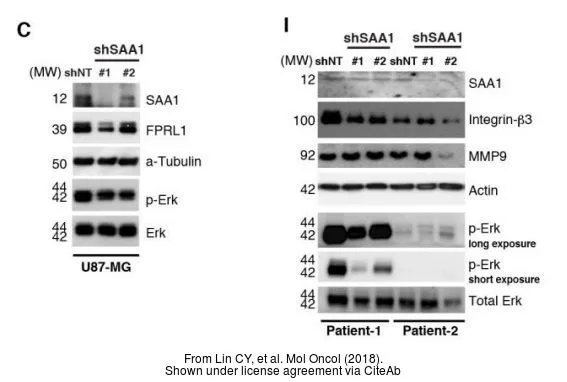
The data was published in the journal Mol Oncol in 2018. PMID: 29603594
The data was published in the journal Mol Oncol in 2018. PMID: 29603594
Serum Amyloid A antibody [115]
GTX20687

ApplicationsWestern Blot, ELISA, ImmunoHistoChemistry, ImmunoHistoChemistry Paraffin
Product group Antibodies
ReactivityHuman
TargetSAA1
Overview
- SupplierGeneTex
- Product NameSerum Amyloid A antibody [115]
- Delivery Days Customer9
- Application Supplier NoteFor ELISA: Use at a concentration of 0.3 microg/ml. For WB: Use at a concentration of 0.1-0.5 microg/ml. Optimal dilutions/concentrations should be determined by the researcher.
- ApplicationsWestern Blot, ELISA, ImmunoHistoChemistry, ImmunoHistoChemistry Paraffin
- CertificationResearch Use Only
- ClonalityMonoclonal
- Clone ID115
- Concentration0.5 mg/ml
- ConjugateUnconjugated
- Gene ID6288
- Target nameSAA1
- Target descriptionserum amyloid A1
- Target synonymsPIG4, SAA, SAA2, TP53I4, serum amyloid A-1 protein, serum amyloid A protein, tumor protein p53 inducible protein 4
- HostMouse
- IsotypeIgG1
- Scientific DescriptionThe serum amyloid A (SAA) family comprises a number of differentially expressed lipoproteins, acute-phase SAA1 and SAA2, the former being a major component in plasma, and constitutive SAAs (C-SAAs). Although the liver is the primary site of synthesis of both SAA types, extrhepatic production has been reported. The in-vivo concentrations increase by as much as 1000 fold during inflammation. Several studies have expressed its importance in the diagnosis and monitoring of various diseases. Pathological SAA values are often detected in association with normal CRP concentrations. SAA rises earlier and more sharply than CRP.
- ReactivityHuman
- Storage Instruction-20°C or -80°C,2°C to 8°C
- UNSPSC12352203
References
- Lin CY, Yang ST, Shen SC, et al. Serum amyloid A1 in combination with integrin αVβ3 increases glioblastoma cells mobility and progression. Mol Oncol. 2018,12(5):756-771. doi: 10.1002/1878-0261.12196Read this paper
- Suesskind D, Ziemssen F, Rohrbach JM. Conjunctival amyloidosis -- clinical and histopathologic features. Graefes Arch Clin Exp Ophthalmol. 2015,253(8):1377-83. doi: 10.1007/s00417-015-2932-3Read this paper
Datasheet
Related products
Product group Antibodies

SAA1 Recombinant Antibody, Biotin ConjugatedBSM-61468R-BIOTIN
ApplicationsWestern Blot, ImmunoHistoChemistry, ImmunoHistoChemistry Frozen, ImmunoHistoChemistry Paraffin
ReactivityHuman
TargetSAA1
- SizePrice
Product group Antibodies

Saa1 Polyclonal AntibodyCAC09172
ApplicationsELISA, ImmunoHistoChemistry
TargetSAA1
- SizePrice


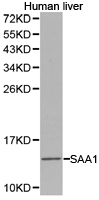
Product group Antibodies

Anti-SAA1 AntibodyA29980
ApplicationsWestern Blot, ImmunoHistoChemistry
ReactivityHuman
- SizePrice

Product group Antibodies

Anti-SAA1 AntibodyAMAB91543
ApplicationsWestern Blot, ImmunoHistoChemistry
ReactivityHuman
TargetSAA1
- SizePrice
Product group Antibodies
Serum Amyloid A antibody [3H62]GTX17758
ApplicationsWestern Blot, ELISA
ReactivityHuman
TargetSAA1
- SizePrice
Product group Antibodies
Serum Amyloid A antibody [38]GTX18707
ApplicationsWestern Blot, ELISA
ReactivityHuman
TargetSAA1
- SizePrice
Product group Antibodies
Serum Amyloid A antibody [607]GTX18711
ApplicationsWestern Blot, ELISA
ReactivityHuman
TargetSAA1
- SizePrice
Product group Antibodies
Serum Amyloid A antibody [291]GTX18713
ApplicationsWestern Blot, ELISA
ReactivityHuman
TargetSAA1
- SizePrice