

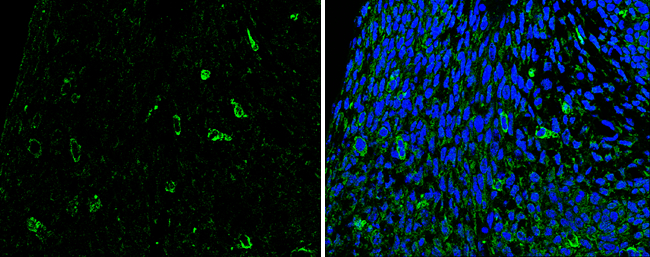
SLIT2 antibody detects SLIT2 protein at cytoplasm in mouse fetal brain by immunohistochemical analysis. Sample: Paraffin-embedded mouse fetal brain. Green: SLIT2 antibody (GTX118220) diluted at 1:200. The signal was developed using goat anti-rabbit IgG antibody (Dylight488) (GTX213110-04). Blue: Nuclear staining with Hoechst 33342.
Antigen Retrieval: Citrate buffer, pH 6.0, 15 min
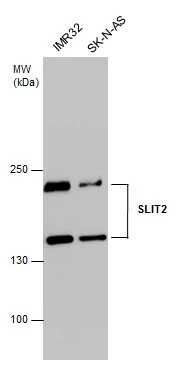
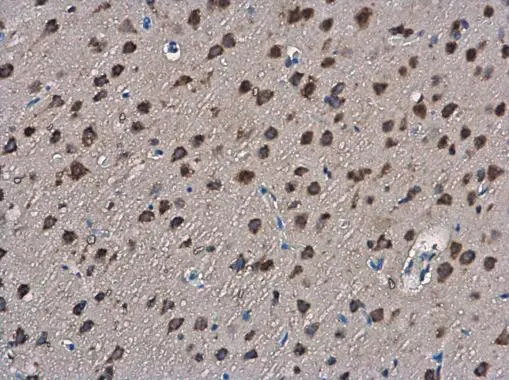
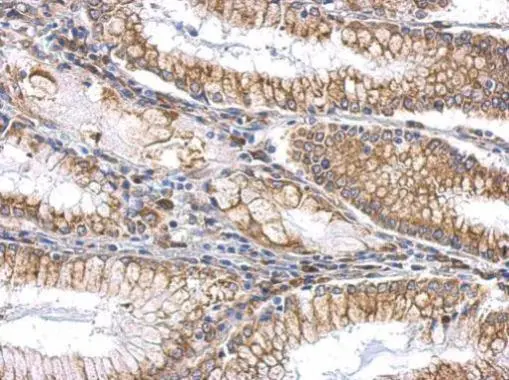
SLIT2 antibody detects SLIT2 protein at cytoplasm in mouse fetal brain by immunohistochemical analysis. Sample: Paraffin-embedded mouse fetal brain. Green: SLIT2 antibody (GTX118220) diluted at 1:200. The signal was developed using goat anti-rabbit IgG antibody (Dylight488) (GTX213110-04). Blue: Nuclear staining with Hoechst 33342.
Antigen Retrieval: Citrate buffer, pH 6.0, 15 min
SLIT2 antibody
GTX118220

ApplicationsWestern Blot, ImmunoHistoChemistry, ImmunoHistoChemistry Paraffin
Product group Antibodies
ReactivityHuman, Mouse, Rat
TargetSLIT2
Overview
- SupplierGeneTex
- Product NameSLIT2 antibody
- Delivery Days Customer9
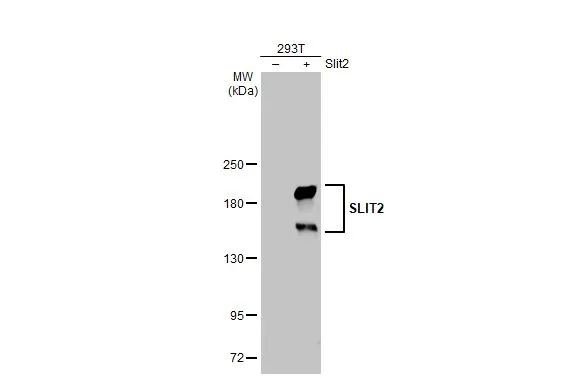
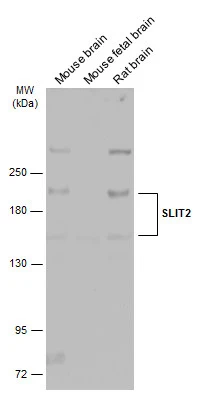
- Application Supplier NoteWB: 1:500-1:10000. IHC-P: 1:100-1:1000. *Optimal dilutions/concentrations should be determined by the researcher.Not tested in other applications.
- ApplicationsWestern Blot, ImmunoHistoChemistry, ImmunoHistoChemistry Paraffin
- CertificationResearch Use Only
- ClonalityPolyclonal
- Concentration0.41 mg/ml
- ConjugateUnconjugated
- Gene ID9353
- Target nameSLIT2
- Target descriptionslit guidance ligand 2
- Target synonymsSLIL3, Slit-2, slit homolog 2 protein
- HostRabbit
- IsotypeIgG
- Protein IDO94813
- Protein NameSlit homolog 2 protein
- Scientific DescriptionThought to act as molecular guidance cue in cellular migration, and function appears to be mediated by interaction with roundabout homolog receptors. During neural development involved in axonal navigation at the ventral midline of the neural tube and projection of axons to different regions. SLIT1 and SLIT2 seem to be essential for midline guidance in the forebrain by acting as repulsive signal preventing inappropriate midline crossing by axons projecting from the olfactory bulb. In spinal chord development may play a role in guiding commissural axons once they reached the floor plate by modulating the response to netrin. In vitro, silences the attractive effect of NTN1 but not its growth-stimulatory effect and silencing requires the formation of a ROBO1-DCC complex. May be implicated in spinal chord midline post-crossing axon repulsion. In vitro, only commissural axons that crossed the midline responded to SLIT2. In the developing visual system appears to function as repellent for retinal ganglion axons by providing a repulsion that directs these axons along their appropriate paths prior to, and after passage through, the optic chiasm. In vitro, collapses and repels retinal ganglion cell growth cones. Seems to play a role in branching and arborization of CNS sensory axons, and in neuronal cell migration. In vitro, Slit homolog 2 protein N-product, but not Slit homolog 2 protein C-product, repels olfactory bulb (OB) but not dorsal root ganglia (DRG) axons, induces OB growth cones collapse and induces branching of DRG axons. Seems to be involved in regulating leukocyte migration.
- ReactivityHuman, Mouse, Rat
- Storage Instruction-20°C or -80°C,2°C to 8°C
- UNSPSC41116161
Datasheet
Related products
Product group Antibodies

Anti-SLIT2 AntibodyA46292
ApplicationsImmunoHistoChemistry
ReactivityHuman, Mouse
- SizePrice

Product group Antibodies

Anti-SLIT2 Antibody Picoband(r)A01627-1-CARRIER-FREE
ApplicationsFlow Cytometry, Western Blot, ELISA
ReactivityHuman
TargetSLIT2
- SizePrice
Product group Antibodies

SLIT2 Polyclonal AntibodyBS-2743R
ApplicationsImmunoFluorescence, Western Blot, ELISA, ImmunoCytoChemistry, ImmunoHistoChemistry, ImmunoHistoChemistry Frozen, ImmunoHistoChemistry Paraffin
ReactivityHuman, Mouse, Rat
TargetSLIT2
- SizePrice
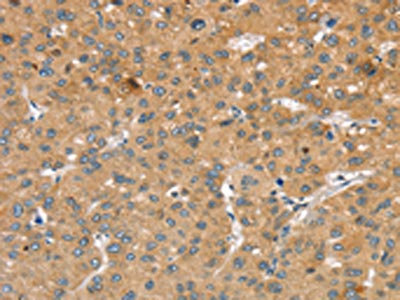
Product group Antibodies

SLIT2 AntibodyCSB-PA136864
ApplicationsWestern Blot, ELISA, ImmunoHistoChemistry
ReactivityHuman, Mouse, Rat
TargetSLIT2
- SizePrice
Product group Antibodies

Goat anti-SLIT2EB07287
ApplicationsELISA, ImmunoHistoChemistry
ReactivityCanine, Human, Mouse, Rat
TargetSLIT2
- SizePrice
Product group Antibodies

ApplicationsImmunoPrecipitation, Western Blot, ImmunoCytoChemistry, ImmunoHistoChemistry
ReactivityMouse, Rat
TargetSLIT2
- SizePrice
Product group Antibodies

SLIT2 AntibodyLS-C403581
ApplicationsWestern Blot, ELISA, ImmunoHistoChemistry
ReactivityHuman, Mouse, Rat
TargetSLIT2
- SizePrice
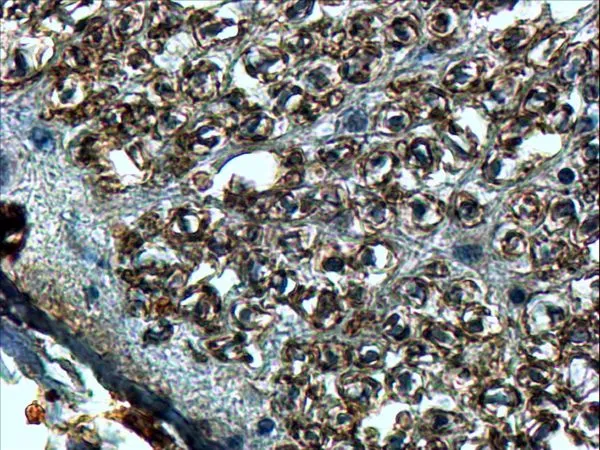
Product group Antibodies
SLIT2 antibody, InternalGTX89329
ApplicationsImmunoHistoChemistry, ImmunoHistoChemistry Paraffin
ReactivityHuman
TargetSLIT2
- SizePrice
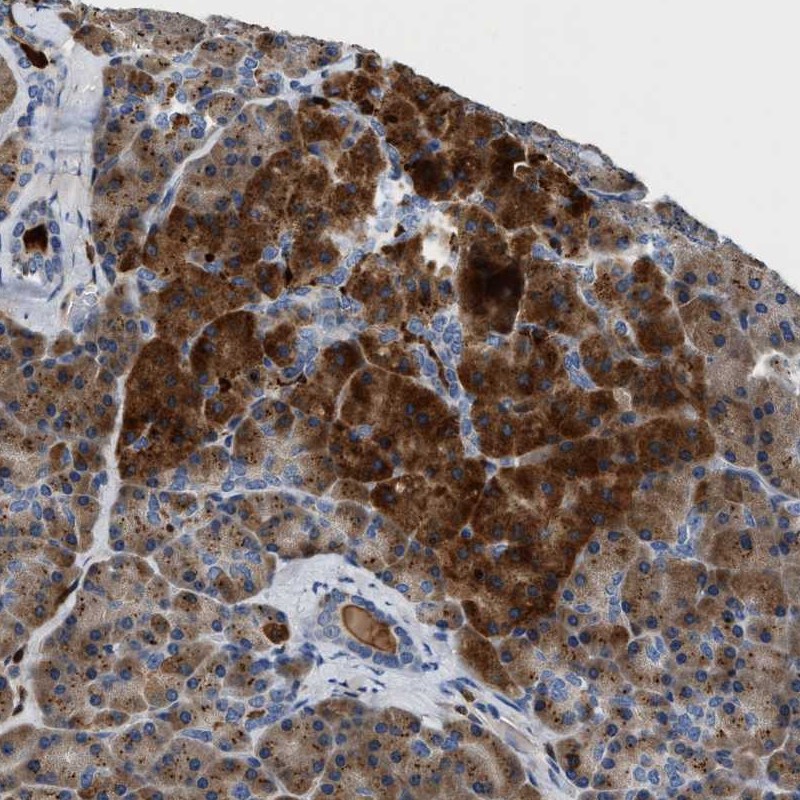
Product group Antibodies

Anti-SLIT2 AntibodyHPA019511
ApplicationsImmunoHistoChemistry
ReactivityHuman
TargetSLIT2
- SizePrice