

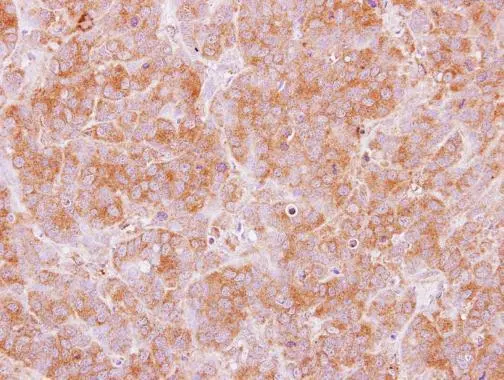
Immunohistochemical analysis of paraffin-embedded MCF7 xenograft, using TRIM29(GTX115749) antibody at 1:100 dilution.
Antigen Retrieval: Citrate buffer, pH 6.0, 15 min
![TRIM29 antibody [C1C3] detects TRIM29 protein at cytoplasm in mouse prostate by immunohistochemical analysis. Sample: Paraffin-embedded mouse prostate. TRIM29 antibody [C1C3] (GTX115749) diluted at 1:500.
Antigen Retrieval: Citrate buffer, pH 6.0, 15 min](https://www.genetex.com/upload/website/prouct_img/normal/GTX115749/GTX115749_40296_20150703_IHC-P_M_w_23060519_651.webp "TRIM29 antibody [C1C3] detects TRIM29 protein at cytoplasm in mouse prostate by immunohistochemical analysis. Sample: Paraffin-embedded mouse prostate. TRIM29 antibody [C1C3] (GTX115749) diluted at 1:500.
Antigen Retrieval: Citrate buffer, pH 6.0, 15 min")
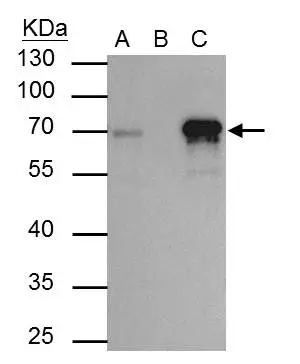
![Various whole cell extracts (30 μg) were separated by 7.5% SDS-PAGE, and the membrane was blotted with TRIM29 antibody [C1C3] (GTX115749) diluted at 1:1000. The HRP-conjugated anti-rabbit IgG antibody (GTX213110-01) was used to detect the primary antibody. Corresponding RNA expression data are based on Human Protein Atlas program.](https://www.genetex.com/upload/website/prouct_img/normal/GTX115749/GTX115749_40296_20250815_WB_TPM_watermark_25082121_813.webp "Various whole cell extracts (30 μg) were separated by 7.5% SDS-PAGE, and the membrane was blotted with TRIM29 antibody [C1C3] (GTX115749) diluted at 1:1000. The HRP-conjugated anti-rabbit IgG antibody (GTX213110-01) was used to detect the primary antibody. Corresponding RNA expression data are based on Human Protein Atlas program.")
Immunohistochemical analysis of paraffin-embedded MCF7 xenograft, using TRIM29(GTX115749) antibody at 1:100 dilution.
Antigen Retrieval: Citrate buffer, pH 6.0, 15 min
TRIM29 antibody [C1C3]
GTX115749

ApplicationsImmunoPrecipitation, Western Blot, ImmunoHistoChemistry, ImmunoHistoChemistry Paraffin
Product group Antibodies
ReactivityHuman, Mouse
TargetTRIM29
Overview
- SupplierGeneTex
- Product NameTRIM29 antibody [C1C3]
- Delivery Days Customer9
- Application Supplier NoteWB: 1:500-1:3000. IHC-P: 1:100-1:1000. IP: 1:100-1:500. *Optimal dilutions/concentrations should be determined by the researcher.Not tested in other applications.
- ApplicationsImmunoPrecipitation, Western Blot, ImmunoHistoChemistry, ImmunoHistoChemistry Paraffin
- CertificationResearch Use Only
- ClonalityPolyclonal
- Concentration0.99 mg/ml
- ConjugateUnconjugated
- Gene ID23650
- Target nameTRIM29
- Target descriptiontripartite motif containing 29
- Target synonymsATDC, tripartite motif-containing protein 29, ataxia-telangiectasia group D-associated protein, tripartite motif protein TRIM29
- HostRabbit
- IsotypeIgG
- Protein IDQ14134
- Protein NameTripartite motif-containing protein 29
- Scientific DescriptionThe protein encoded by this gene belongs to the TRIM protein family. It has multiple zinc finger motifs and a leucine zipper motif. It has been proposed to form homo- or heterodimers which are involved in nucleic acid binding. Thus, it may act as a transcriptional regulatory factor involved in carcinogenesis and/or differentiation. It may also function in the suppression of radiosensitivity since it is associated with ataxia telangiectasia phenotype. [provided by RefSeq]
- ReactivityHuman, Mouse
- Storage Instruction-20°C or -80°C,2°C to 8°C
- UNSPSC41116161
Datasheet
Related products
Product group Antibodies

Anti-TRIM29 AntibodyA15751
ApplicationsWestern Blot
ReactivityHuman, Mouse, Rat
- SizePrice

Product group Antibodies

Anti-TRIM29 Antibody Picoband(r)A04472-1-CARRIER-FREE
ApplicationsFlow Cytometry, Western Blot, ELISA
ReactivityHuman
TargetTRIM29
- SizePrice
Product group Antibodies

Anti-TRIM29 Antibody144-65823
ApplicationsWestern Blot
ReactivityHuman, Mouse
TargetTRIM29
- SizePrice
Product group Antibodies

Goat anti-TRIM29 / ATDCEB09814
ApplicationsFlow Cytometry, ImmunoFluorescence, Western Blot, ELISA, ImmunoHistoChemistry
ReactivityBovine, Human, Mouse, Rat
TargetTRIM29
- SizePrice
Product group Antibodies

TRIM29 AntibodyCSB-PA289988
ApplicationsWestern Blot, ELISA, ImmunoHistoChemistry
ReactivityHuman, Mouse
TargetTRIM29
- SizePrice
Product group Antibodies

ApplicationsImmunoFluorescence, ELISA, ImmunoCytoChemistry, ImmunoHistoChemistry, ImmunoHistoChemistry Frozen, ImmunoHistoChemistry Paraffin
ReactivityHuman
TargetTRIM29
- SizePrice
![IHC-P analysis of human tonsil tissue using GTX04467 TRIM29 antibody [MSVA-629M] HistoMAX?. A strong membranous and cytoplasmic TRIM29 immunostaining is seen in squamous epithelial cells of the tonsil surface.](https://www.genetex.com/upload/website/prouct_img/normal/GTX04467/GTX04467_20230728_IHC-P_120_23072722_721.webp)
Product group Antibodies
ApplicationsImmunoHistoChemistry, ImmunoHistoChemistry Paraffin
ReactivityHuman
TargetTRIM29
- SizePrice
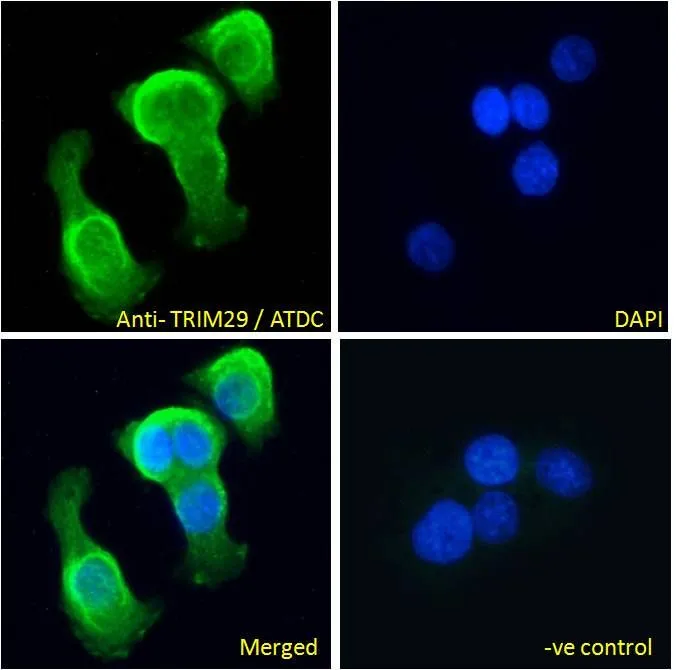
Product group Antibodies
TRIM29 antibody, InternalGTX88145
ApplicationsFlow Cytometry, ImmunoFluorescence, Western Blot, ImmunoCytoChemistry, ImmunoHistoChemistry, ImmunoHistoChemistry Paraffin
ReactivityHuman
TargetTRIM29
- SizePrice

Product group Antibodies

Anti-TRIM29 AntibodyHPA020053
ApplicationsWestern Blot, ImmunoCytoChemistry, ImmunoHistoChemistry
ReactivityHuman, Rat
TargetTRIM29
- SizePrice
![TRIM29 antibody [N3C3] detects TRIM29 protein at cytosol on human normal colon by immunohistochemical analysis. Sample: Paraffin-embedded human normal colon. TRIM29 antibody [N3C3] (GTX118367) dilution: 1:200.
Antigen Retrieval: Trilogy? (EDTA based, pH 8.0) buffer, 15min](https://www.genetex.com/upload/website/prouct_img/normal/GTX118367/GTX118367_40310_IHC_w_23060519_487.webp)
Product group Antibodies
TRIM29 antibody [N3C3]GTX118367
ApplicationsWestern Blot, ImmunoHistoChemistry, ImmunoHistoChemistry Paraffin
ReactivityHuman
TargetTRIM29
- SizePrice