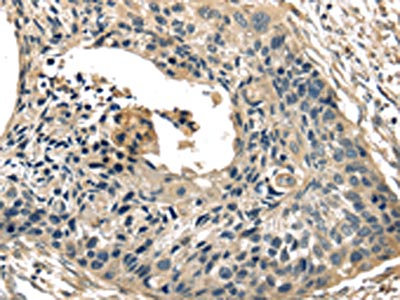
The image on the left is immunohistochemistry of paraffin-embedded Human esophagus cancer tissue using CSB-PA296101(TXNIP Antibody) at dilution 1/40, on the right is treated with synthetic peptide. (Original magnification: x200)
The image on the left is immunohistochemistry of paraffin-embedded Human esophagus cancer tissue using CSB-PA296101(TXNIP Antibody) at dilution 1/40, on the right is treated with synthetic peptide. (Original magnification: x200)
TXNIP Antibody
CSB-PA296101

ApplicationsELISA, ImmunoHistoChemistry
Product group Antibodies
ReactivityHuman, Mouse, Rat
TargetTXNIP
Overview
- SupplierCusabio
- Product NameTXNIP Antibody
- Delivery Days Customer20
- ApplicationsELISA, ImmunoHistoChemistry
- CertificationResearch Use Only
- ClonalityPolyclonal
- ConjugateUnconjugated
- Gene ID10628
- Target nameTXNIP
- Target descriptionthioredoxin interacting protein
- Target synonymsARRDC6, EST01027, HHCPA78, THIF, VDUP1, thioredoxin-interacting protein, thioredoxin binding protein 2, upregulated by 1,25-dihydroxyvitamin D-3, vitamin D3 up-regulated protein 1
- HostRabbit
- IsotypeIgG
- Protein IDQ9H3M7
- Protein NameThioredoxin-interacting protein
- Scientific DescriptionMay act as an oxidative stress mediator by inhibiting thioredoxin activity or by limiting its bioavailability. Interacts with COPS5 and restores COPS5-induced suppression of CDKN1B stability, blocking the COPS5-mediated translocation of CDKN1B from the nucleus to the cytoplasm. Functions as a transcriptional repressor, possibly by acting as a bridge molecule between transcription factors and corepressor complexes, and over-expression will induce G0/G1 cell cycle arrest. Required for the maturation of natural killer cells. Acts as a suppressor of tumor cell growth. Inhibits the proteasomal degradation of DDIT4, and thereby contributes to the inhibition of the mammalian target of rapamycin complex 1 (mTORC1).
- ReactivityHuman, Mouse, Rat
- Storage Instruction-20°C or -80°C
- UNSPSC41116161
Related products
Product group Antibodies

Anti-TXNIP AntibodyA81009
ApplicationsImmunoFluorescence, Western Blot, ImmunoCytoChemistry
ReactivityHuman, Mouse, Rat
- SizePrice

Product group Antibodies

Anti-TXNIP Antibody144-66751
ApplicationsWestern Blot
ReactivityHuman, Mouse
TargetTXNIP
- SizePrice
Product group Antibodies

TXNIP AntibodyLS-C771531
ApplicationsELISA, ImmunoHistoChemistry
ReactivityHuman, Mouse, Rat
TargetTXNIP
- SizePrice

Product group Antibodies

Anti-TXNIP Antibody Picoband(r)A01409-1-CARRIER-FREE
ApplicationsFlow Cytometry, Western Blot, ELISA, ImmunoHistoChemistry
ReactivityHuman, Mouse, Rat
TargetTXNIP
- SizePrice
Product group Antibodies
References

TXNIP Polyclonal AntibodyBS-3897R
ApplicationsFlow Cytometry, ImmunoFluorescence, Western Blot, ELISA, ImmunoCytoChemistry, ImmunoHistoChemistry, ImmunoHistoChemistry Frozen, ImmunoHistoChemistry Paraffin
ReactivityCanine, Human, Mouse, Porcine, Rabbit, Rat
TargetTXNIP
- SizePrice
Product group Antibodies

Txnip Polyclonal AntibodyCAC11357
ApplicationsImmunoFluorescence, ELISA
TargetTXNIP
- SizePrice
Product group Antibodies

TXNIP antibodyGTX31592
ApplicationsWestern Blot, ELISA, ImmunoHistoChemistry, ImmunoHistoChemistry Paraffin
ReactivityHuman, Mouse, Rat
TargetTXNIP
- SizePrice

Product group Antibodies

Anti-TXNIP AntibodyHPA031085
ApplicationsWestern Blot, ImmunoHistoChemistry
ReactivityHuman
TargetTXNIP
- SizePrice