

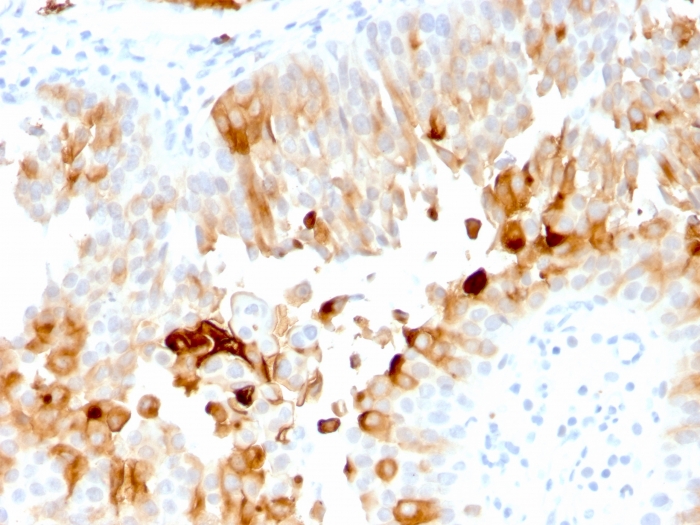
Uroplakin 1A (Urothelial Differentiation Marker)(UPK1A/2921), Biotin conjugate, 0.1mg/mL [26628-22-8]
BNCB2921

ApplicationsImmunoHistoChemistry, ImmunoHistoChemistry Paraffin
Product group Antibodies
ReactivityBovine, Human, Mouse
TargetUPK1A
Overview
- SupplierBiotium
- Product NameUroplakin 1A (Urothelial Differentiation Marker)(UPK1A/2921), Biotin conjugate, 0.1mg/mL [26628-22-8]
- Delivery Days Customer9
- ApplicationsImmunoHistoChemistry, ImmunoHistoChemistry Paraffin
- CAS Number26628-22-8
- CertificationResearch Use Only
- ClonalityMonoclonal
- Clone IDUPK1A/2921
- Concentration0.1 mg/ml
- ConjugateBiotin
- Gene ID11045
- Target nameUPK1A
- Target descriptionuroplakin 1A
- Target synonymsTSPAN21, UP1A, UPIA, UPKA, uroplakin-1a, tetraspanin-21, tspan-21, uroplakin Ia
- HostMouse
- IsotypeIgG2b
- Protein IDO00322
- Protein NameUroplakin-1a
- Scientific DescriptionThe protein encoded by this gene is a member of the transmembrane 4 superfamily, also known as the tetraspanin family. Most of these members are cell-surface proteins that are characterized by the presence of four hydrophobic domains. The proteins mediate signal transduction events that play a role in the regulation of cell development, activation, growth and motility. This encoded protein is found in the asymmetrical unit membrane (AUM) where it can complex with other transmembrane 4 superfamily proteins. It may play a role in normal bladder epithelial physiology, possibly in regulating membrane permeability of superficial umbrella cells or in stabilizing the apical membrane through AUM/cytoskeletal interactions. The protein may also play a role in tumor suppression. Primary antibodies are available purified, or with a selection of fluorescent CF® Dyes and other labels. CF® Dyes offer exceptional brightness and photostability. Note: Conjugates of blue fluorescent dyes like CF®405S and CF®405M are not recommended for detecting low abundance targets, because blue dyes have lower fluorescence and can give higher non-specific background than other dye colors.
- SourceAnimal
- ReactivityBovine, Human, Mouse
- Storage Instruction2°C to 8°C,RT
- UNSPSC41116161
MSDS
Related products
Product group Antibodies

UPK1A / Uroplakin 1A AntibodyLS-C747840
ApplicationsWestern Blot
ReactivityHuman, Mouse, Rat
TargetUPK1A
- SizePrice
Product group Antibodies

ApplicationsImmunoPrecipitation, Western Blot, ImmunoCytoChemistry, ImmunoHistoChemistry
ReactivityMouse, Rat
TargetUPK1A
- SizePrice
![IHC-P analysis of human urinary bladder tissue using GTX04462 UPK1A antibody [MSVA-735M] HistoMAX?. Strong UPK1A immunostaining of the urothelium.](https://www.genetex.com/upload/website/prouct_img/normal/GTX04462/GTX04462_20230728_IHC-P_123_23072722_619.webp)
Product group Antibodies

ApplicationsImmunoHistoChemistry, ImmunoHistoChemistry Paraffin
ReactivityHuman
TargetUPK1A
- SizePrice