

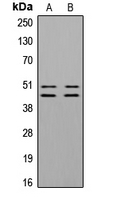
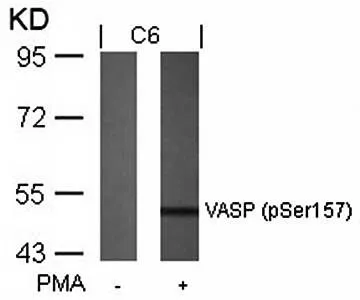
WB analysis of PMA-treated C6 (A), HUVEC (B) whole cell lysates using GTX32362 VASP (phospho Ser157) antibody.
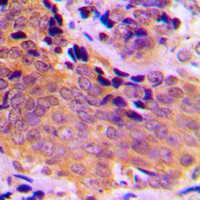
WB analysis of PMA-treated C6 (A), HUVEC (B) whole cell lysates using GTX32362 VASP (phospho Ser157) antibody.
VASP (phospho Ser157) antibody
GTX32362

ApplicationsWestern Blot, ImmunoHistoChemistry, ImmunoHistoChemistry Paraffin
Product group Antibodies
ReactivityHuman, Rat
TargetVASP
Overview
- SupplierGeneTex
- Product NameVASP (phospho Ser157) antibody
- Delivery Days Customer9
- Application Supplier NoteWB: 1:500 - 1:1000. IHC-P: 1:100 - 1:200. *Optimal dilutions/concentrations should be determined by the researcher.Not tested in other applications.
- ApplicationsWestern Blot, ImmunoHistoChemistry, ImmunoHistoChemistry Paraffin
- CertificationResearch Use Only
- ClonalityPolyclonal
- ConjugateUnconjugated
- Gene ID7408
- Target nameVASP
- Target descriptionvasodilator stimulated phosphoprotein
- Target synonymsvasodilator-stimulated phosphoprotein
- HostRabbit
- IsotypeIgG
- Protein IDP50552
- Protein NameVasodilator-stimulated phosphoprotein
- Scientific DescriptionVasodilator-stimulated phosphoprotein (VASP) is a member of the Ena-VASP protein family. Ena-VASP family members contain an EHV1 N-terminal domain that binds proteins containing E/DFPPPPXD/E motifs and targets Ena-VASP proteins to focal adhesions. In the mid-region of the protein, family members have a proline-rich domain that binds SH3 and WW domain-containing proteins. Their C-terminal EVH2 domain mediates tetramerization and binds both G and F actin. VASP is associated with filamentous actin formation and likely plays a widespread role in cell adhesion and motility. VASP may also be involved in the intracellular signaling pathways that regulate integrin-extracellular matrix interactions. VASP is regulated by the cyclic nucleotide-dependent kinases PKA and PKG. [provided by RefSeq, Jul 2008]
- ReactivityHuman, Rat
- Storage Instruction-20°C or -80°C,2°C to 8°C
- UNSPSC12352203
References
- Jayakumar T, Lin KC, Lu WJ, et al. Nobiletin, a citrus flavonoid, activates vasodilator-stimulated phosphoprotein in human platelets through non-cyclic nucleotide-related mechanisms. Int J Mol Med. 2017,39(1):174-182. doi: 10.3892/ijmm.2016.2822Read this paper
Datasheet
Related products
Product group Antibodies

Anti-VASP Antibody144-61571
ApplicationsWestern Blot
ReactivityHuman, Mouse, Rat
TargetVASP
- SizePrice
Product group Antibodies

ApplicationsFlow Cytometry, Western Blot, ImmunoCytoChemistry
ReactivityHuman, Mouse, Rat
TargetVASP
- SizePrice

Product group Antibodies

VASP AntibodyCSB-PA004422
ApplicationsImmunoFluorescence, Western Blot, ELISA, ImmunoHistoChemistry
ReactivityHuman, Monkey, Mouse, Rat
TargetVASP
- SizePrice
Product group Antibodies

anti-VASP (human), pAbAG-25T-0112
ApplicationsImmunoPrecipitation, Western Blot, ImmunoCytoChemistry
ReactivityHuman
TargetVASP
- SizePrice
Product group Antibodies

Anti-VASP AntibodyA96109
ApplicationsWestern Blot, ELISA, ImmunoHistoChemistry
ReactivityHuman, Mouse, Rat
- SizePrice
Product group Antibodies
VASP (phospho Ser239) antibodyGTX38661
ApplicationsWestern Blot, ImmunoHistoChemistry, ImmunoHistoChemistry Paraffin
ReactivityHuman, Mouse
TargetVASP
- SizePrice
Product group Antibodies
VASP (phospho Ser157) antibodyGTX38672
ApplicationsWestern Blot, ImmunoHistoChemistry, ImmunoHistoChemistry Paraffin
ReactivityHuman, Rat
TargetVASP
- SizePrice
Product group Antibodies

VASP AntibodyLS-C831873
ApplicationsWestern Blot, ELISA, ImmunoHistoChemistry
ReactivityHuman, Mouse
TargetVASP
- SizePrice

Product group Antibodies

Anti-VASP AntibodyHPA005724
ApplicationsWestern Blot, ImmunoCytoChemistry, ImmunoHistoChemistry
ReactivityHuman, Mouse, Rat
TargetVASP
- SizePrice