

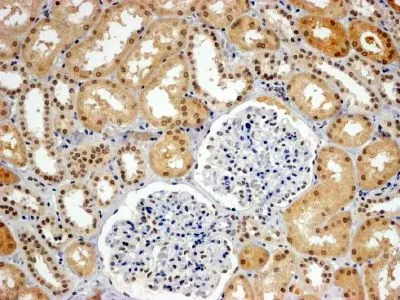
IHC-P analysis of human kidney using GTX89707 WHIP antibody, C-term. Antigen retrieval : Tris/EDTA buffer pH 9 Dilution : 4μg/ml
IHC-P analysis of human kidney using GTX89707 WHIP antibody, C-term. Antigen retrieval : Tris/EDTA buffer pH 9 Dilution : 4μg/ml
WHIP antibody, C-term
GTX89707

ApplicationsWestern Blot, ImmunoHistoChemistry, ImmunoHistoChemistry Paraffin
Product group Antibodies
ReactivityHuman
TargetWRNIP1
Overview
- SupplierGeneTex
- Product NameWHIP antibody, C-term
- Delivery Days Customer9
- Application Supplier NoteWB: 1-3microg/ml. IHC-P: 4-6microg/ml. *Optimal dilutions/concentrations should be determined by the researcher.Not tested in other applications.
- ApplicationsWestern Blot, ImmunoHistoChemistry, ImmunoHistoChemistry Paraffin
- CertificationResearch Use Only
- ClonalityPolyclonal
- Concentration0.50 mg/ml
- ConjugateUnconjugated
- Gene ID56897
- Target nameWRNIP1
- Target descriptionWRN helicase interacting protein 1
- Target synonymsCFAP93, FAP93, WHIP, bA420G6.2, ATPase WRNIP1, Werner helicase interacting protein 1, putative helicase RUVBL
- HostGoat
- IsotypeIgG
- Protein IDQ96S55
- Protein NameATPase WRNIP1
- Scientific DescriptionWerners syndrome is a rare autosomal recessive disorder characterized by accelerated aging that is caused by defects in the Werner syndrome ATP-dependent helicase gene (WRN). The protein encoded by this gene interacts with the exonuclease-containing N-terminal portion of the Werner protein. This protein has a ubiquitin-binding zinc-finger domain in the N-terminus, an ATPase domain, and two leucine zipper motifs in the C-terminus. It has sequence similarity to replication factor C family proteins and is conserved from E. coli to human. This protein likely accumulates at sites of DNA damage by interacting with polyubiquinated proteins and also binds to DNA polymerase delta and increases the initiation frequency of DNA polymerase delta-mediated DNA synthesis. This protein also interacts with nucleoporins at nuclear pore complexes. Two transcript variants encoding different isoforms have been isolated for this gene. [provided by RefSeq, Jul 2012]
- ReactivityHuman
- Storage Instruction-20°C or -80°C,2°C to 8°C
- UNSPSC41116161
Datasheet
Related products
Product group Antibodies

Anti-WRNIP1 (N-term) Antibody102-23472
ApplicationsWestern Blot
TargetWRNIP1
- SizePrice
Product group Antibodies

Goat anti-WHIP / WRNIP1EB05132
ApplicationsWestern Blot, ELISA, ImmunoHistoChemistry
ReactivityBovine, Canine, Human, Mouse, Rat
TargetWRNIP1
- SizePrice
Product group Antibodies

WRNIP1 AntibodyCSB-PA026150GA01HU
ApplicationsWestern Blot, ELISA
ReactivityHuman, Mouse, Rat
TargetWRNIP1
- SizePrice
Product group Antibodies

WRNIP1 / WHIP AntibodyLS-C410704
ApplicationsWestern Blot
ReactivityHuman
TargetWRNIP1
- SizePrice
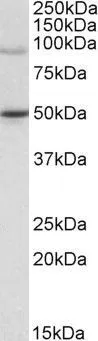
![Western blot analysis is shown using GeneTex Affinity Purified anti-Human WHIP antibody (GTX24731) to detect Human WHIP present in a HEK293 whole cell lysate. ~30mg of lysate was loaded per lane for 4-20% gradient SDS-PAGE. Comparison to a molecular weight marker (not shown) indicates a primary band of ~96.0 kDa is detected. The identity of the minor band migrating at a slightly higher molecular weight is unknown, but may represent an alternate isoform of WHIP or post translational modification of the WHIP protein. The blot was incubated with a 1:200 dilution of the antibody at room temperature for 2 h followed by detection using infrared labeled Goat-a-Rabbit IgG [H&L] MX10 diluted 1:5,000 for 45 min. The fluorescence image was captured using the OdysseyR Infrared Imaging System developed by LI-COR.](https://www.genetex.com/upload/website/prouct_img/normal/GTX24731/GTX24731_20160330_WB_w_23060722_700.webp)
Product group Antibodies
References
WHIP antibodyGTX24731
ApplicationsWestern Blot, ELISA, ImmunoHistoChemistry
ReactivityHuman
TargetWRNIP1
- SizePrice
Product group Antibodies
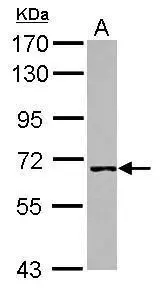
WHIP antibody [C1C3]GTX107101
ApplicationsWestern Blot
ReactivityHuman
TargetWRNIP1
- SizePrice

Product group Antibodies

Anti-WRNIP1 AntibodyHPA031753
ApplicationsWestern Blot, ImmunoCytoChemistry, ImmunoHistoChemistry
ReactivityHuman
TargetWRNIP1
- SizePrice