

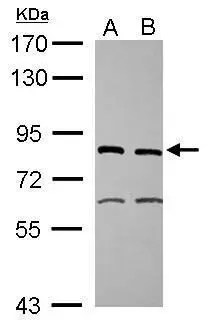
Sample (30 ug of whole cell lysate) A: IMR32 B: U87-MG 7.5% SDS PAGE GTX105357 diluted at 1:1000
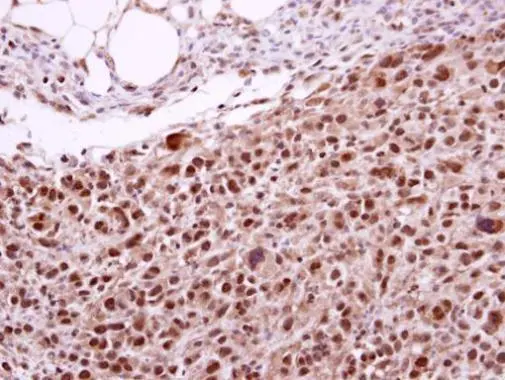
![ERCC2 antibody [N2C2], Internal detects ERCC2 protein at cytosol and nucleus on mouse esophagus by immunohistochemical analysis. Sample: Paraffin-embedded mouse esophagus. ERCC2 antibody [N2C2], Internal (GTX105357) dilution: 1:500.
Antigen Retrieval: Trilogy? (EDTA based, pH 8.0) buffer, 15min](https://www.genetex.com/upload/website/prouct_img/normal/GTX105357/GTX105357_40275_IHC_M_w_23060120_709.webp "ERCC2 antibody [N2C2], Internal detects ERCC2 protein at cytosol and nucleus on mouse esophagus by immunohistochemical analysis. Sample: Paraffin-embedded mouse esophagus. ERCC2 antibody [N2C2], Internal (GTX105357) dilution: 1:500.
Antigen Retrieval: Trilogy? (EDTA based, pH 8.0) buffer, 15min")
![XPD antibody [N2C2], Internal detects XPD protein at cytoplasm and nucleus by immunofluorescent analysis. Sample: Mock and treated HeLa cells were fixed in 4% paraformaldehyde at RT for 15 min. Green: XPD stained by XPD antibody [N2C2], Internal (GTX105357) diluted at 1:500. Blue: Hoechst 33342 staining. Scale bar= 10 μm.](https://www.genetex.com/upload/website/prouct_img/normal/GTX105357/GTX105357_40275_20180809_ICC_IF_UVC_w_23060120_181.webp "XPD antibody [N2C2], Internal detects XPD protein at cytoplasm and nucleus by immunofluorescent analysis. Sample: Mock and treated HeLa cells were fixed in 4% paraformaldehyde at RT for 15 min. Green: XPD stained by XPD antibody [N2C2], Internal (GTX105357) diluted at 1:500. Blue: Hoechst 33342 staining. Scale bar= 10 μm.")
Sample (30 ug of whole cell lysate) A: IMR32 B: U87-MG 7.5% SDS PAGE GTX105357 diluted at 1:1000
XPD antibody [N2C2], Internal
GTX105357

ApplicationsImmunoFluorescence, Western Blot, ImmunoCytoChemistry, ImmunoHistoChemistry, ImmunoHistoChemistry Paraffin
Product group Antibodies
ReactivityHuman, Mouse
TargetERCC2
Overview
- SupplierGeneTex
- Product NameXPD antibody [N2C2], Internal
- Delivery Days Customer9
- Application Supplier NoteWB: 1:500-1:3000. ICC/IF: 1:100-1:1000. IHC-P: 1:100-1:1000. *Optimal dilutions/concentrations should be determined by the researcher.Not tested in other applications.
- ApplicationsImmunoFluorescence, Western Blot, ImmunoCytoChemistry, ImmunoHistoChemistry, ImmunoHistoChemistry Paraffin
- CertificationResearch Use Only
- ClonalityPolyclonal
- Concentration1 mg/ml
- ConjugateUnconjugated
- Gene ID2068
- Target nameERCC2
- Target descriptionERCC excision repair 2, TFIIH core complex helicase subunit
- Target synonymsCOFS2, CXPD, EM9, TFIIH, TTD, TTD1, XPD, general transcription and DNA repair factor IIH helicase subunit XPD, BTF2 p80, DNA 5'-3' helicase XPD, DNA excision repair protein ERCC-2, DNA repair protein complementing XP-D cells, TFIIH 80 kDa subunit, TFIIH basal transcription factor complex 80 kDa subunit, TFIIH basal transcription factor complex helicase XPD subunit, TFIIH p80, TFIIH subunit XPD, basic transcription factor 2 80 kDa subunit, excision repair cross-complementation group 2, excision repair cross-complementing rodent repair deficiency, complementation group 2, xeroderma pigmentosum complementary group D, xeroderma pigmentosum group D-complementing protein
- HostRabbit
- IsotypeIgG
- Protein IDP18074
- Protein NameGeneral transcription and DNA repair factor IIH helicase subunit XPD
- Scientific DescriptionThe nucleotide excision repair pathway is a mechanism to repair damage to DNA. The protein encoded by this gene is involved in transcription-coupled nucleotide excision repair and is an integral member of the basal transcription factor BTF2/TFIIH complex. The gene product has ATP-dependent DNA helicase activity and belongs to the RAD3/XPD subfamily of helicases. Defects in this gene can result in three different disorders, the cancer-prone syndrome xeroderma pigmentosum complementation group D, trichothiodystrophy, and Cockayne syndrome. Alternatively spliced transcript variants encoding different isoforms have been found for this gene. [provided by RefSeq]
- ReactivityHuman, Mouse
- Storage Instruction-20°C or -80°C,2°C to 8°C
- UNSPSC41116161
Datasheet
Related products

Product group Antibodies

ERCC2 AntibodyCSB-PA007770ESR1HU
ApplicationsELISA, ImmunoHistoChemistry
ReactivityHuman
TargetERCC2
- SizePrice

Product group Antibodies

Anti-XPD/ERCC2 Antibody Picoband(r)A00694-2-CARRIER-FREE
ApplicationsFlow Cytometry, Western Blot, ELISA, ImmunoHistoChemistry
ReactivityHuman, Mouse, Rat
TargetERCC2
- SizePrice
Product group Antibodies

ERCC2 / XPD AntibodyLS-C749564
ApplicationsWestern Blot
ReactivityHuman, Mouse, Rat
TargetERCC2
- SizePrice
Product group Antibodies

Anti-ERCC2 AntibodyA39743
ApplicationsImmunoFluorescence, Western Blot
ReactivityHuman, Mouse, Rat
- SizePrice

Product group Antibodies

Anti-ERCC2 AntibodyHPA038057
ApplicationsWestern Blot, ImmunoHistoChemistry
ReactivityHuman
TargetERCC2
- SizePrice
Product group Antibodies

ERCC2 Polyclonal AntibodyCAC13030
ApplicationsWestern Blot, ELISA, ImmunoHistoChemistry
TargetERCC2
- SizePrice
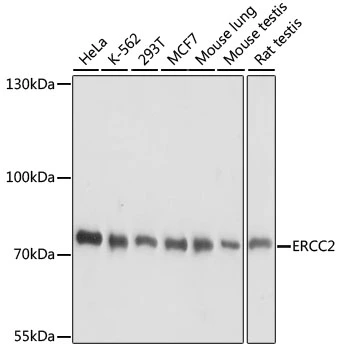
Product group Antibodies
References
XPD antibodyGTX66267
ApplicationsWestern Blot
ReactivityHuman, Mouse, Rat
TargetERCC2
- SizePrice
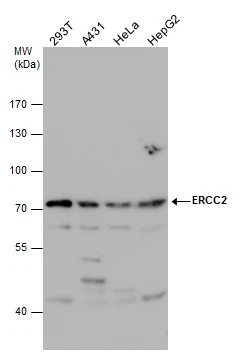
Product group Antibodies
XPD antibodyGTX108948
ApplicationsImmunoFluorescence, Western Blot, ImmunoCytoChemistry, ImmunoHistoChemistry, ImmunoHistoChemistry Paraffin
ReactivityHuman
TargetERCC2
- SizePrice
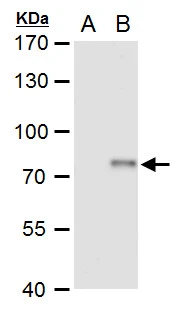
Product group Antibodies
XPD antibodyGTX129284
ApplicationsWestern Blot
ReactivityHuman
TargetERCC2
- SizePrice