

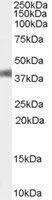
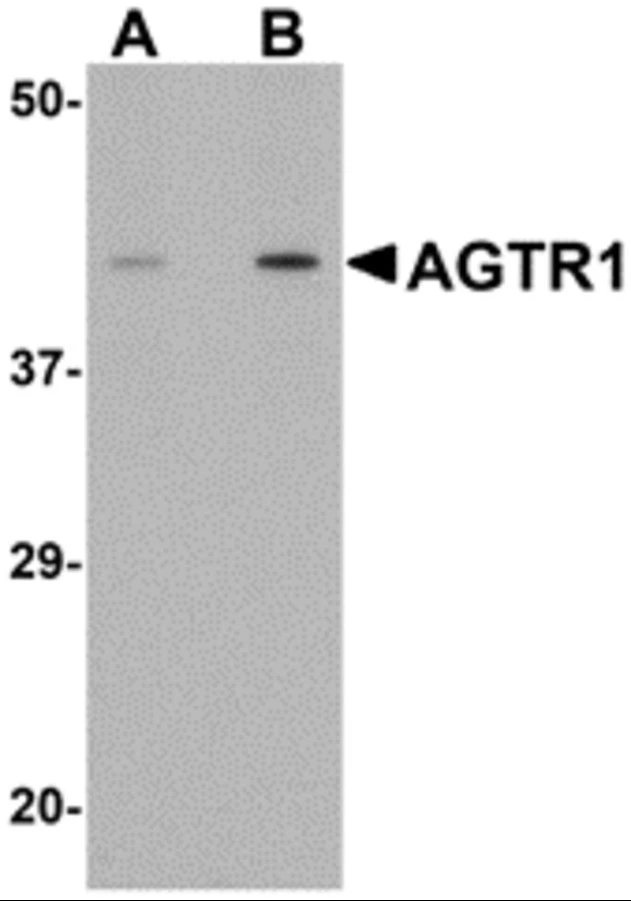
WB analysis of mouse liver lysate using GTX89149 AGTR1 antibody, Internal. Dilution : 0.3μg/ml Loading : 35μg protein in RIPA buffer
WB analysis of mouse liver lysate using GTX89149 AGTR1 antibody, Internal. Dilution : 0.3μg/ml Loading : 35μg protein in RIPA buffer
AGTR1 antibody, Internal
GTX89149

ApplicationsWestern Blot
Product group Antibodies
ReactivityHuman, Mouse
TargetAGTR1
Overview
- SupplierGeneTex
- Product NameAGTR1 antibody, Internal
- Delivery Days Customer9
- Application Supplier NoteWB: 0.3-1microg/ml. *Optimal dilutions/concentrations should be determined by the researcher.Not tested in other applications.
- ApplicationsWestern Blot
- CertificationResearch Use Only
- ClonalityPolyclonal
- Concentration0.50 mg/ml
- ConjugateUnconjugated
- Gene ID185
- Target nameAGTR1
- Target descriptionangiotensin II receptor type 1
- Target synonymsAG2S, AGTR1B, AT1, AT1AR, AT1B, AT1BR, AT1R, AT2R1, ATR1, HAT1R, type-1 angiotensin II receptor, AT1 receptor, type-1B angiotensin II receptor
- HostGoat
- IsotypeIgG
- Protein IDP30556
- Protein NameType-1 angiotensin II receptor
- Scientific DescriptionAngiotensin II is a potent vasopressor hormone and a primary regulator of aldosterone secretion. It is an important effector controlling blood pressure and volume in the cardiovascular system. It acts through at least two types of receptors. This gene encodes the type 1 receptor which is thought to mediate the major cardiovascular effects of angiotensin II. This gene may play a role in the generation of reperfusion arrhythmias following restoration of blood flow to ischemic or infarcted myocardium. It was previously thought that a related gene, denoted as AGTR1B, existed; however, it is now believed that there is only one type 1 receptor gene in humans. Multiple alternatively spliced transcript variants have been reported for this gene. [provided by RefSeq, Jul 2012]
- ReactivityHuman, Mouse
- Storage Instruction-20°C or -80°C,2°C to 8°C
- UNSPSC41116161
References
- Elevated blood pressure in high-fat diet-exposed low birthweight rat offspring is most likely caused by elevated glucocorticoid levels due to abnormal pituitary negative feedback. Nemoto T et al., 2020, PLoS OneRead this paper
- Increased AT2R expression is induced by AT1R autoantibody via two axes, Klf-5/IRF-1 and circErbB4/miR-29a-5p, to promote VSMC migration. Sun Y et al., 2020 Jun 8, Cell Death DisRead this paper
Datasheet
Related products
Product group Antibodies

ApplicationsWestern Blot, ELISA
ReactivityHuman, Mouse
- SizePrice

Product group Antibodies

Anti-AGTR1 Antibody144-63128
ApplicationsWestern Blot
ReactivityHuman, Mouse, Rat
TargetAGTR1
- SizePrice
Product group Antibodies

AGTR1 / AT1 Receptor AntibodyLS-C749212
ApplicationsWestern Blot
ReactivityHuman, Mouse, Rat
TargetAGTR1
- SizePrice
Product group Antibodies
References

ApplicationsFlow Cytometry, ImmunoFluorescence, Western Blot, ELISA, ImmunoCytoChemistry, ImmunoHistoChemistry, ImmunoHistoChemistry Frozen, ImmunoHistoChemistry Paraffin
ReactivityHuman, Mouse, Rat
TargetAGTR1
- SizePrice
Product group Antibodies

AGTR1 AntibodyCSB-PA001465LA01HU
ApplicationsImmunoFluorescence, Western Blot, ELISA, ImmunoHistoChemistry
ReactivityHuman, Mouse
TargetAGTR1
- SizePrice
Product group Antibodies

Goat anti-AGTR1 / AT1EB07446
ApplicationsWestern Blot, ELISA
ReactivityHuman, Mouse
TargetAGTR1
- SizePrice
Product group Antibodies

Agtr1 Polyclonal AntibodyCAC07759
ApplicationsImmunoFluorescence, Western Blot, ELISA, ImmunoHistoChemistry
ReactivityMouse
TargetAGTR1
- SizePrice
Product group Antibodies
AGTR1 antibodyGTX31793
ApplicationsWestern Blot, ELISA, ImmunoHistoChemistry, ImmunoHistoChemistry Paraffin
ReactivityHuman, Mouse, Rat
TargetAGTR1
- SizePrice
![AGTR1 antibody [HL2524] detects AGTR1 protein at cell membrane and cytoplasm by immunohistochemical analysis. Sample: Paraffin-embedded Huh-7 xenograft. AGTR1 stained by AGTR1 antibody [HL2524] (GTX638885) diluted at 1:100. Antigen Retrieval: Citrate buffer, pH 6.0, 15 min](https://www.genetex.com/upload/website/prouct_img/normal/GTX638885/GTX638885_T-45117_20230829_IHC-P_23091319_854.webp)
Product group Antibodies
AGTR1 antibody [HL2524]GTX638885
ApplicationsImmunoFluorescence, Western Blot, ImmunoCytoChemistry, ImmunoHistoChemistry, ImmunoHistoChemistry Paraffin
ReactivityHuman, Mouse
TargetAGTR1
- SizePrice