

Anti-AKR1C1 Antibody
R1512-11

ApplicationsFlow Cytometry, Western Blot, ImmunoHistoChemistry, ImmunoHistoChemistry Paraffin
Product group Antibodies
ReactivityHuman, Mouse
TargetAKR1C1
Overview
- SupplierHUABIO
- Product NameAnti-AKR1C1 Antibody
- Delivery Days Customer7
- ApplicationsFlow Cytometry, Western Blot, ImmunoHistoChemistry, ImmunoHistoChemistry Paraffin
- Applications SupplierWB,IHC-P,FC
- CertificationResearch Use Only
- ClonalityPolyclonal
- Concentration1 mg/ml
- ConjugateUnconjugated
- Gene ID1645
- Target nameAKR1C1
- Target descriptionaldo-keto reductase family 1 member C1
- Target synonyms2-ALPHA-HSD, 20-ALPHA-HSD, C9, DD1, DD1/DD2, DDH, DDH1, H-37, HAKRC, HBAB, MBAB, aldo-keto reductase family 1 member C1, 20 alpha-hydroxysteroid dehydrogenase, aldo-keto reductase C, chlordecone reductase homolog HAKRC, dihydrodiol dehydrogenase 1, dihydrodiol dehydrogenase 1/2, dihydrodiol dehydrogenase 1; 20-alpha (3-alpha)-hydroxysteroid dehydrogenase, hepatic dihydrodiol dehydrogenase, high-affinity hepatic bile acid-binding protein, indanol dehydrogenase, trans-1,2-dihydrobenzene-1,2-diol dehydrogenase, type II 3-alpha-hydroxysteroid dehydrogenase
- HostRabbit
- IsotypeIgG
- Protein IDQ04828
- Protein NameAldo-keto reductase family 1 member C1
- Scientific DescriptionHuman liver contains isoforms of dihydrodiol dehydrogenase (DD1, DD2, DD3 and DD4), which belong to the aldo-oxo reductase/aldo-keto reductase (AKR) superfamily, have 20alpha- or 3alpha-hydroxysteroid dehydrogenase (HSD) activity. DD1 is also designated AKR1C1, DDH or DDH1, while DD2 also can be designated AKR1C2, dDD, BABP or DDH2. AKR1C3 and 3alpha-HSD are alternate designations for human DD3 (which is referred to as AKR1C18 in rodents), while DD4 also can be called AKR1C4, CD, CHDR or AKR1C6 (in rodents). DD1 and DD2 are 20alpha-HSDs, whereas DD3 and DD4 are the 3alpha-HSDs. The multiple human cytosolic dihydrodiol dehydrogenases are involved in the metabolism of xenobiotics, such as polycyclic aromatic hydrocarbons, pesticides and steroid hormones, and are responsible for the reduction of ketone-containing drugs by using NADH or NADPH as a cofactor. The 20alpha-HSD catalyzes the reaction of progesterone to the inactive form 20alpha-hydroxyprogesterone. The 3alpha-HSD is a cytosolic, monomeric, NADPH-dependent oxidoreductase that reduces 3-keto-5-dihydrosteroids to their tetrahydro products. DD1 and DD2 are ubiquitously expressed, whereas DD4 mRNA is restricted to the liver. DD3 is a unique enzyme that can specifically catalyze the dehydrogenation of trans-benzenedihydrodiol and trans-naphthalenedihydrodiol.
- ReactivityHuman, Mouse
- Reactivity SupplierHuman,Mouse
- Storage Instruction-20°C,2°C to 8°C
- UNSPSC41116161
Datasheet
Related products
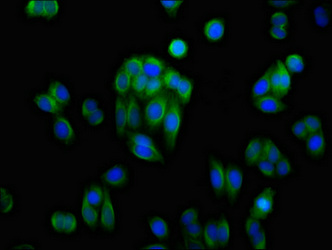
Product group Antibodies

AKR1C1 AntibodyCSB-PA001542LA01HU
ApplicationsImmunoFluorescence, ELISA
ReactivityHuman
TargetAKR1C1
- SizePrice
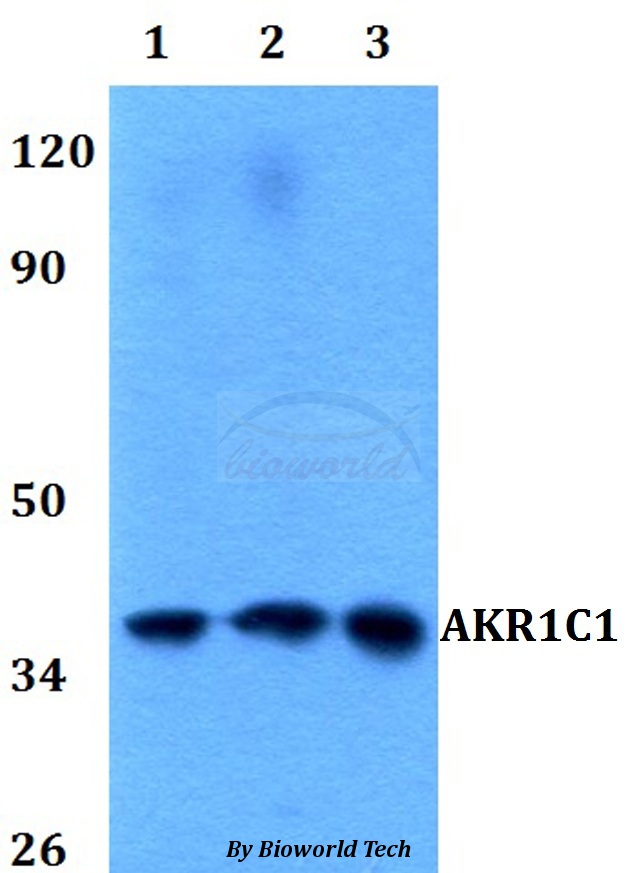
Product group Antibodies

Anti-AKR1C1 AntibodyA28765
ApplicationsWestern Blot
ReactivityHuman, Mouse, Rat
- SizePrice

Product group Antibodies

Anti-AKR1C1 AntibodyHPA068265
ApplicationsWestern Blot, ImmunoCytoChemistry
ReactivityHuman
TargetAKR1C1
- SizePrice
Product group Antibodies

DDH / AKR1C1 AntibodyLS-C402612
ApplicationsWestern Blot, ELISA, ImmunoHistoChemistry
ReactivityHuman
TargetAKR1C1
- SizePrice

Product group Antibodies

Anti-AKR1C1/C2 Antibody Picoband(r)PB10036-CARRIER-FREE
ApplicationsFlow Cytometry, ImmunoFluorescence, Western Blot, ImmunoCytoChemistry
ReactivityHuman, Mouse, Rat
TargetAKR1C1
- SizePrice
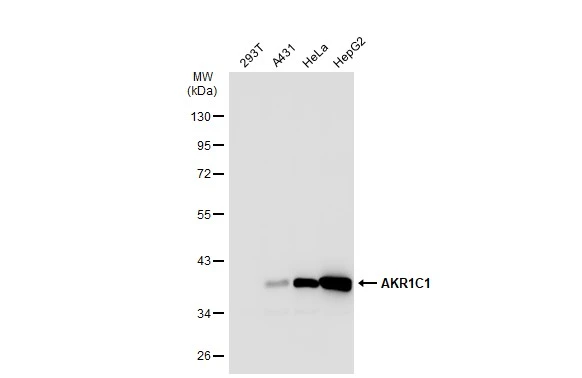
Product group Antibodies

AKR1C1 antibodyGTX105620
ApplicationsImmunoFluorescence, Western Blot, ImmunoCytoChemistry, ImmunoHistoChemistry, ImmunoHistoChemistry Paraffin
ReactivityHuman, Mouse
TargetAKR1C1
- SizePrice
Product group Antibodies

Anti-AKR1C1Y058805
ApplicationsWestern Blot, ImmunoHistoChemistry
ReactivityHuman
- SizePrice

Product group Antibodies

Anti-AKR1C1 Antibody144-60143
ApplicationsWestern Blot
ReactivityHuman, Mouse
TargetAKR1C1
- SizePrice
Product group Antibodies

AKR1C1/2 Recombinant AntibodyBSM-62246R
ApplicationsFlow Cytometry, Western Blot
ReactivityHuman, Mouse, Rat
TargetAKR1C1
- SizePrice