

Anti-Osteoprotegerin Antibody
R1608-4

ApplicationsFlow Cytometry, ImmunoFluorescence, Western Blot, ImmunoHistoChemistry, ImmunoHistoChemistry Paraffin
Product group Antibodies
ReactivityHuman, Mouse, Rat
TargetTNFRSF11B
Overview
- SupplierHUABIO
- Product NameAnti-Osteoprotegerin Antibody
- Delivery Days Customer7
- ApplicationsFlow Cytometry, ImmunoFluorescence, Western Blot, ImmunoHistoChemistry, ImmunoHistoChemistry Paraffin
- Applications SupplierWB,IF-Cell,IHC-P
- CertificationResearch Use Only
- ClonalityPolyclonal
- Concentration1 mg/ml
- ConjugateUnconjugated
- Gene ID4982
- Target nameTNFRSF11B
- Target descriptionTNF receptor superfamily member 11b
- Target synonymsOCIF, OPG, PDB5, TR1, tumor necrosis factor receptor superfamily member 11B, osteoclastogenesis inhibitory factor, osteoprotegerin, tumor necrosis factor receptor superfamily, member 11b
- HostRabbit
- IsotypeIgG
- Protein IDO00300
- Protein NameTumor necrosis factor receptor superfamily member 11B
- Scientific DescriptionBone morphogenesis and remodeling involve the formation of bone from osteoblasts and the resorption of bone by osteoclasts. The cytokine osteoprotegerin (OPG), also designated osteoclastogenesis inhibitory factor (OCIF), is known to inhibit osteoclast formation. A secreted glycoprotein, OPG is a member of the TNF receptor family that increases bone density and volume. OPG is thought to inhibit osteoclastogenesis by disrupting the cell-to-cell signaling between osteoblastic stromal cells and osteoclast progenitors. OPG is known to bind to TRAIL, a death domain-containing protein, and to inhibit TRAIL apoptosis in Jurkat cells. OPG also binds to osteoclast differentiation factor (ODF), also known as TRANCE/RANKL, a membrane-bound protein belonging to the TNF ligand family. Both TNFalpha and TNFbeta upregulate OPG expression, while the bone resorbing agent prostaglandin E2 downregulates OPG.
- ReactivityHuman, Mouse, Rat
- Reactivity SupplierHuman,Mouse,Rat
- Storage Instruction-20°C,2°C to 8°C
- UNSPSC41116161
Datasheet
Related products

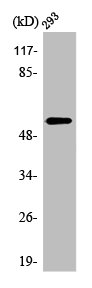
Product group Antibodies

TNFRSF11B AntibodyCSB-PA003597
ApplicationsImmunoFluorescence, Western Blot, ELISA, ImmunoHistoChemistry
ReactivityHuman, Mouse
TargetTNFRSF11B
- SizePrice

Product group Antibodies

Anti-Osteoprotegerin/TNFRSF11B Antibody Picoband(r)A00863-CARRIER-FREE
ApplicationsFlow Cytometry, Western Blot, ELISA, ImmunoHistoChemistry
ReactivityHuman, Monkey, Mouse, Rat
TargetTNFRSF11B
- SizePrice
Product group Antibodies

Anti-OPG [AbAb01OPG]AB04113-1.1
ApplicationsELISA
ReactivityHuman
TargetTNFRSF11B
- SizePrice
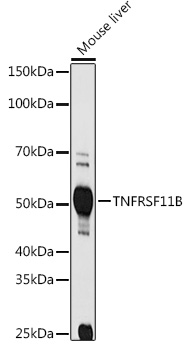
Product group Antibodies

ApplicationsWestern Blot, ImmunoHistoChemistry
ReactivityHuman, Mouse, Rat
- SizePrice
![Immunofluorescent staining of human cell line BJ [Human fibroblast] shows localization to the Golgi apparatus.](https://atlasantibodies.s3.amazonaws.com/images/icc/hpa058613-icc-1.jpg)
Product group Antibodies

Anti-TNFRSF11B AntibodyHPA058613
ApplicationsImmunoCytoChemistry
ReactivityHuman
TargetTNFRSF11B
- SizePrice
Product group Antibodies

OPG / Osteoprotegerin AntibodyLS-C400934
ApplicationsWestern Blot, ELISA, ImmunoHistoChemistry
ReactivityHuman, Mouse, Rat
TargetTNFRSF11B
- SizePrice
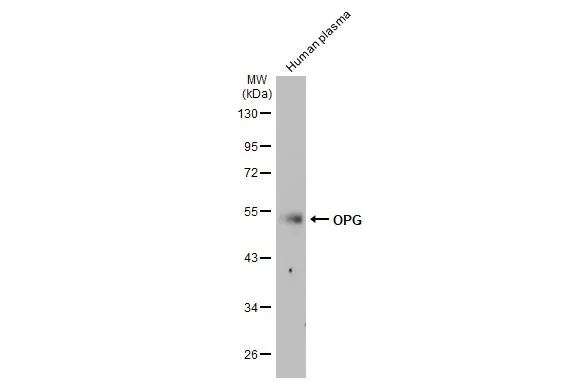
Product group Antibodies

OPG antibodyGTX127948
ApplicationsWestern Blot, ImmunoHistoChemistry, ImmunoHistoChemistry Paraffin
ReactivityHuman, Mouse, Rat
TargetTNFRSF11B
- SizePrice

Product group Antibodies

Anti-TNFRSF11B Antibody144-02100
ApplicationsImmunoFluorescence, Western Blot, ImmunoHistoChemistry
ReactivityHuman, Mouse, Rat
TargetTNFRSF11B
- SizePrice