

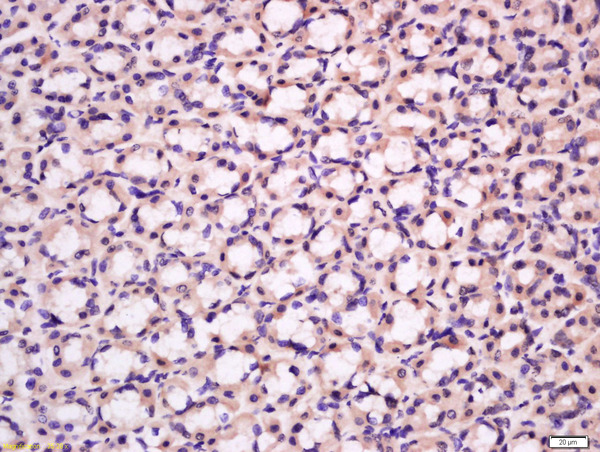
Formalin-fixed and paraffin embedded rat stomach tissue labeled with Anti-BK channel Polyclonal Antibody, Unconjugated(bs-0729R) 1:300 followed by conjugation to the secondary antibody and DAB staining.
Formalin-fixed and paraffin embedded rat stomach tissue labeled with Anti-BK channel Polyclonal Antibody, Unconjugated(bs-0729R) 1:300 followed by conjugation to the secondary antibody and DAB staining.
KCNMA1/BK channel Polyclonal Antibody
BS-0729R

ApplicationsWestern Blot, ImmunoHistoChemistry, ImmunoHistoChemistry Frozen, ImmunoHistoChemistry Paraffin
Product group Antibodies
ReactivityBovine, Canine, Human, Mouse, Porcine, Rabbit, Rat, Sheep
TargetKCNMA1
Overview
- SupplierBioss
- Product NameKCNMA1/BK channel Polyclonal Antibody
- Delivery Days Customer16
- ApplicationsWestern Blot, ImmunoHistoChemistry, ImmunoHistoChemistry Frozen, ImmunoHistoChemistry Paraffin
- Applications SupplierWB(1:300-5000), IHC-P(1:200-400), IHC-F(1:100-500)
- CertificationResearch Use Only
- ClonalityPolyclonal
- Concentration1 ug/ul
- ConjugateUnconjugated
- Gene ID3778
- Target nameKCNMA1
- Target descriptionpotassium calcium-activated channel subfamily M alpha 1
- Target synonymsBKTM, CADEDS, IEG16, KCa1.1, LIWAS, MaxiK, PNKD3, SAKCA, SLO, SLO-ALPHA, SLO1, bA205K10.1, hSlo, mSLO1, Calcium-activated potassium channel subunit alpha-1, calcium-activated potassium channel subunit alpha-1, BK channel alpha subunit, BKCA alpha subunit, big potassium channel alpha subunit, calcium-activated potassium channel, subfamily M subunit alpha-1, k(VCA)alpha, maxi-K channel HSLO, potassium channel, calcium activated large conductance subfamily M alpha, member 1, potassium large conductance calcium-activated channel, subfamily M, alpha member 1, slo homolog, slowpoke homolog, stretch-activated Kca channel
- HostRabbit
- IsotypeIgG
- Protein IDQ12791
- Protein NameCalcium-activated potassium channel subunit alpha-1
- ReactivityBovine, Canine, Human, Mouse, Porcine, Rabbit, Rat, Sheep
- Storage Instruction-20°C
- UNSPSC41116161
References
- Time-course of glial changes in the hyperhomocysteinemia model of vascular cognitive impairment and dementia (VCID). Sudduth TL et al., 2017 Jan 26, NeuroscienceRead this paper
Datasheet
Related products
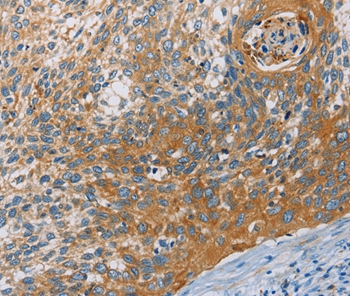
Product group Antibodies

Anti-KCNMA1 AntibodyA45438
ApplicationsImmunoHistoChemistry
ReactivityHuman
- SizePrice
Product group Antibodies

Anti-KCNMA1 (N-term) Antibody102-24871
ApplicationsWestern Blot
TargetKCNMA1
- SizePrice
Product group Antibodies

KCNMA1 / BK AntibodyLS-C750254
ApplicationsWestern Blot
ReactivityHuman, Rat
TargetKCNMA1
- SizePrice
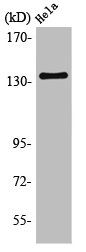
Product group Antibodies

KCNMA1 AntibodyCSB-PA003200
ApplicationsWestern Blot, ELISA, ImmunoHistoChemistry
ReactivityHuman, Mouse, Rat
TargetKCNMA1
- SizePrice
Product group Antibodies

Goat anti-KCNMA1EB08857
ApplicationsELISA
ReactivityBovine, Human, Mouse, Rat
TargetKCNMA1
- SizePrice
Product group Antibodies

Kcnma1 Polyclonal AntibodyCAC09256
ApplicationsImmunoFluorescence, ELISA, ImmunoHistoChemistry
TargetKCNMA1
- SizePrice

Product group Antibodies

Anti-KCNMA1 AntibodyHPA054648
ApplicationsImmunoHistoChemistry
ReactivityHuman
TargetKCNMA1
- SizePrice
![Boiled and unboiled various tissue extracts (50 μg) were separated by 5% SDS-PAGE, and the membrane was blotted with Maxi Potassium channel alpha antibody [HL3164] (GTX640674) diluted at 1:1000. The HRP-conjugated anti-rabbit IgG antibody (GTX213110-01) was used to detect the primary antibody.](https://www.genetex.com/upload/website/prouct_img/normal/GTX640674/GTX640674_T-45481_20240802_WB_M_tissue_ub_24080602_171.webp)
Product group Antibodies

ApplicationsImmunoFluorescence, Western Blot, ImmunoCytoChemistry
ReactivityHuman, Mouse, Rat
TargetKCNMA1
- SizePrice

Product group Antibodies

Anti-Maxi Potassium channel alpha/KCNMA1 Antibody Picoband(r)PB9227-CARRIER-FREE
ApplicationsWestern Blot, ImmunoHistoChemistry
ReactivityBovine, Equine, Hamster, Human, Monkey, Mouse, Rabbit, Rat
TargetKCNMA1
- SizePrice