

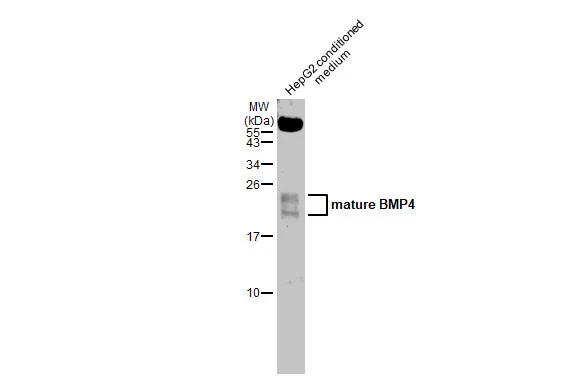
HepG2 conditioned medium (30 μg) was separated by 15% SDS-PAGE, and the membrane was blotted with BMP4 antibody (GTX100875) diluted at 1:500. The HRP-conjugated anti-rabbit IgG antibody (GTX213110-01) was used to detect the primary antibody.
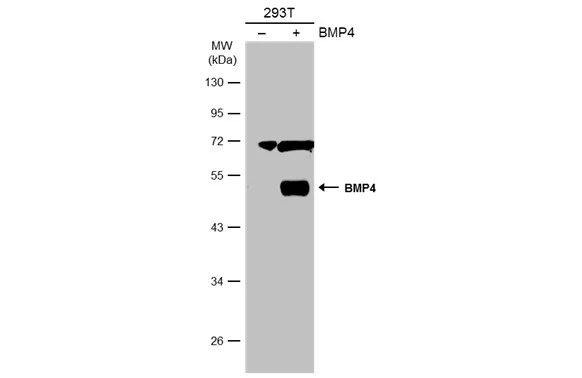
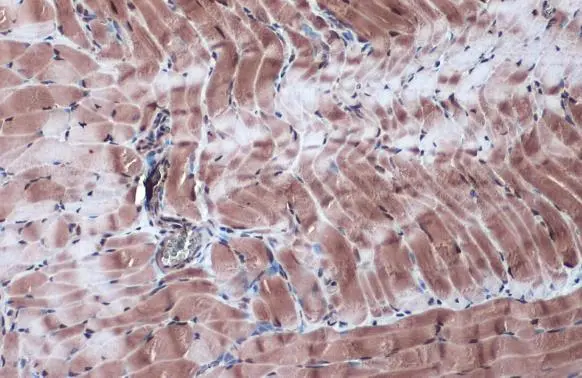
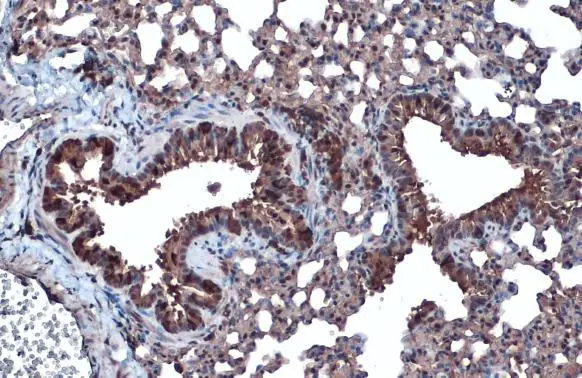
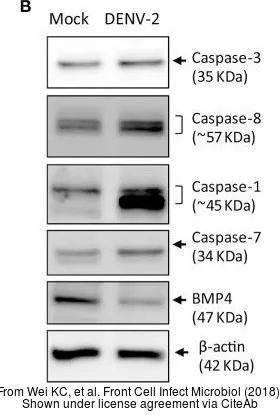
HepG2 conditioned medium (30 μg) was separated by 15% SDS-PAGE, and the membrane was blotted with BMP4 antibody (GTX100875) diluted at 1:500. The HRP-conjugated anti-rabbit IgG antibody (GTX213110-01) was used to detect the primary antibody.
BMP4 antibody
GTX100875

ApplicationsWestern Blot, ImmunoHistoChemistry, ImmunoHistoChemistry Paraffin
Product group Antibodies
ReactivityHuman, Mouse, Rat
TargetBMP4
Overview
- SupplierGeneTex
- Product NameBMP4 antibody
- Delivery Days Customer9
- Application Supplier NoteWB: 1:500-1:10000. *Optimal dilutions/concentrations should be determined by the researcher.Not tested in other applications.
- ApplicationsWestern Blot, ImmunoHistoChemistry, ImmunoHistoChemistry Paraffin
- CertificationResearch Use Only
- ClonalityPolyclonal
- Concentration2.02 mg/ml
- ConjugateUnconjugated
- Gene ID652
- Target nameBMP4
- Target descriptionbone morphogenetic protein 4
- Target synonymsBMP2B, BMP2B1, MCOPS6, OFC11, ZYME, bone morphogenetic protein 4, bone morphogenetic protein 2B
- HostRabbit
- IsotypeIgG
- Protein IDP12644
- Protein NameBone morphogenetic protein 4
- Scientific DescriptionThis gene encodes a secreted ligand of the TGF-beta (transforming growth factor-beta) superfamily of proteins. Ligands of this family bind various TGF-beta receptors leading to recruitment and activation of SMAD family transcription factors that regulate gene expression. The encoded preproprotein is proteolytically processed to generate each subunit of the disulfide-linked homodimer. This protein regulates heart development and adipogenesis. Mutations in this gene are associated with orofacial cleft and microphthalmia in human patients. The encoded protein may also be involved in the pathology of multiple cardiovascular diseases and human cancers. [provided by RefSeq, Jul 2016]
- ReactivityHuman, Mouse, Rat
- Storage Instruction-20°C or -80°C,2°C to 8°C
- UNSPSC41116161
Datasheet
Related products
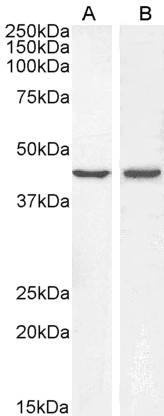
Product group Antibodies

Anti-BMP4 AntibodyA83520
ApplicationsWestern Blot, ELISA
ReactivityHuman
- SizePrice

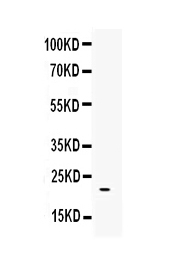
Product group Antibodies

Anti-BMP4 Antibody Picoband(r)A00321-CARRIER-FREE
ApplicationsWestern Blot
ReactivityHuman, Mouse, Rat
TargetBMP4
- SizePrice
Product group Antibodies

BMP4 Recombinant AntibodyBSM-61132R
ApplicationsFlow Cytometry, ImmunoFluorescence, ImmunoPrecipitation, Western Blot, ImmunoCytoChemistry, ImmunoHistoChemistry, ImmunoHistoChemistry Frozen, ImmunoHistoChemistry Paraffin
TargetBMP4
- SizePrice
Product group Antibodies

Goat anti-BMP4EB12544
ApplicationsWestern Blot, ELISA
ReactivityHuman
TargetBMP4
- SizePrice
Product group Antibodies

Bmp4 Polyclonal AntibodyCAC07069
ApplicationsWestern Blot, ELISA, ImmunoHistoChemistry
ReactivityMouse, Zebra Fish
TargetBMP4
- SizePrice
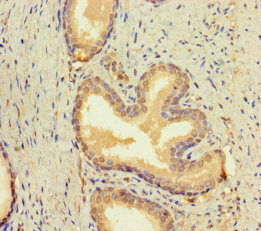
Product group Antibodies

BMP4 AntibodyCSB-PA05799A0RB
ApplicationsWestern Blot, ELISA, ImmunoHistoChemistry
ReactivityHuman, Mouse, Zebra Fish
TargetBMP4
- SizePrice
Product group Antibodies

BMP4 AntibodyLS-C403867
ApplicationsWestern Blot, ELISA, ImmunoHistoChemistry
ReactivityHuman, Mouse, Rat
TargetBMP4
- SizePrice
Product group Antibodies
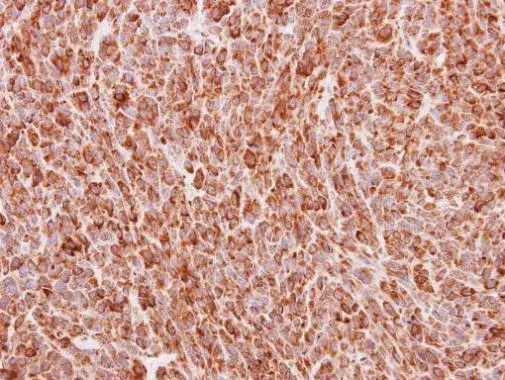
BMP4 antibodyGTX100874
ApplicationsImmunoFluorescence, Western Blot, ImmunoCytoChemistry, ImmunoHistoChemistry, ImmunoHistoChemistry Paraffin
ReactivityHuman
TargetBMP4
- SizePrice
![WB analysis of BMP4-hIgGFc transfected HEK293 cell lysate using GTX83027 BMP4 antibody [10F4B4].](https://www.genetex.com/upload/website/prouct_img/normal/GTX83027/GTX83027_20170912_WB_w_23061322_193.webp)
Product group Antibodies
BMP4 antibody [10F4B4]GTX83027
ApplicationsWestern Blot, ELISA
ReactivityHuman
TargetBMP4
- SizePrice