

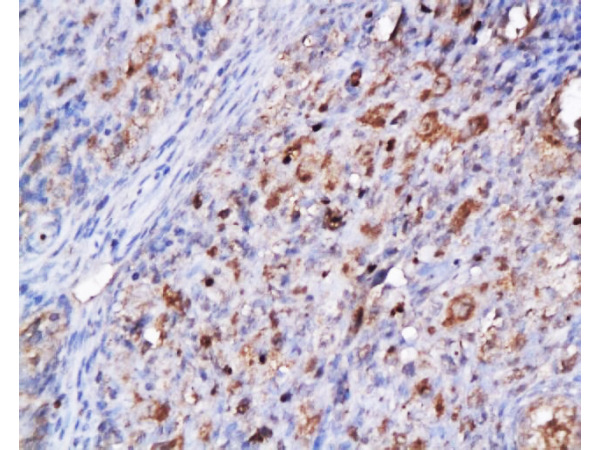
Formalin-fixed and paraffin embedded rat ovary tissue labeled Anti-CDK2 Polyclonal Antibody, Unconjugated (bs-0757R) 1:200, followed by conjugation to the secondary antibody and DAB staining.
Formalin-fixed and paraffin embedded rat ovary tissue labeled Anti-CDK2 Polyclonal Antibody, Unconjugated (bs-0757R) 1:200, followed by conjugation to the secondary antibody and DAB staining.
CDK2 Polyclonal Antibody
BS-0757R

ApplicationsImmunoFluorescence, Western Blot, ELISA, ImmunoCytoChemistry, ImmunoHistoChemistry, ImmunoHistoChemistry Frozen, ImmunoHistoChemistry Paraffin
Product group Antibodies
ReactivityBovine, Equine, Human, Mouse, Porcine, Rabbit, Rat
TargetCDK2
Overview
- SupplierBioss
- Product NameCDK2 Polyclonal Antibody
- Delivery Days Customer7
- ApplicationsImmunoFluorescence, Western Blot, ELISA, ImmunoCytoChemistry, ImmunoHistoChemistry, ImmunoHistoChemistry Frozen, ImmunoHistoChemistry Paraffin
- Applications SupplierWB(1:300-5000), ELISA(1:500-1000), IHC-P(1:200-400), IHC-F(1:100-500), IF(IHC-P)(1:50-200), IF(IHC-F)(1:50-200), IF(ICC)(1:50-200)
- CertificationResearch Use Only
- ClonalityPolyclonal
- Concentration1 ug/ul
- ConjugateUnconjugated
- Gene ID1017
- Target nameCDK2
- Target descriptioncyclin dependent kinase 2
- Target synonymsCDKN2, p33(CDK2), cyclin-dependent kinase 2, cdc2-related protein kinase, cell division protein kinase 2, p33 protein kinase
- HostRabbit
- IsotypeIgG
- Protein IDP24941
- Protein NameCyclin-dependent kinase 2
- ReactivityBovine, Equine, Human, Mouse, Porcine, Rabbit, Rat
- Storage Instruction-20°C
- UNSPSC41116161
References
- Silica nanoparticles exacerbates reproductive toxicity development in high-fat diet-treated Wistar rats. Zhang L et al., 2020 Feb 15, J Hazard MaterRead this paper
- Sundew plant, a potential source of anti-inflammatory agents, selectively induces G2/M arrest and apoptosis in MCF-7 cells through upregulation of p53 and Bax/Bcl-2 ratio. Ghate NB et al., 2016, Cell Death DiscovRead this paper
- STAT1 inhibits human hepatocellular carcinoma cell growth through induction of p53 and Fbxw7. Chen J et al., 2015, Cancer Cell IntRead this paper
Related products
Product group Antibodies

Anti-CDK2 AntibodyA96410
ApplicationsImmunoFluorescence, Western Blot, ELISA
ReactivityHuman, Mouse, Rat
- SizePrice
Product group Antibodies

Anti-CDK2 Antibody130-10267
ApplicationsWestern Blot, ELISA
ReactivityHuman
TargetCDK2
- SizePrice


Product group Antibodies

Anti-CDK2 AntibodyAMAB91497
ApplicationsWestern Blot, ImmunoCytoChemistry, ImmunoHistoChemistry
ReactivityHuman
TargetCDK2
- SizePrice
Product group Antibodies

CDK2 AntibodyCSB-PA001533
ApplicationsImmunoFluorescence, Western Blot, ELISA, ImmunoHistoChemistry
ReactivityHuman, Mouse, Rat
TargetCDK2
- SizePrice
Product group Antibodies

Cdk2 Polyclonal AntibodyCAC07055
ApplicationsImmunoFluorescence, ImmunoPrecipitation, Western Blot, ELISA, ImmunoHistoChemistry
TargetCDK2
- SizePrice
Product group Antibodies

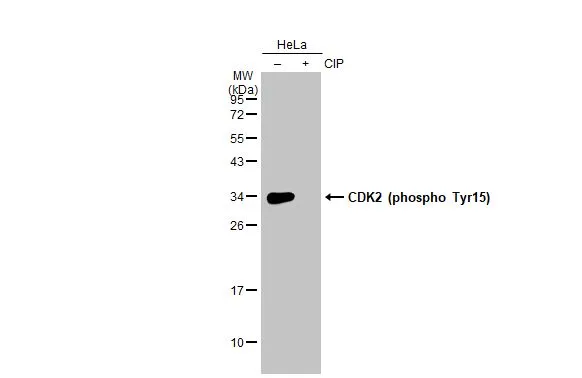
CDK2 (phospho Tyr15) antibodyGTX132802
ApplicationsWestern Blot
ReactivityHuman
TargetCDK2
- SizePrice
Product group Antibodies

CDK2 Antibody (Preservative Free)LS-C343132
ApplicationsWestern Blot, ELISA
ReactivityHuman
TargetCDK2
- SizePrice
Product group Antibodies

Anti-CDK2Y058204
ApplicationsWestern Blot, ELISA, ImmunoHistoChemistry
ReactivityHuman, Mouse, Rat
- SizePrice

Product group Antibodies

Anti-Cdk2 Antibody Picoband(r)PB9534-CARRIER-FREE
ApplicationsImmunoFluorescence, Western Blot, ImmunoCytoChemistry, ImmunoHistoChemistry
ReactivityHuman
TargetCDK2
- SizePrice