

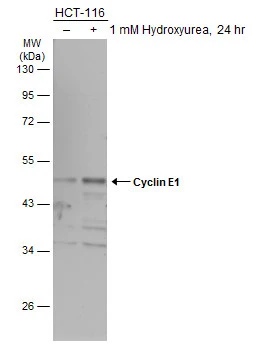
Untreated (–) and treated (+) HCT-116 whole cell extracts (30 μg) were separated by 10% SDS-PAGE, and the membrane was blotted with Cyclin E1 antibody (GTX103045) diluted at 1:500. The HRP-conjugated anti-rabbit IgG antibody (GTX213110-01) was used to detect the primary antibody.
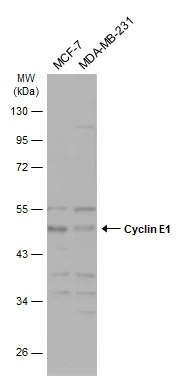
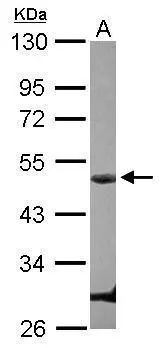
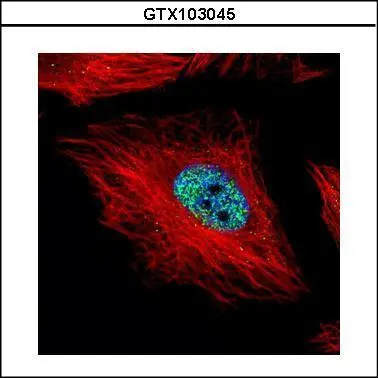
Untreated (–) and treated (+) HCT-116 whole cell extracts (30 μg) were separated by 10% SDS-PAGE, and the membrane was blotted with Cyclin E1 antibody (GTX103045) diluted at 1:500. The HRP-conjugated anti-rabbit IgG antibody (GTX213110-01) was used to detect the primary antibody.
Cyclin E1 antibody
GTX103045

ApplicationsImmunoFluorescence, Western Blot, ImmunoCytoChemistry
Product group Antibodies
ReactivityHuman, Monkey
TargetCCNE1
Overview
- SupplierGeneTex
- Product NameCyclin E1 antibody
- Delivery Days Customer9
- Application Supplier NoteWB: 1:500-1:3000. ICC/IF: 1:100-1:1000. *Optimal dilutions/concentrations should be determined by the researcher.Not tested in other applications.
- ApplicationsImmunoFluorescence, Western Blot, ImmunoCytoChemistry
- CertificationResearch Use Only
- ClonalityPolyclonal
- Concentration1 mg/ml
- ConjugateUnconjugated
- Gene ID898
- Target nameCCNE1
- Target descriptioncyclin E1
- Target synonymsCCNE, pCCNE1, G1/S-specific cyclin-E1
- HostRabbit
- IsotypeIgG
- Protein IDP24864
- Protein NameG1/S-specific cyclin-E1
- Scientific DescriptionThe protein encoded by this gene belongs to the highly conserved cyclin family, whose members are characterized by a dramatic periodicity in protein abundance through the cell cycle. Cyclins function as regulators of CDK kinases. Different cyclins exhibit distinct expression and degradation patterns which contribute to the temporal coordination of each mitotic event. This cyclin forms a complex with and functions as a regulatory subunit of CDK2, whose activity is required for cell cycle G1/S transition. This protein accumulates at the G1-S phase boundary and is degraded as cells progress through S phase. Overexpression of this gene has been observed in many tumors, which results in chromosome instability, and thus may contribute to tumorigenesis. This protein was found to associate with, and be involved in, the phosphorylation of NPAT protein (nuclear protein mapped to the ATM locus), which participates in cell-cycle regulated histone gene expression and plays a critical role in promoting cell-cycle progression in the absence of pRB. Two alternatively spliced transcript variants of this gene, which encode distinct isoforms, have been described. Two additional splice variants were reported but detailed nucleotide sequence information is not yet available. [provided by RefSeq]
- ReactivityHuman, Monkey
- Storage Instruction-20°C or -80°C,2°C to 8°C
- UNSPSC41116161
Datasheet
Related products
Product group Antibodies

Anti-Cyclin E1 AntibodyA94771
ApplicationsImmunoFluorescence, Western Blot, ELISA, ImmunoHistoChemistry
ReactivityHuman, Mouse, Rat
- SizePrice
Product group Antibodies

Anti-CCNE1 Antibody144-63138
ApplicationsWestern Blot
ReactivityHuman, Mouse, Rat
TargetCCNE1
- SizePrice
Product group Antibodies

CCNE1 / Cyclin E1 AntibodyLS-C831032
ApplicationsELISA, ImmunoHistoChemistry
ReactivityHuman
TargetCCNE1
- SizePrice
![HepG2 cells were stained with Cyclin E1 (4H7) Monoclonal Antibody (bsm-52048R) at [1:200] incubated overnight at 4C, followed by secondary antibody incubation, DAPI staining of the nuclei and detection.](https://biossantibodies.com/image-raw/16228.jpeg)
Product group Antibodies

Cyclin E1 Recombinant AntibodyBSM-52048R
ApplicationsImmunoFluorescence, Western Blot, ImmunoCytoChemistry, ImmunoHistoChemistry, ImmunoHistoChemistry Frozen, ImmunoHistoChemistry Paraffin
ReactivityHuman, Mouse
TargetCCNE1
- SizePrice

Product group Antibodies

Anti-Cyclin E1/CCNE1 Antibody Picoband(r)A00543-2-CARRIER-FREE
ApplicationsFlow Cytometry, Western Blot, ELISA, ImmunoHistoChemistry
ReactivityHuman, Mouse, Rat
TargetCCNE1
- SizePrice
Product group Antibodies

CCNE1 AntibodyCSB-PA001879
ApplicationsImmunoFluorescence, Western Blot, ELISA, ImmunoHistoChemistry
ReactivityHuman, Mouse, Rat
TargetCCNE1
- SizePrice
Product group Antibodies

CCNE1 Polyclonal AntibodyCAC14982
ApplicationsWestern Blot, ELISA, ImmunoHistoChemistry
ReactivityMouse
TargetCCNE1
- SizePrice
Product group Antibodies
Cyclin E1 antibodyGTX133414
ApplicationsWestern Blot
ReactivityHuman
TargetCCNE1
- SizePrice
Product group Antibodies
Cyclin E antibody [168]GTX16122
ApplicationsImmunoPrecipitation, Western Blot
ReactivityHuman, Monkey
TargetCCNE1
- SizePrice
![WB analysis of Jurkat cell lysate using GTX18047 Cyclin E1 antibody [CCNE1/2460].](https://www.genetex.com/upload/website/prouct_img/normal/GTX18047/GTX18047_20200115_WB_1455_w_23060620_633.webp)
Product group Antibodies
Cyclin E1 antibody [CCNE1/2460]GTX18047
ApplicationsWestern Blot, ImmunoHistoChemistry, ImmunoHistoChemistry Paraffin, Other Application
ReactivityHuman
TargetCCNE1
- SizePrice