

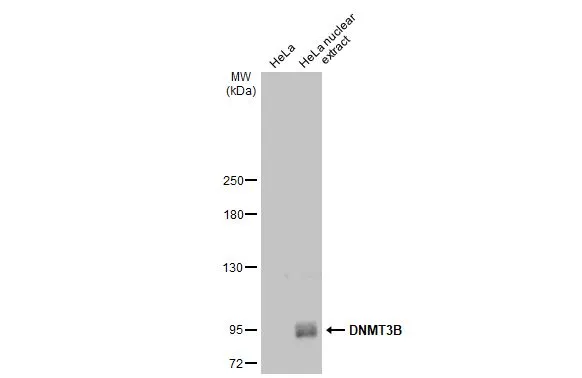
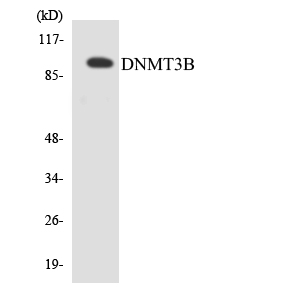
Various whole cell extracts (30 μg) were separated by 5% SDS-PAGE, and the membrane was blotted with DNMT3B antibody (GTX129127) diluted at 1:500. The HRP-conjugated anti-rabbit IgG antibody (GTX213110-01) was used to detect the primary antibody.
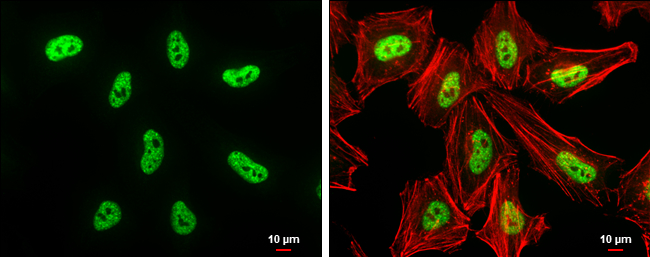
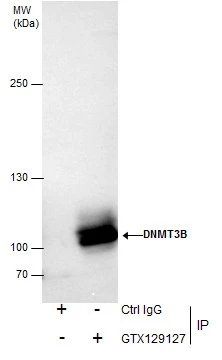
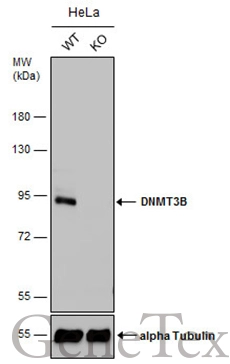
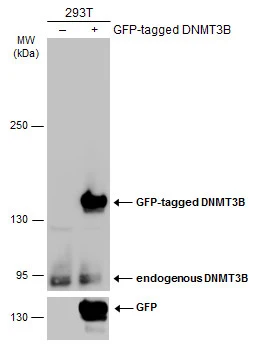
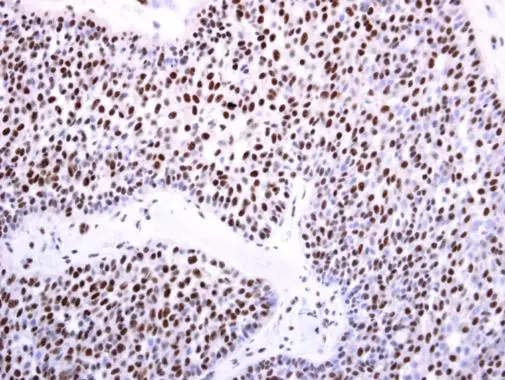
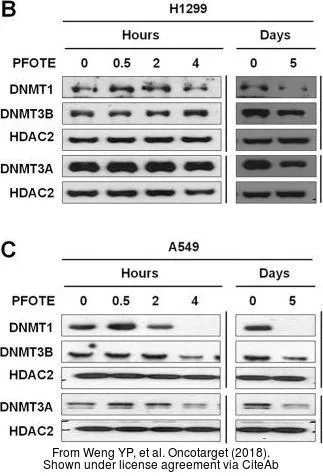
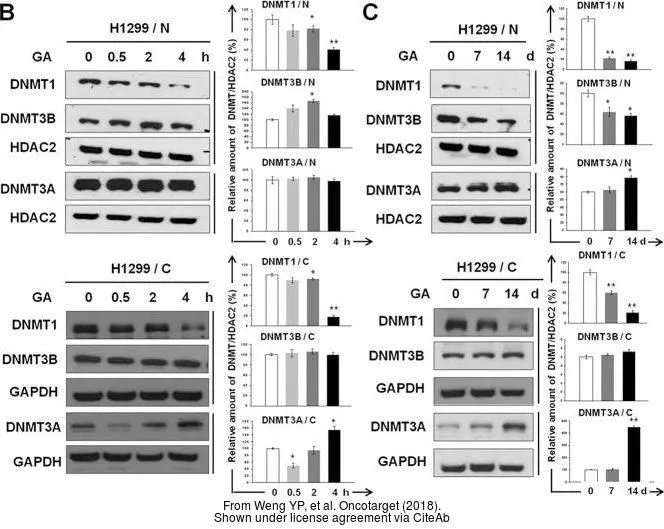
Various whole cell extracts (30 μg) were separated by 5% SDS-PAGE, and the membrane was blotted with DNMT3B antibody (GTX129127) diluted at 1:500. The HRP-conjugated anti-rabbit IgG antibody (GTX213110-01) was used to detect the primary antibody.
DNMT3B antibody
GTX129127

ApplicationsImmunoFluorescence, ImmunoPrecipitation, Western Blot, ImmunoCytoChemistry, ImmunoHistoChemistry, ImmunoHistoChemistry Paraffin
Product group Antibodies
ReactivityHuman, Rat
TargetDNMT3B
Overview
- SupplierGeneTex
- Product NameDNMT3B antibody
- Delivery Days Customer9
- Application Supplier NoteWB: 1:1000-1:10000. ICC/IF: 1:100-1:1000. IHC-P: 1:100-1:1000. IP: 1:100-1:500. *Optimal dilutions/concentrations should be determined by the researcher.Not tested in other applications.
- ApplicationsImmunoFluorescence, ImmunoPrecipitation, Western Blot, ImmunoCytoChemistry, ImmunoHistoChemistry, ImmunoHistoChemistry Paraffin
- CertificationResearch Use Only
- ClonalityPolyclonal
- Concentration1.29 mg/ml
- ConjugateUnconjugated
- Gene ID1789
- Target nameDNMT3B
- Target descriptionDNA methyltransferase 3 beta
- Target synonymsFSHD4, ICF, ICF1, M.HsaIIIB, DNA (cytosine-5)-methyltransferase 3B, DNA (cytosine-5-)-methyltransferase 3 beta, DNA MTase HsaIIIB, DNA cytosine-5--methyltransferase 3 beta, DNA methyltransferase HsaIIIB
- HostRabbit
- IsotypeIgG
- Protein IDQ9UBC3
- Protein NameDNA (cytosine-5)-methyltransferase 3B
- Scientific DescriptionCpG methylation is an epigenetic modification that is important for embryonic development, imprinting, and X-chromosome inactivation. Studies in mice have demonstrated that DNA methylation is required for mammalian development. This gene encodes a DNA methyltransferase which is thought to function in de novo methylation, rather than maintenance methylation. The protein localizes primarily to the nucleus and its expression is developmentally regulated. Mutations in this gene cause the immunodeficiency-centromeric instability-facial anomalies (ICF) syndrome. Six alternatively spliced transcript variants have been described. The full length sequences of variants 4 and 5 have not been determined. [provided by RefSeq]
- ReactivityHuman, Rat
- Storage Instruction-20°C or -80°C,2°C to 8°C
- UNSPSC41116161
Datasheet
Related products
Product group Antibodies

Anti-DNMT3B AntibodyA99302
ApplicationsWestern Blot, ELISA, ImmunoHistoChemistry
ReactivityHuman
- SizePrice

Product group Antibodies

Anti-DNMT3B Antibody144-02899
ApplicationsWestern Blot
ReactivityHuman, Mouse, Rat
TargetDNMT3B
- SizePrice

Product group Antibodies

DNMT3B AntibodyLS-C746877
ApplicationsWestern Blot
ReactivityHuman, Mouse, Rat
TargetDNMT3B
- SizePrice

Product group Antibodies

Anti-DNMT3B Antibody Picoband(r)A00319-2-CARRIER-FREE
ApplicationsFlow Cytometry, Western Blot, ELISA
ReactivityHuman, Monkey
TargetDNMT3B
- SizePrice
Product group Antibodies
References

Dnmt3b Polyclonal AntibodyBS-0301R
ApplicationsFlow Cytometry, ImmunoFluorescence, Western Blot, ELISA, ImmunoCytoChemistry, ImmunoHistoChemistry, ImmunoHistoChemistry Paraffin
ReactivityHuman, Mouse, Rat
TargetDNMT3B
- SizePrice
Product group Antibodies

DNMT3B AntibodyCSB-PA002178
ApplicationsImmunoFluorescence, Western Blot, ELISA, ImmunoHistoChemistry
ReactivityHuman
TargetDNMT3B
- SizePrice
Product group Antibodies

Dnmt3B Polyclonal AntibodyCAC07176
ApplicationsImmunoFluorescence, Western Blot, ELISA, ImmunoHistoChemistry
TargetDNMT3B
- SizePrice

Product group Antibodies

Anti-DNMT3B AntibodyHPA001595
ApplicationsWestern Blot, ImmunoCytoChemistry, ImmunoHistoChemistry
ReactivityHuman
TargetDNMT3B
- SizePrice