

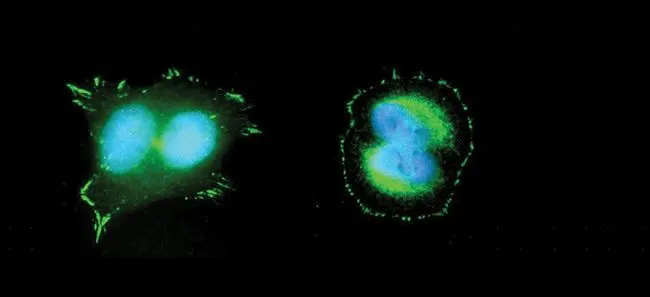
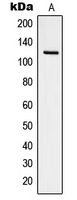
ICC/IF analysis of HeLa cells using GTX24803 FAK (phospho Tyr397) antibody. Green : Primary antibody Blue : cell nucleus Fixation/Permeabilization : ice-cold 95% methanol
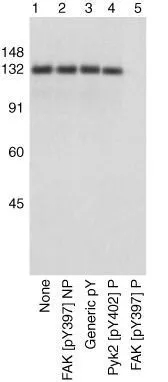
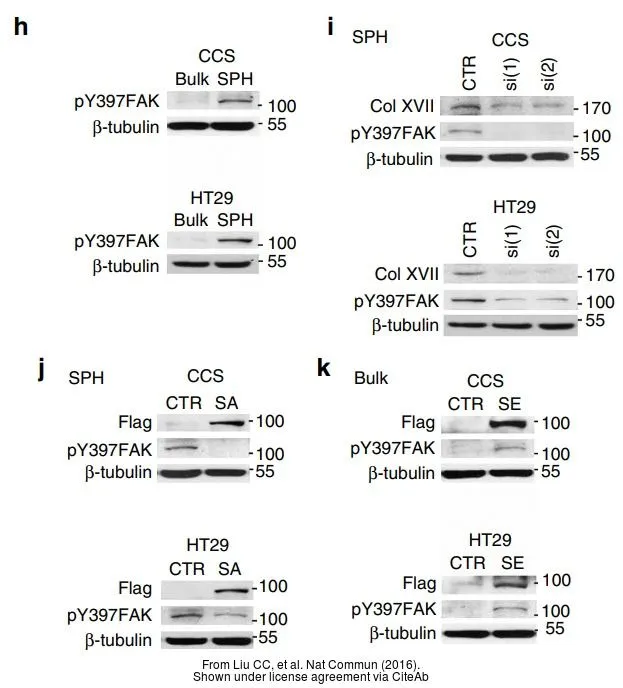
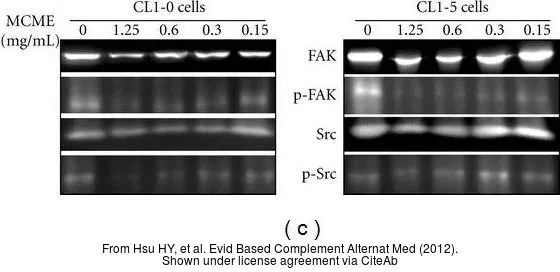
ICC/IF analysis of HeLa cells using GTX24803 FAK (phospho Tyr397) antibody. Green : Primary antibody Blue : cell nucleus Fixation/Permeabilization : ice-cold 95% methanol
FAK (phospho Tyr397) antibody
GTX24803

ApplicationsImmunoFluorescence, ImmunoPrecipitation, Western Blot, ChIP Chromatin ImmunoPrecipitation, ImmunoCytoChemistry, ImmunoHistoChemistry, ImmunoHistoChemistry Frozen
Product group Antibodies
ReactivityAmphibian, Canine, Chicken, Drosophila, Feline, Fish, Human, Mouse, Primate, Rat, Xenopus, Zebra Fish
TargetPTK2
Overview
- SupplierGeneTex
- Product NameFAK (phospho Tyr397) antibody
- Delivery Days Customer9
- ApplicationsImmunoFluorescence, ImmunoPrecipitation, Western Blot, ChIP Chromatin ImmunoPrecipitation, ImmunoCytoChemistry, ImmunoHistoChemistry, ImmunoHistoChemistry Frozen
- CertificationResearch Use Only
- ClonalityPolyclonal
- ConjugateUnconjugated
- Gene ID5747
- Target namePTK2
- Target descriptionprotein tyrosine kinase 2
- Target synonymsFADK, FADK 1, FAK, FAK1, FRNK, PPP1R71, p125FAK, pp125FAK, focal adhesion kinase 1, FAK-related non-kinase polypeptide, PTK2 protein tyrosine kinase 2, focal adhesion kinase-related nonkinase, protein phosphatase 1 regulatory subunit 71
- HostRabbit
- IsotypeIgG
- Protein IDQ05397
- Protein NameFocal adhesion kinase 1
- Scientific DescriptionThis gene encodes a cytoplasmic protein tyrosine kinase which is found concentrated in the focal adhesions that form between cells growing in the presence of extracellular matrix constituents. The encoded protein is a member of the FAK subfamily of protein tyrosine kinases but lacks significant sequence similarity to kinases from other subfamilies. Activation of this gene may be an important early step in cell growth and intracellular signal transduction pathways triggered in response to certain neural peptides or to cell interactions with the extracellular matrix. Several transcript variants encoding different isoforms have been found for this gene. [provided by RefSeq, Jun 2017]
- ReactivityAmphibian, Canine, Chicken, Drosophila, Feline, Fish, Human, Mouse, Primate, Rat, Xenopus, Zebra Fish
- Storage Instruction-20°C or -80°C,2°C to 8°C
- UNSPSC12352203
References
- Kuroda J, Itabashi T, Iwane AH, et al. The Physical Role of Mesenchymal Cells Driven by the Actin Cytoskeleton Is Essential for the Orientation of Collagen Fibrils in Zebrafish Fins. Front Cell Dev Biol. 2020,8:580520. doi: 10.3389/fcell.2020.580520Read this paper
- Terasaki M, Mima M, Kudoh S, et al. Glycine and succinic acid are effective indicators of the suppression of epithelial-mesenchymal transition by fucoxanthinol in colorectal cancer stem-like cells. Oncol Rep. 2018,40(1):414-424. doi: 10.3892/or.2018.6398Read this paper
- Liu CC, Lin SP, Hsu HS, et al. Suspension survival mediated by PP2A-STAT3-Col XVII determines tumour initiation and metastasis in cancer stem cells. Nat Commun. 2016,7:11798. doi: 10.1038/ncomms11798Read this paper
- McAndrews KM, McGrail DJ, Ravikumar N, et al. Mesenchymal Stem Cells Induce Directional Migration of Invasive Breast Cancer Cells through TGF-β. Sci Rep. 2015,5:16941. doi: 10.1038/srep16941Read this paper
- McGrail DJ, Khambhati NN, Qi MX, et al. Alterations in ovarian cancer cell adhesion drive taxol resistance by increasing microtubule dynamics in a FAK-dependent manner. Sci Rep. 2015,5:9529. doi: 10.1038/srep09529Read this paper
- Hsu HY, Lin JH, Li CJ, et al. Antimigratory Effects of the Methanol Extract from Momordica charantia on Human Lung Adenocarcinoma CL1 Cells. Evid Based Complement Alternat Med. 2012,2012:819632. doi: 10.1155/2012/819632Read this paper
Datasheet
Related products
Product group Antibodies

Anti-P-FAK Antibody130-10618
ApplicationsELISA
ReactivityHuman
TargetPTK2
- SizePrice
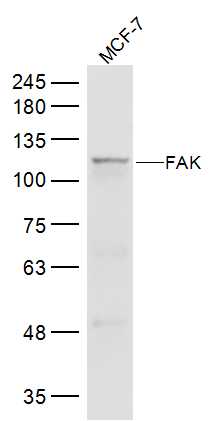
Product group Antibodies
References

FAK Polyclonal AntibodyBS-1340R
ApplicationsFlow Cytometry, ImmunoFluorescence, Western Blot, ELISA, ImmunoCytoChemistry, ImmunoHistoChemistry, ImmunoHistoChemistry Frozen, ImmunoHistoChemistry Paraffin
ReactivityHuman, Mouse, Rat
TargetPTK2
- SizePrice
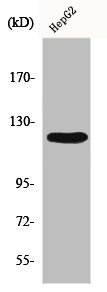
Product group Antibodies

PTK2 AntibodyCSB-PA002465
ApplicationsImmunoFluorescence, Western Blot, ELISA, ImmunoHistoChemistry
ReactivityHuman, Mouse, Rat
TargetPTK2
- SizePrice
Product group Antibodies

ApplicationsWestern Blot, ELISA, ImmunoHistoChemistry, ImmunoHistoChemistry Paraffin
ReactivityHuman, Mouse, Rat
TargetPTK2
- SizePrice
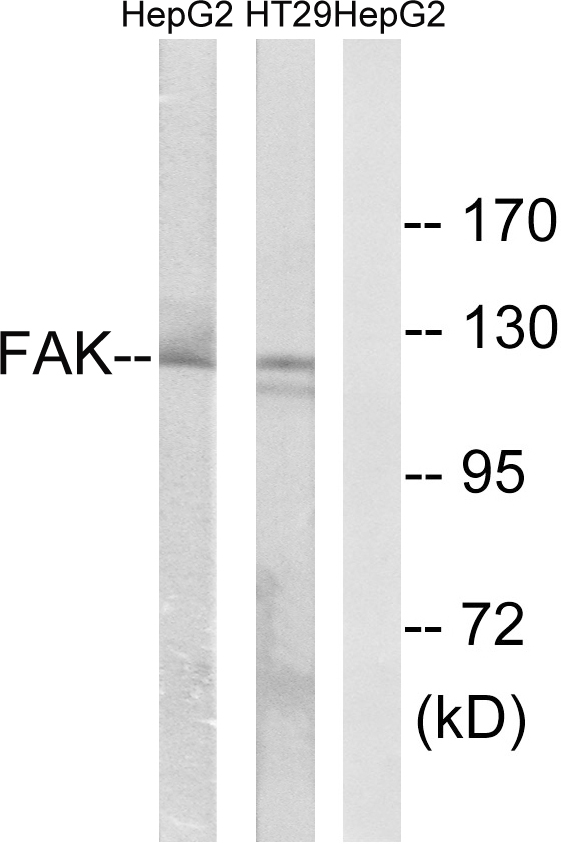
Product group Antibodies

Anti-FAK AntibodyA95486
ApplicationsImmunoFluorescence, Western Blot, ELISA, ImmunoHistoChemistry
ReactivityHuman, Mouse, Rat
- SizePrice
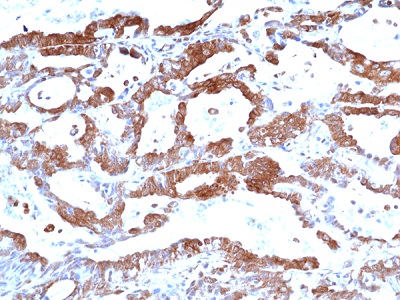
Product group Antibodies

ApplicationsWestern Blot, ImmunoHistoChemistry
ReactivityHuman
TargetPTK2
- SizePrice
Product group Antibodies
FAK (phospho Ser722) antibodyGTX24790
ApplicationsImmunoPrecipitation, Western Blot
ReactivityHuman
TargetPTK2
- SizePrice
Product group Antibodies
FAK (phospho Ser732) antibodyGTX24792
ApplicationsImmunoPrecipitation, Western Blot
ReactivityHuman, Mouse
TargetPTK2
- SizePrice
Product group Antibodies
FAK (phospho Tyr861) antibodyGTX24804
ApplicationsImmunoFluorescence, ImmunoPrecipitation, Western Blot, ImmunoCytoChemistry, ImmunoHistoChemistry, ImmunoHistoChemistry Paraffin
ReactivityAmphibian, Canine, Chicken, Hamster, Human, Mouse, Rat, Xenopus, Zebra Fish
TargetPTK2
- SizePrice
Product group Antibodies
FAK (phospho Tyr925) antibodyGTX32252
ApplicationsImmunoFluorescence, Western Blot, ImmunoCytoChemistry
ReactivityHuman, Mouse
TargetPTK2
- SizePrice