

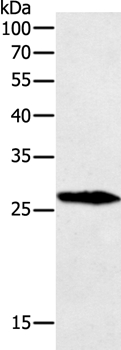
Western Blot analysis of Mouse testis tissue using GREM1 Polyclonal Antibody at dilution of 1:700
Western Blot analysis of Mouse testis tissue using GREM1 Polyclonal Antibody at dilution of 1:700
GREM1 Polyclonal Antibody
E-AB-14111

ApplicationsWestern Blot
Product group Antibodies
TargetGREM1
Overview
- SupplierElabscience
- Product NameGREM1 Polyclonal Antibody
- Delivery Days Customer12
- ApplicationsWestern Blot
- Applications SupplierELISA WB
- CertificationResearch Use Only
- ClonalityPolyclonal
- Concentration0.3 mg/ml
- ConjugateUnconjugated
- Gene ID26585
- Target nameGREM1
- Target descriptiongremlin 1, DAN family BMP antagonist
- Target synonymsC15DUPq, CKTSF1B1, CRAC1, CRCS4, DAND2, DRM, DUP15q, GREMLIN, HMPS, HMPS1, IHG-2, MPSH, PIG2, gremlin-1, DAN domain family member 2, cell proliferation-inducing gene 2 protein, colorectal adenoma and carcinoma 1, cysteine knot superfamily 1, BMP antagonist 1, down-regulated in Mos-transformed cells protein, gremlin 1, cysteine knot superfamily, homolog, gremlin 1-like protein, hereditary mixed polyposis syndrome, increased in high glucose-2
- HostRabbit
- IsotypeIgG
- Protein IDO60565
- Protein NameGremlin-1
- Scientific DescriptionThis gene encodes a member of the BMP (bone morphogenic protein) antagonist family. Like BMPs, BMP antagonists contain cystine knots and typically form homo- and heterodimers. The CAN (cerberus and dan) subfamily of BMP antagonists, to which this gene belongs, is characterized by a C-terminal cystine knot with an eight-membered ring. The antagonistic effect of the secreted glycosylated protein encoded by this gene is likely due to its direct binding to BMP proteins. As an antagonist of BMP, this gene may play a role in regulating organogenesis, body patterning, and tissue differentiation. In mouse, this protein has been shown to relay the sonic hedgehog (SHH) signal from the polarizing region to the apical ectodermal ridge during limb bud outgrowth. Alternatively spliced transcript variants encoding different isoforms have been found for this gene.
- Storage Instruction-20°C
- UNSPSC41116161
MSDS
Related products
Product group Antibodies

Anti-GREM1 Antibody144-11595
ApplicationsWestern Blot
ReactivityHuman
TargetGREM1
- SizePrice
Product group Antibodies

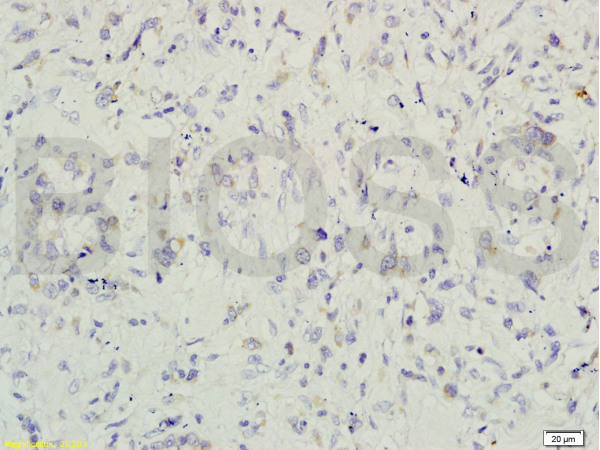
Anti-GREM1 AntibodyA43148
ApplicationsWestern Blot
ReactivityHuman, Mouse
- SizePrice
Product group Antibodies

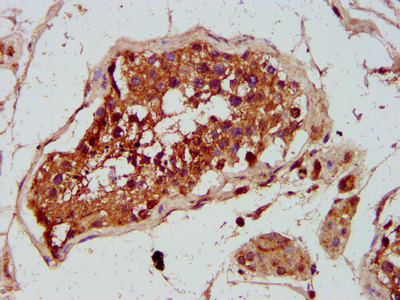
Gremlin Polyclonal AntibodyBS-1475R
ApplicationsImmunoFluorescence, Western Blot, ELISA, ImmunoCytoChemistry, ImmunoHistoChemistry, ImmunoHistoChemistry Frozen, ImmunoHistoChemistry Paraffin
ReactivityBovine, Canine, Chicken, Equine, Human, Mouse, Rabbit, Rat
TargetGREM1
- SizePrice
Product group Antibodies

GREM1 AntibodyCSB-PA009892LA01HU
ApplicationsELISA, ImmunoHistoChemistry
ReactivityHuman
TargetGREM1
- SizePrice
Product group Antibodies

ApplicationsImmunoPrecipitation, Western Blot, ImmunoCytoChemistry, ImmunoHistoChemistry
ReactivityMouse, Rat
TargetGREM1
- SizePrice
Product group Antibodies

GREM1 / Gremlin-1 AntibodyLS-C404029
ApplicationsWestern Blot, ELISA
ReactivityHuman, Mouse, Rat
TargetGREM1
- SizePrice
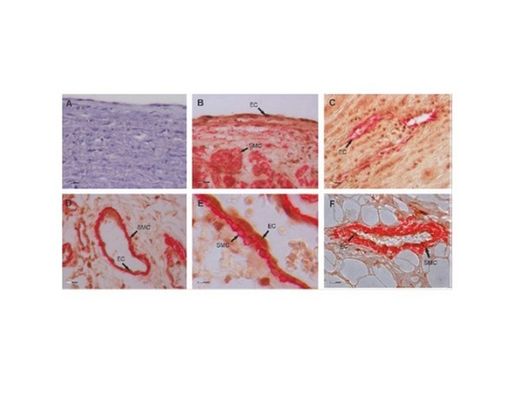
Product group Antibodies

Gremlin 1 antibodyGTX03394
ApplicationsImmunoHistoChemistry, ImmunoHistoChemistry Paraffin
ReactivityHuman
TargetGREM1
- SizePrice

Product group Antibodies

Anti-Gremlin 1/GREM1 Antibody Picoband(r)PB9626-CARRIER-FREE
ApplicationsWestern Blot
ReactivityHamster, Human, Mouse, Rat
TargetGREM1
- SizePrice