

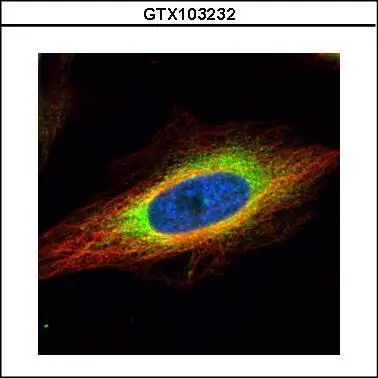
Confocal immunofluorescence analysis (Olympus FV10i) of paraformaldehyde-fixed HeLa, using GRP94(GTX103232) antibody (green) at 1:500 dilution. Alpha-tubulin filaments were labeled with GTX11304 (red) at 1:2500.
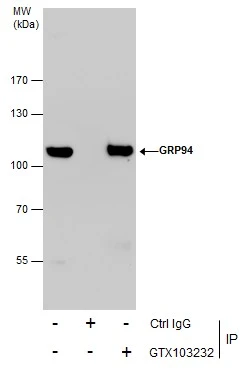
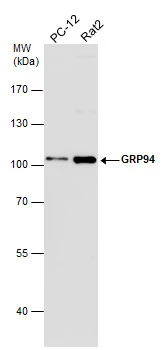
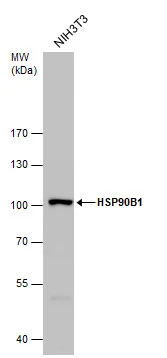
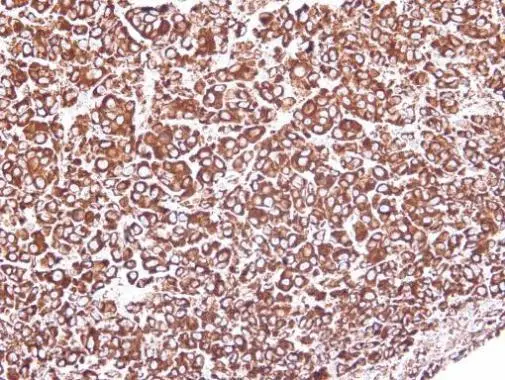
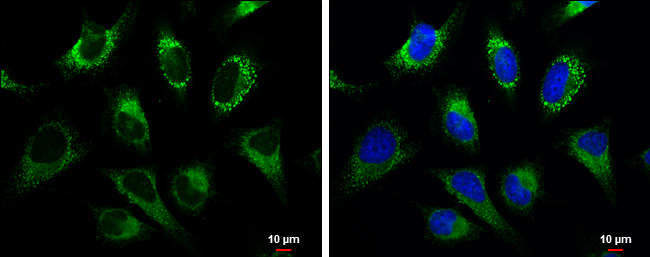
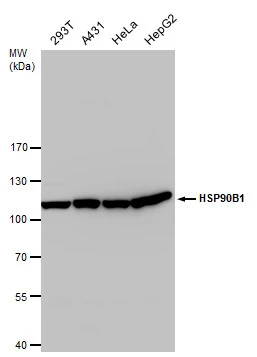
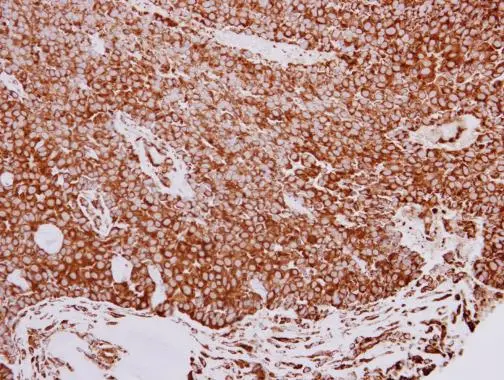
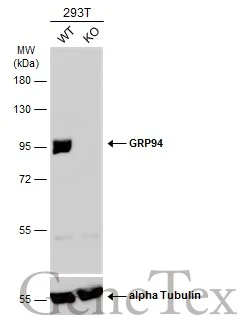
Confocal immunofluorescence analysis (Olympus FV10i) of paraformaldehyde-fixed HeLa, using GRP94(GTX103232) antibody (green) at 1:500 dilution. Alpha-tubulin filaments were labeled with GTX11304 (red) at 1:2500.
GRP94 antibody
GTX103232

ApplicationsImmunoFluorescence, ImmunoPrecipitation, Western Blot, ImmunoCytoChemistry, ImmunoHistoChemistry, ImmunoHistoChemistry Paraffin
Product group Antibodies
ReactivityHuman, Mouse, Rat
TargetHSP90B1
Overview
- SupplierGeneTex
- Product NameGRP94 antibody
- Delivery Days Customer9
- Application Supplier NoteWB: 1:500-1:3000. ICC/IF: 1:100-1:1000. IHC-P: 1:100-1:1000. IP: 1:100-1:500. *Optimal dilutions/concentrations should be determined by the researcher.Not tested in other applications.
- ApplicationsImmunoFluorescence, ImmunoPrecipitation, Western Blot, ImmunoCytoChemistry, ImmunoHistoChemistry, ImmunoHistoChemistry Paraffin
- CertificationResearch Use Only
- ClonalityPolyclonal
- Concentration1 mg/ml
- ConjugateUnconjugated
- Gene ID7184
- Target nameHSP90B1
- Target descriptionheat shock protein 90 beta family member 1
- Target synonymsECGP, GP96, GRP94, HEL-S-125m, HEL35, TRA1, endoplasmin, 94 kDa glucose-regulated protein, endothelial cell (HBMEC) glycoprotein, epididymis luminal protein 35, epididymis secretory sperm binding protein Li 125m, heat shock protein 90 kDa beta member 1, heat shock protein 90kDa beta (Grp94), member 1, heat shock protein 90kDa beta family member 1, heat shock protein family C member 4, stress-inducible tumor rejection antigen gp96, tumor rejection antigen (gp96) 1, tumor rejection antigen 1
- HostRabbit
- IsotypeIgG
- Protein IDP14625
- Protein NameEndoplasmin
- Scientific DescriptionHSP90 proteins are highly conserved molecular chaperones that have key roles in signal transduction, protein folding, protein degradation, and morphologic evolution. HSP90 proteins normally associate with other cochaperones and play important roles in folding newly synthesized proteins or stabilizing and refolding denatured proteins after stress. HSP90B1 is an endoplasmic reticulum HSP90 protein. Other HSP90 proteins are found in cytosol (see HSP90AA1; MIM 140571) and mitochondria (TRAP1; MIM 606219) (Chen et al., 2005 [PubMed 16269234]).[supplied by OMIM]
- ReactivityHuman, Mouse, Rat
- Storage Instruction-20°C or -80°C,2°C to 8°C
- UNSPSC41116161
Datasheet
Related products
Product group Antibodies

Anti-GRP94 AntibodyA96057
ApplicationsImmunoFluorescence, Western Blot, ELISA, ImmunoHistoChemistry
ReactivityHuman, Mouse
- SizePrice
Product group Antibodies

Anti-HSP90B1 Antibody144-00989
ApplicationsImmunoFluorescence, Western Blot
ReactivityHuman, Mouse, Rat
TargetHSP90B1
- SizePrice

Product group Antibodies

Anti-HSP90B1 AntibodyAMAB91019
ApplicationsWestern Blot, ImmunoCytoChemistry, ImmunoHistoChemistry
ReactivityHuman
TargetHSP90B1
- SizePrice
Product group Antibodies
References

GRP94 Polyclonal AntibodyBS-0194R
ApplicationsFlow Cytometry, ImmunoFluorescence, Western Blot, ELISA, ImmunoCytoChemistry, ImmunoHistoChemistry, ImmunoHistoChemistry Frozen, ImmunoHistoChemistry Paraffin
ReactivityBovine, Canine, Chicken, Equine, Human, Mouse, Porcine, Rabbit, Rat
TargetHSP90B1
- SizePrice
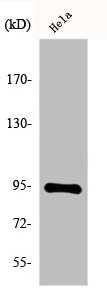
Product group Antibodies

HSP90B1 AntibodyCSB-PA002347
ApplicationsImmunoFluorescence, Western Blot, ELISA, ImmunoHistoChemistry
ReactivityHuman, Mouse
TargetHSP90B1
- SizePrice
Product group Antibodies

Goat anti-GPR94 / TRA1EB07290
ApplicationsFlow Cytometry, ImmunoFluorescence, Western Blot, ELISA, ImmunoHistoChemistry
ReactivityBovine, Canine, Human, Mouse, Porcine, Rat, Zebra Fish
TargetHSP90B1
- SizePrice
Product group Antibodies

Hsp90B1 Polyclonal AntibodyCAC07049
ApplicationsImmunoFluorescence, Western Blot, ELISA, ImmunoHistoChemistry
TargetHSP90B1
- SizePrice
Product group Antibodies

HSP90B1 / GP96 / GRP94 AntibodyLS-C400779
ApplicationsWestern Blot, ELISA, ImmunoHistoChemistry
ReactivityHuman, Mouse, Rat
TargetHSP90B1
- SizePrice
![ICC/IF analysis of C6 cells using GTX22791 GRP94 antibody [9G10]. Cells were probed without (right) or with(left) an antibody. Green : Primary antibody Blue : Nuclei Red : Actin Fixation : formaldehyde Dilution : 1:100 overnight at 4 oC](https://www.genetex.com/upload/website/prouct_img/normal/GTX22791/GTX22791_452_ICC-IF_w_23060620_104.webp)
Product group Antibodies
GRP94 antibody [9G10]GTX22791
ApplicationsImmunoFluorescence, ImmunoPrecipitation, Western Blot, ImmunoCytoChemistry, ImmunoHistoChemistry, ImmunoHistoChemistry Paraffin
ReactivityBovine, Chicken, Hamster, Human, Mouse, Porcine, Rat, Xenopus
TargetHSP90B1
- SizePrice
![Immunoprecipitation of GRP94 protein from HeLa whole cell extracts using 5 μg of GRP94 antibody [N1N3] (GTX103203). Western blot analysis was performed using GRP94 antibody [N1N3] (GTX103203). EasyBlot anti-Rabbit IgG (GTX221666-01) was used as a secondary reagent.](https://www.genetex.com/upload/website/prouct_img/normal/GTX103203/GTX103203_40016_20150522_IP_w_23060119_571.webp)
Product group Antibodies
GRP94 antibody [N1N3]GTX103203
ApplicationsImmunoFluorescence, ImmunoPrecipitation, Western Blot, ImmunoCytoChemistry, ImmunoHistoChemistry, ImmunoHistoChemistry Paraffin
ReactivityHuman, Mouse
TargetHSP90B1
- SizePrice