

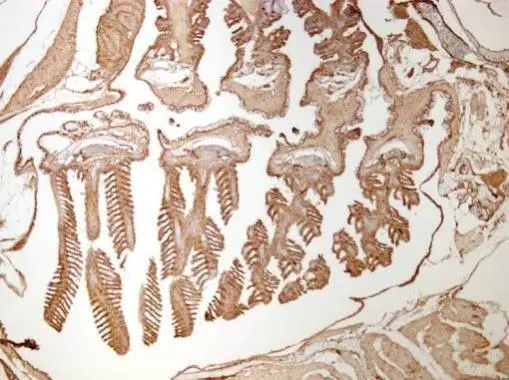
Immunohistochemical analysis of paraffin-embedded zebrafish tissue, using HDAC1 antibody (GTX100513) at 1:300 dilution.
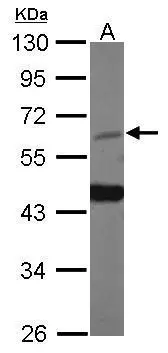
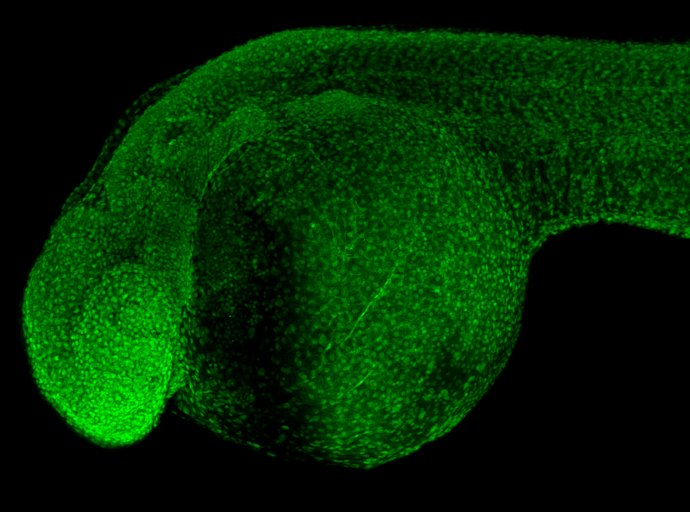
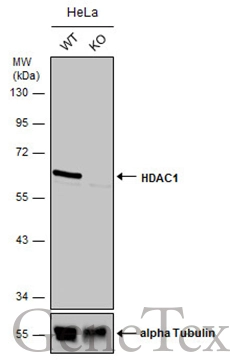
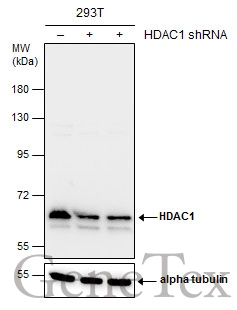

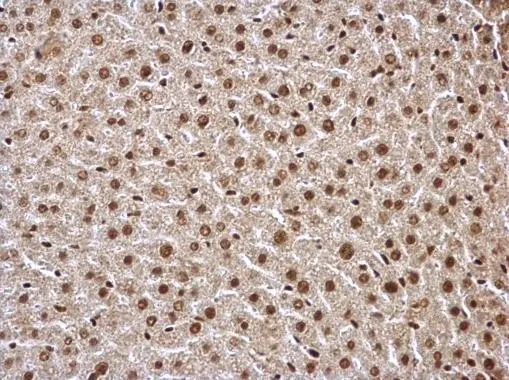
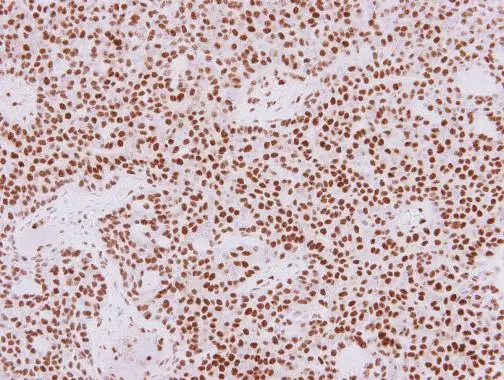
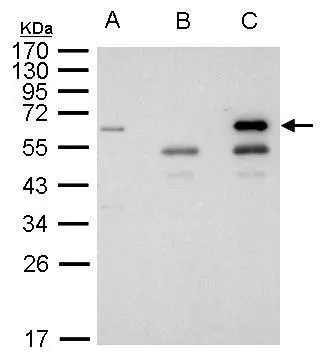
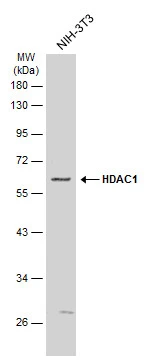
Immunohistochemical analysis of paraffin-embedded zebrafish tissue, using HDAC1 antibody (GTX100513) at 1:300 dilution.
HDAC1 antibody
GTX100513

ApplicationsImmunoFluorescence, ImmunoPrecipitation, Western Blot, ChIP Chromatin ImmunoPrecipitation, ImmunoCytoChemistry, ImmunoHistoChemistry, ImmunoHistoChemistry Frozen, ImmunoHistoChemistry Paraffin
Product group Antibodies
ReactivityHuman, Mouse, Rat, Zebra Fish
TargetHDAC1
Overview
- SupplierGeneTex
- Product NameHDAC1 antibody
- Delivery Days Customer9
- Application Supplier NoteWB: 1:500-1:3000. ICC/IF: 1:100-1:1000. IHC-P: 1:100-1:1000. IP: 1:100-1:500. *Optimal dilutions/concentrations should be determined by the researcher.Not tested in other applications.
- ApplicationsImmunoFluorescence, ImmunoPrecipitation, Western Blot, ChIP Chromatin ImmunoPrecipitation, ImmunoCytoChemistry, ImmunoHistoChemistry, ImmunoHistoChemistry Frozen, ImmunoHistoChemistry Paraffin
- CertificationResearch Use Only
- ClonalityPolyclonal
- Concentration1 mg/ml
- ConjugateUnconjugated
- Gene ID3065
- Target nameHDAC1
- Target descriptionhistone deacetylase 1
- Target synonymsGON-10, HD1, KDAC1, RPD3, RPD3L1, histone deacetylase 1, protein deacetylase HDAC1, protein deacylase HDAC1, protein decrotonylase HDAC1, reduced potassium dependency, yeast homolog-like 1
- HostRabbit
- IsotypeIgG
- Protein IDQ13547
- Protein NameHistone deacetylase 1
- Scientific DescriptionHistone acetylation and deacetylation, catalyzed by multisubunit complexes, play a key role in the regulation of eukaryotic gene expression. The protein encoded by this gene belongs to the histone deacetylase/acuc/apha family and is a component of the histone deacetylase complex. It also interacts with retinoblastoma tumor-suppressor protein and this complex is a key element in the control of cell proliferation and differentiation. Together with metastasis-associated protein-2, it deacetylates p53 and modulates its effect on cell growth and apoptosis. [provided by RefSeq]
- ReactivityHuman, Mouse, Rat, Zebra Fish
- Storage Instruction-20°C or -80°C,2°C to 8°C
- UNSPSC41116161
Datasheet
Related products
Product group Antibodies

Anti-HDAC1 AntibodyA84192
ApplicationsImmunoFluorescence, Western Blot, ChIP Chromatin ImmunoPrecipitation, ELISA
ReactivityHuman, Mouse
- SizePrice
Product group Antibodies

ApplicationsImmunoFluorescence, Western Blot, ELISA, ImmunoCytoChemistry, ImmunoHistoChemistry
- SizePrice
Product group Antibodies

Anti-HDAC1 Antibody144-00238
ApplicationsImmunoFluorescence, ImmunoPrecipitation, Western Blot, ImmunoHistoChemistry
ReactivityHuman, Mouse, Rat
TargetHDAC1
- SizePrice

Product group Antibodies

Anti-HDAC1 AntibodyAMAB90781
ApplicationsWestern Blot, ImmunoCytoChemistry, ImmunoHistoChemistry
ReactivityHuman, Mouse, Rat
TargetHDAC1
- SizePrice

Product group Antibodies

Anti-HDAC1 Antibody Picoband(r)A00256-4-CARRIER-FREE
ApplicationsFlow Cytometry, Western Blot, ImmunoHistoChemistry
ReactivityHuman
TargetHDAC1
- SizePrice
Product group Antibodies

HDAC1 AntibodyCSB-PA002877
ApplicationsWestern Blot, ELISA, ImmunoHistoChemistry
ReactivityHuman, Mouse, Rat
TargetHDAC1
- SizePrice
Product group Antibodies

ApplicationsImmunoFluorescence, Western Blot, ChIP Chromatin ImmunoPrecipitation, ELISA
ReactivityCanine, Human, Mouse, Rat
TargetHDAC1
- SizePrice
Product group Antibodies

Hdac1 Polyclonal AntibodyCAC07026
ApplicationsImmunoFluorescence, ChIP Chromatin ImmunoPrecipitation, ELISA, ImmunoHistoChemistry
TargetHDAC1
- SizePrice
Product group Antibodies
References

HDAC1 Polyclonal AntibodyBS-1414R
ApplicationsFlow Cytometry, ImmunoFluorescence, Western Blot, ELISA, ImmunoCytoChemistry, ImmunoHistoChemistry, ImmunoHistoChemistry Frozen, ImmunoHistoChemistry Paraffin
ReactivityBovine, Canine, Guinea Pig, Human, Mouse, Porcine, Rat, Sheep
TargetHDAC1
- SizePrice
Product group Antibodies
References
HDAC1 antibodyGTX27028
ApplicationsImmunoFluorescence, ImmunoPrecipitation, Western Blot, ImmunoCytoChemistry, ImmunoHistoChemistry, ImmunoHistoChemistry Paraffin
ReactivityHuman, Mouse, Rat
TargetHDAC1
- SizePrice