

HSPA1L Antibody, Biotin conjugated
CSB-PA010823HD01HU

ApplicationsELISA
Product group Antibodies
ReactivityHuman
TargetHSPA1L
Overview
- SupplierCusabio
- Product NameHSPA1L Antibody, Biotin conjugated
- Delivery Days Customer20
- ApplicationsELISA
- CertificationResearch Use Only
- ClonalityPolyclonal
- ConjugateBiotin
- Gene ID3305
- Target nameHSPA1L
- Target descriptionheat shock protein family A (Hsp70) member 1 like
- Target synonymsHSP70-1L, HSP70-HOM, HSP70T, hum70t, heat shock 70 kDa protein 1-like, epididymis secretory sperm binding protein, heat shock 10kDa protein 1-like, heat shock 70 kDa protein 1-Hom, heat shock 70 kDa protein 1L, heat shock 70kD protein-like 1, heat shock 70kDa protein 1-like, heat shock protein family A member 1L
- HostRabbit
- IsotypeIgG
- Protein IDP34931
- Protein NameHeat shock 70 kDa protein 1-like
- Scientific DescriptionMolecular chaperone implicated in a wide variety of cellular processes, including protection of the proteome from stress, folding and transport of newly synthesized polypeptides, activation of proteolysis of misfolded proteins and the formation and dissociation of protein complexes. Plays a pivotal role in the protein quality control system, ensuring the correct folding of proteins, the re-folding of misfolded proteins and controlling the targeting of proteins for subsequent degradation. This is achieved through cycles of ATP binding, ATP hydrolysis and ADP release, mediated by co-chaperones. The affinity for polypeptides is regulated by its nucleotide bound state. In the ATP-bound form, it has a low affinity for substrate proteins. However, upon hydrolysis of the ATP to ADP, it undergoes a conformational change that increases its affinity for substrate proteins. It goes through repeated cycles of ATP hydrolysis and nucleotide exchange, which permits cycles of substrate binding and release (PubMed:26865365). Positive regulator of PRKN translocation to damaged mitochondria (PubMed:24270810).
- ReactivityHuman
- Storage Instruction-20°C or -80°C
- UNSPSC41116161
Related products

Product group Antibodies

Anti-HSPA1L Antibody Picoband(r)A04286-3-CARRIER-FREE
ApplicationsFlow Cytometry, ImmunoFluorescence, Western Blot, ELISA, ImmunoCytoChemistry, ImmunoHistoChemistry
ReactivityHuman, Mouse, Rat
TargetHSPA1L
- SizePrice
Product group Antibodies

Anti-HSPA1L Antibody144-01856
ApplicationsImmunoFluorescence, Western Blot
ReactivityHuman, Mouse, Rat
TargetHSPA1L
- SizePrice
Product group Antibodies

ApplicationsFlow Cytometry
TargetHSPA1L
- SizePrice

Product group Antibodies
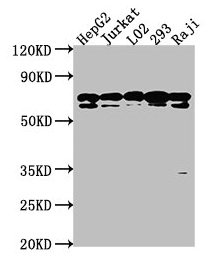
HSPA1L AntibodyCSB-PA010823HA01HU
ApplicationsImmunoFluorescence, Western Blot, ELISA, ImmunoHistoChemistry
ReactivityHuman
TargetHSPA1L
- SizePrice

Product group Antibodies

Anti-HSPA1L AntibodyHPA043285
ApplicationsWestern Blot, ImmunoHistoChemistry
ReactivityHuman, Mouse, Rat
TargetHSPA1L
- SizePrice
Product group Antibodies

HSPA1L AntibodyLS-C331734
ApplicationsImmunoFluorescence, Western Blot, ImmunoHistoChemistry
ReactivityHuman, Mouse, Rat
TargetHSPA1L
- SizePrice
![Mouse tissue extract (50 μg) was separated by 7.5% SDS-PAGE, and the membrane was blotted with HSP70 1L antibody [C1C3] (GTX105164) diluted at 1:5000. The HRP-conjugated anti-rabbit IgG antibody (GTX213110-01) was used to detect the primary antibody.](https://www.genetex.com/upload/website/prouct_img/normal/GTX105164/GTX105164_40002_20160310_WB_M_testis_w_23060120_988.webp)
Product group Antibodies

HSP70 1L antibody [C1C3]GTX105164
ApplicationsImmunoFluorescence, Western Blot, ImmunoCytoChemistry
ReactivityHuman, Mouse, Rat
TargetHSPA1L
- SizePrice
Product group Antibodies

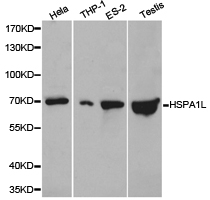
Anti-HSPA1L AntibodyA29883
ApplicationsImmunoFluorescence, Western Blot, ImmunoHistoChemistry
ReactivityHuman, Mouse, Rat
- SizePrice