

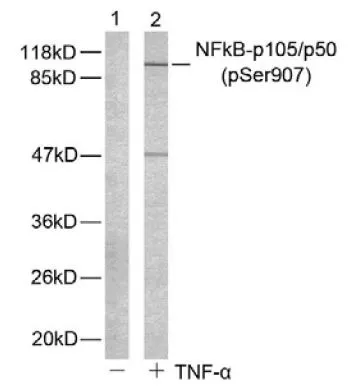
WB analysis of HeLa cells untreated or treated with TNF-α lysates using GTX78998 NFkB p105 (phospho Ser907) antibody.
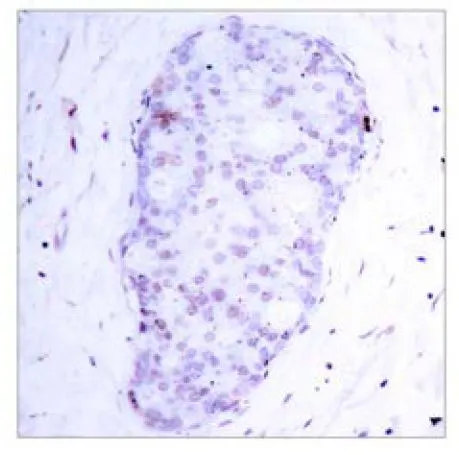
WB analysis of HeLa cells untreated or treated with TNF-α lysates using GTX78998 NFkB p105 (phospho Ser907) antibody.
NFkB p105 (phospho Ser907) antibody
GTX78998

ApplicationsWestern Blot, ImmunoHistoChemistry, ImmunoHistoChemistry Paraffin
Product group Antibodies
ReactivityHuman
TargetNFKB1
Overview
- SupplierGeneTex
- Product NameNFkB p105 (phospho Ser907) antibody
- Delivery Days Customer9
- Application Supplier NoteWB: 1:500 - 1:1000. IHC-P: 1:50 - 1:100. *Optimal dilutions/concentrations should be determined by the researcher.Not tested in other applications.
- ApplicationsWestern Blot, ImmunoHistoChemistry, ImmunoHistoChemistry Paraffin
- CertificationResearch Use Only
- ClonalityPolyclonal
- ConjugateUnconjugated
- Gene ID4790
- Target nameNFKB1
- Target descriptionnuclear factor kappa B subunit 1
- Target synonymsCVID12, EBP-1, KBF1, NF-kB, NF-kB1, NF-kappa-B1, NF-kappaB, NF-kappabeta, NFKB-p105, NFKB-p50, NFkappaB, nuclear factor NF-kappa-B p105 subunit, DNA-binding factor KBF1, nuclear factor NF-kappa-B p50 subunit, nuclear factor kappa-B DNA binding subunit, nuclear factor of kappa light polypeptide gene enhancer in B-cells 1
- HostRabbit
- IsotypeIgG
- Protein IDP19838
- Protein NameNuclear factor NF-kappa-B p105 subunit
- Scientific DescriptionThis gene encodes a 105 kD protein which can undergo cotranslational processing by the 26S proteasome to produce a 50 kD protein. The 105 kD protein is a Rel protein-specific transcription inhibitor and the 50 kD protein is a DNA binding subunit of the NF-kappa-B (NFKB) protein complex. NFKB is a transcription regulator that is activated by various intra- and extra-cellular stimuli such as cytokines, oxidant-free radicals, ultraviolet irradiation, and bacterial or viral products. Activated NFKB translocates into the nucleus and stimulates the expression of genes involved in a wide variety of biological functions. Inappropriate activation of NFKB has been associated with a number of inflammatory diseases while persistent inhibition of NFKB leads to inappropriate immune cell development or delayed cell growth. Alternative splicing results in multiple transcript variants encoding different isoforms, at least one of which is proteolytically processed. [provided by RefSeq, Feb 2016]
- ReactivityHuman
- Storage Instruction-20°C or -80°C,2°C to 8°C
- UNSPSC41116161
Datasheet
Related products
Product group Antibodies

Anti-NFKB1 AntibodyA39842
ApplicationsImmunoFluorescence, Western Blot
ReactivityHuman, Mouse, Rat
- SizePrice
Product group Antibodies

Anti-NFKB1 [RAB-C534]Ab01818-1.1
ApplicationsFlow Cytometry
ReactivityHuman
TargetNFKB1
- SizePrice
Product group Antibodies

Anti-NFKB1 Antibody144-06667
ApplicationsImmunoFluorescence, Western Blot, ImmunoHistoChemistry
ReactivityHuman, Mouse
TargetNFKB1
- SizePrice
Product group Antibodies

NFKB1 / NF-Kappa-B AntibodyLS-C831717
ApplicationsELISA, ImmunoHistoChemistry
ReactivityHuman
TargetNFKB1
- SizePrice
Product group Antibodies
References

NFKB1 Polyclonal AntibodyBS-1194R
ApplicationsImmunoFluorescence, Western Blot, ELISA, ImmunoCytoChemistry, ImmunoHistoChemistry, ImmunoHistoChemistry Frozen, ImmunoHistoChemistry Paraffin
ReactivityBovine, Canine, Chicken, Human, Mouse, Porcine, Rat
TargetNFKB1
- SizePrice
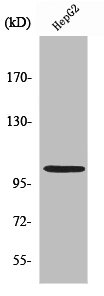
Product group Antibodies

NFKB1 AntibodyCSB-PA003430
ApplicationsImmunoPrecipitation, Western Blot, ELISA, ImmunoHistoChemistry
ReactivityHuman
TargetNFKB1
- SizePrice
Product group Antibodies

NFKB1 Polyclonal AntibodyCAC14122
ApplicationsImmunoFluorescence, Western Blot, ChIP Chromatin ImmunoPrecipitation, ELISA, ImmunoHistoChemistry
TargetNFKB1
- SizePrice
![Western blot of HeLa cell extract.? The membrane was blocked in 5% dry milk for 2 h.? After washing, a:1:1,000 dilution of the primary antibody was added to the membrane and incubated for 2 h.? Washes with buffer were performed 4 times for 5' each.? The western blot was incubated with secondary antibody (HRP Goat-a-Rabbit IgG [H&L]) diluted 1:2,000 for 1 h.?? Washes with TBS preceded color development.](https://www.genetex.com/upload/website/prouct_img/normal/GTX27549/GTX27549_20160330_WB_w_23060722_566.webp)
Product group Antibodies
References
NFkB p105/p50 antibodyGTX27549
ApplicationsWestern Blot, ELISA, Other Application
ReactivityHuman
TargetNFKB1
- SizePrice
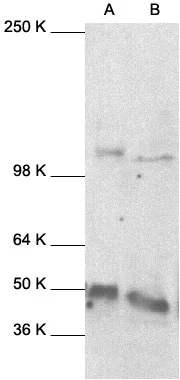
Product group Antibodies
NFkB p105/p50 antibodyGTX27971
ApplicationsImmunoPrecipitation, Western Blot, ImmunoHistoChemistry
ReactivityHuman, Mouse, Rat
TargetNFKB1
- SizePrice
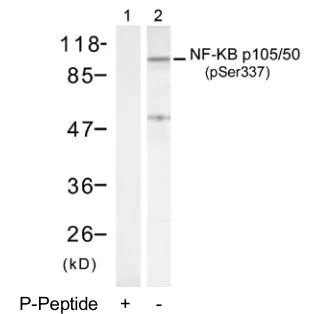
Product group Antibodies
ApplicationsWestern Blot, ImmunoHistoChemistry, ImmunoHistoChemistry Paraffin
ReactivityHuman
TargetNFKB1
- SizePrice