

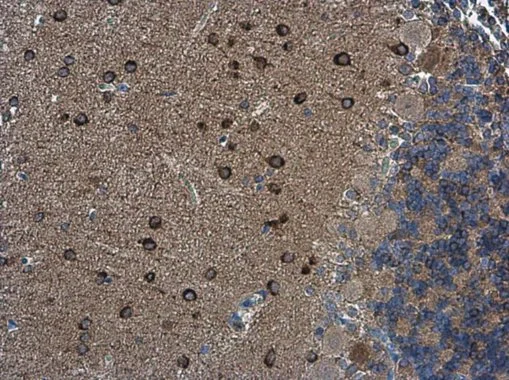
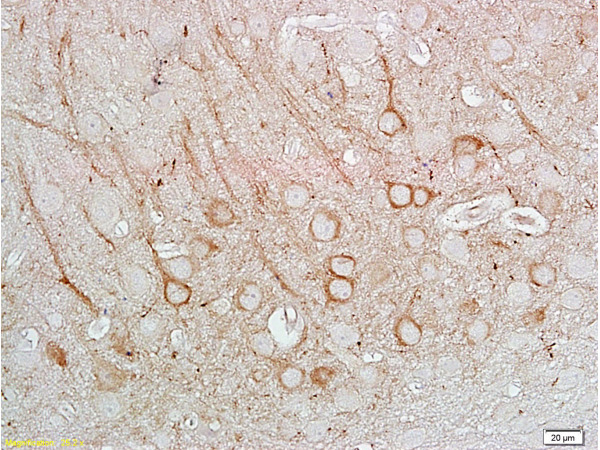
nNOS antibody detects nNOS protein at cytoplasm in rat brain by immunohistochemical analysis. Sample: Paraffin-embedded rat brain. nNOS antibody (GTX133407) diluted at 1:500.
Antigen Retrieval: Citrate buffer, pH 6.0, 10 min
![nNOS antibody detects nNOS protein by immunofluorescent analysis. Sample: DIV9 rat E18 primary cortical neuron cells were fixed in 4% paraformaldehyde at RT for 15 min. Green: nNOS stained by nNOS antibody (GTX133407) diluted at 1:500. Red: beta Tubulin 3/ Tuj1, stained by beta Tubulin 3/ Tuj1 antibody [GT1338] (GTX631831) diluted at 1:500. Blue: Fluoroshield with DAPI (GTX30920).](https://www.genetex.com/upload/website/prouct_img/normal/GTX133407/GTX133407_42725_20171115_ICC_IF_R_w_23060523_117.webp "nNOS antibody detects nNOS protein by immunofluorescent analysis. Sample: DIV9 rat E18 primary cortical neuron cells were fixed in 4% paraformaldehyde at RT for 15 min. Green: nNOS stained by nNOS antibody (GTX133407) diluted at 1:500. Red: beta Tubulin 3/ Tuj1, stained by beta Tubulin 3/ Tuj1 antibody [GT1338] (GTX631831) diluted at 1:500. Blue: Fluoroshield with DAPI (GTX30920).")
![nNOS antibody detects nNOS protein expression by immunohistochemical analysis. Sample: Frozen-sectioned adult mouse cerebellum. Green: nNOS protein stained by nNOS antibody (GTX133407) diluted at 1:250. Red: NF-H, stained by NF-H antibody [GT114] (GTX634289) diluted at 1:500. Blue: Fluoroshield with DAPI (GTX30920).
Antigen Retrieval: Citrate buffer, pH 6.0, 10 min](https://www.genetex.com/upload/website/prouct_img/normal/GTX133407/GTX133407_42725_20170831_IHC-Fr_M_w_23060523_400.webp "nNOS antibody detects nNOS protein expression by immunohistochemical analysis. Sample: Frozen-sectioned adult mouse cerebellum. Green: nNOS protein stained by nNOS antibody (GTX133407) diluted at 1:250. Red: NF-H, stained by NF-H antibody [GT114] (GTX634289) diluted at 1:500. Blue: Fluoroshield with DAPI (GTX30920).
Antigen Retrieval: Citrate buffer, pH 6.0, 10 min")
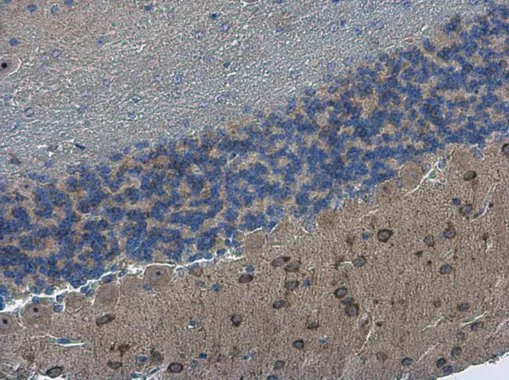
nNOS antibody detects nNOS protein at cytoplasm in rat brain by immunohistochemical analysis. Sample: Paraffin-embedded rat brain. nNOS antibody (GTX133407) diluted at 1:500.
Antigen Retrieval: Citrate buffer, pH 6.0, 10 min
nNOS antibody
GTX133407

ApplicationsImmunoFluorescence, Western Blot, ImmunoCytoChemistry, ImmunoHistoChemistry, ImmunoHistoChemistry Frozen, ImmunoHistoChemistry Paraffin
Product group Antibodies
ReactivityHuman, Mouse, Rat, Zebra Fish
TargetNOS1
Overview
- SupplierGeneTex
- Product NamenNOS antibody
- Delivery Days Customer9
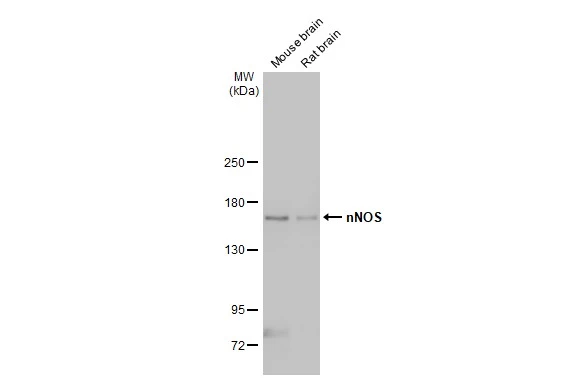
- Application Supplier NoteWB: 1:500-1:3000. ICC/IF: 1:100-1:1000. IHC-P: 1:100-1:1000. IHC-Fr: 1:100-1:1000. *Optimal dilutions/concentrations should be determined by the researcher.Not tested in other applications.
- ApplicationsImmunoFluorescence, Western Blot, ImmunoCytoChemistry, ImmunoHistoChemistry, ImmunoHistoChemistry Frozen, ImmunoHistoChemistry Paraffin
- CertificationResearch Use Only
- ClonalityPolyclonal
- Concentration0.79 mg/ml
- ConjugateUnconjugated
- Gene ID4842
- Target nameNOS1
- Target descriptionnitric oxide synthase 1
- Target synonymsIHPS1, N-NOS, NC-NOS, NOS, bNOS, nNOS, nitric oxide synthase 1, NOS type I, constitutive NOS, neuronal NOS, nitric oxide synthase 1 (neuronal), peptidyl-cysteine S-nitrosylase NOS1
- HostRabbit
- IsotypeIgG
- Protein IDP29475
- Protein NameNitric oxide synthase 1
- Scientific DescriptionNitric oxide (NO) is a messenger molecule with diverse functions throughout the body. In the brain and peripheral nervous system, NO displays many properties of a neurotransmitter; it is implicated in neurotoxicity associated with stroke and neurodegenerative diseases, neural regulation of smooth muscle, including peristalsis, and penile erection. NO is also responsible for endothelium-derived relaxing factor activity regulating blood pressure. In macrophages, NO mediates tumoricidal and bactericidal actions, as indicated by the fact that inhibitors of NO synthase (NOS) block these effects. Neuronal NOS and macrophage NOS (MIM 163730) are distinct isoforms (Lowenstein et al., 1992 [PubMed 1379716]). Both the neuronal and the macrophage forms are unusual among oxidative enzymes in requiring several electron donors: FAD (see MIM 610595), flavin mononucleotide (FMN), NADPH, and tetrahydrobiopterin.[supplied by OMIM]
- ReactivityHuman, Mouse, Rat, Zebra Fish
- Storage Instruction-20°C or -80°C,2°C to 8°C
- UNSPSC41116161
Datasheet
Related products

Product group Antibodies

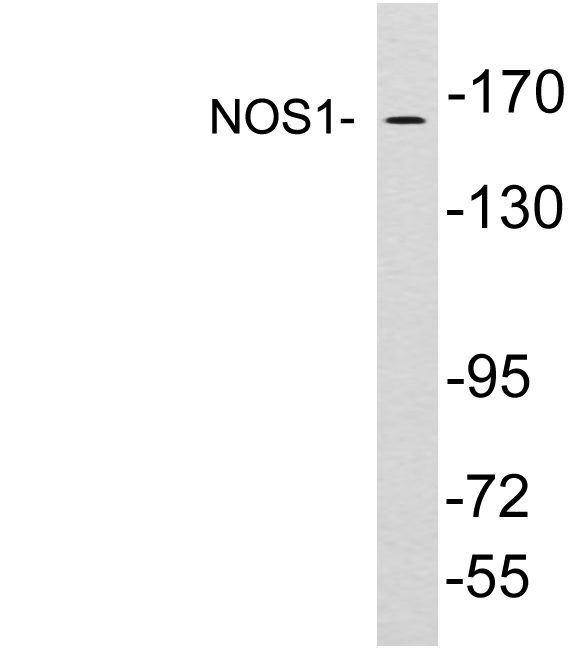
Anti-NOS1 AntibodyA101356
ApplicationsWestern Blot, ELISA
ReactivityHuman
- SizePrice

Product group Antibodies

Anti-nNOS (neuronal)/NOS1 Antibody Picoband(r)A01070-2-CARRIER-FREE
ApplicationsFlow Cytometry, Western Blot, ELISA
ReactivityHuman, Mouse, Rat
TargetNOS1
- SizePrice
Product group Antibodies

Anti-Rat NOS1 Antibody144-01485
ApplicationsWestern Blot
ReactivityHuman, Rat
TargetNOS1
- SizePrice
Product group Antibodies

NOS1 / nNOS AntibodyLS-C760906
ApplicationsWestern Blot
ReactivityHuman, Mouse, Rat
TargetNOS1
- SizePrice
Product group Antibodies
References

nNos Polyclonal AntibodyBS-0156R
ApplicationsImmunoFluorescence, Western Blot, ELISA, ImmunoCytoChemistry, ImmunoHistoChemistry, ImmunoHistoChemistry Frozen, ImmunoHistoChemistry Paraffin
ReactivityHuman, Mouse, Rabbit, Rat
TargetNOS1
- SizePrice
Product group Antibodies

NOS1 AntibodyCSB-PA003463
ApplicationsImmunoFluorescence, Western Blot, ELISA, ImmunoHistoChemistry
ReactivityHuman, Mouse, Rat
TargetNOS1
- SizePrice
Product group Antibodies
References

Goat anti-NOS1EB05259
ApplicationsFlow Cytometry, ImmunoFluorescence, ELISA, ImmunoHistoChemistry
ReactivityBovine, Canine, Human, Mouse, Rat
TargetNOS1
- SizePrice
Product group Antibodies

NOS1 Polyclonal AntibodyCAC14656
ApplicationsImmunoFluorescence, Western Blot, ELISA
ReactivityMouse
TargetNOS1
- SizePrice
Product group Antibodies
nNOS antibodyGTX132857
ApplicationsWestern Blot
ReactivityHuman, Mouse, Rat
TargetNOS1
- SizePrice