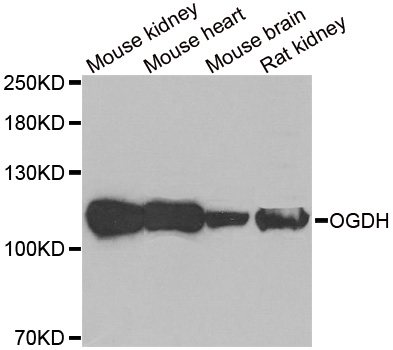
WB analysis of various sample lysates using GTX33374 OGDH antibody. The signal was developed with ECL plus-Enhanced. Dilution : 1:1000 Loading : 25μg per lane
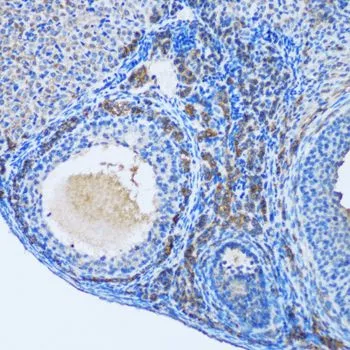
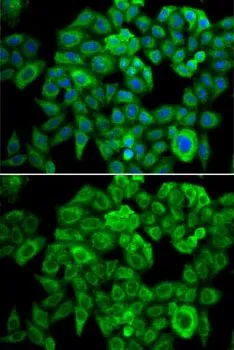
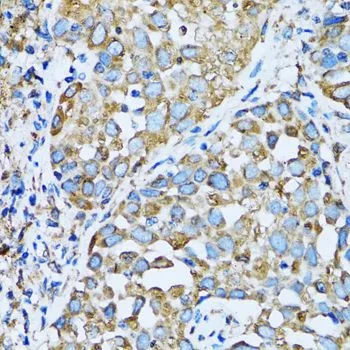
WB analysis of various sample lysates using GTX33374 OGDH antibody. The signal was developed with ECL plus-Enhanced. Dilution : 1:1000 Loading : 25μg per lane
OGDH antibody
GTX33374

ApplicationsImmunoFluorescence, Western Blot, ImmunoCytoChemistry, ImmunoHistoChemistry, ImmunoHistoChemistry Paraffin
Product group Antibodies
ReactivityHuman, Mouse, Rat
TargetOGDH
Overview
- SupplierGeneTex
- Product NameOGDH antibody
- Delivery Days Customer9
- Application Supplier NoteWB: 1:500 - 1:2000. ICC/IF: 1:10 - 1:100. IHC-P: 1:50 - 1:200. *Optimal dilutions/concentrations should be determined by the researcher.Not tested in other applications.
- ApplicationsImmunoFluorescence, Western Blot, ImmunoCytoChemistry, ImmunoHistoChemistry, ImmunoHistoChemistry Paraffin
- CertificationResearch Use Only
- ClonalityPolyclonal
- ConjugateUnconjugated
- Gene ID4967
- Target nameOGDH
- Target descriptionoxoglutarate dehydrogenase
- Target synonymsAKGDH, E1k, E1o, HsOGDH, KGD1, OGDC, OGDH-E1, OGDH2, OGDHD, 2-oxoglutarate dehydrogenase complex component E1, 2-oxoglutarate dehydrogenase, mitochondrial, OGDC-E1, alpha-KGDH-E1, oxoglutarate (alpha-ketoglutarate) dehydrogenase (lipoamide), oxoglutarate decarboxylase, oxoglutarate dehydrogenase (succinyl-transferring), testicular tissue protein Li 131, thiamine diphosphate (ThDP)-dependent 2-oxoglutarate dehydrogenase
- HostRabbit
- IsotypeIgG
- Protein IDQ02218
- Protein Name2-oxoglutarate dehydrogenase complex component E1
- Scientific DescriptionThis gene encodes one subunit of the 2-oxoglutarate dehydrogenase complex. This complex catalyzes the overall conversion of 2-oxoglutarate (alpha-ketoglutarate) to succinyl-CoA and CO(2) during the Krebs cycle. The protein is located in the mitochondrial matrix and uses thiamine pyrophosphate as a cofactor. A congenital deficiency in 2-oxoglutarate dehydrogenase activity is believed to lead to hypotonia, metabolic acidosis, and hyperlactatemia. Alternative splicing results in multiple transcript variants encoding distinct isoforms.[provided by RefSeq, Sep 2009]
- ReactivityHuman, Mouse, Rat
- Storage Instruction-20°C or -80°C,2°C to 8°C
- UNSPSC41116161
References
- Cancer cells with defective oxidative phosphorylation require endoplasmic reticulum-to-mitochondria Ca(2+) transfer for survival.Read this paper
- Regulation of the alpha-ketoglutarate dehydrogenasecomplex during hibernation in a small mammal, the Richardsons ground squirrel (Urocitellus richardsonii). Green SR et al., 2020 Sep, Biochim Biophys Acta Proteins ProteomRead this paper
- DHTKD1 and OGDH display substrate overlap in cultured cells and form a hybrid 2-oxo acid dehydrogenase complex in vivo. Leandro J et al., 2020 May 8, Hum Mol GenetRead this paper
Datasheet
Related products
Product group Antibodies

OGDH AntibodyCSB-PA016307LA01HU
ApplicationsELISA, ImmunoHistoChemistry
ReactivityHuman
TargetOGDH
- SizePrice


Product group Antibodies

Anti-OGDH Antibody Picoband(r)A05301-1-CARRIER-FREE
ApplicationsFlow Cytometry, Western Blot, ELISA
ReactivityHuman, Mouse, Rat
TargetOGDH
- SizePrice
Product group Antibodies

Anti-OGDH AntibodyA31346
ApplicationsWestern Blot, ImmunoHistoChemistry
ReactivityHuman, Mouse, Rat
- SizePrice
Product group Antibodies

OGDH AntibodyLS-C747576
ApplicationsImmunoFluorescence, Western Blot, ImmunoHistoChemistry
ReactivityHuman, Mouse, Rat
TargetOGDH
- SizePrice
Product group Antibodies

Anti-OGDH AntibodyHPA019514
ApplicationsImmunoCytoChemistry, ImmunoHistoChemistry
ReactivityHuman
TargetOGDH
- SizePrice
Product group Antibodies

ApplicationsImmunoPrecipitation, Western Blot, ImmunoCytoChemistry, ImmunoHistoChemistry
ReactivityMouse, Rat
TargetOGDH
- SizePrice
![Non-transfected (–) and transfected (+) 293T whole cell extracts (30 μg) were separated by 7.5% SDS-PAGE, and the membrane was blotted with OGDH antibody [HL2072] (GTX637980) diluted at 1:5000. The HRP-conjugated anti-rabbit IgG antibody (GTX213110-01) was used to detect the primary antibody.](https://www.genetex.com/upload/website/prouct_img/normal/GTX637980/GTX637980_T-44893_20240202_WB_multiple_B_24021917_358.webp)
Product group Antibodies
OGDH antibody [HL2072]GTX637980
ApplicationsImmunoFluorescence, Western Blot, ImmunoCytoChemistry
ReactivityHuman, Mouse, Rat
TargetOGDH
- SizePrice
Product group Antibodies
OGDH antibody [C2C3], C-termGTX105124
ApplicationsImmunoFluorescence, Western Blot, ImmunoCytoChemistry, ImmunoHistoChemistry, ImmunoHistoChemistry Paraffin
ReactivityHuman, Mouse
TargetOGDH
- SizePrice