

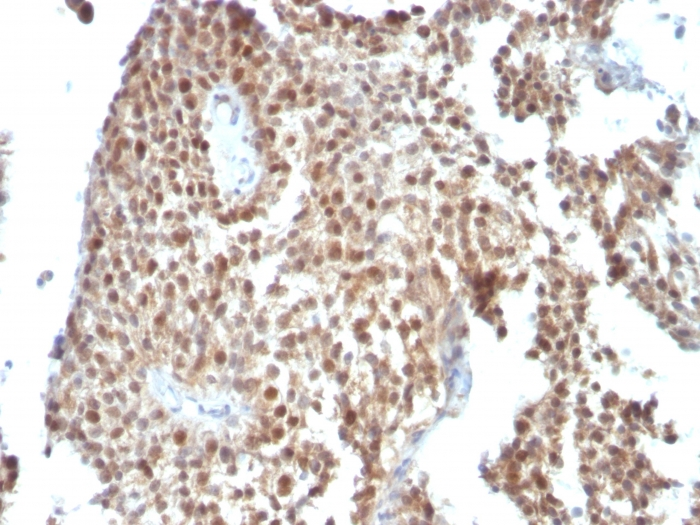
IHC-P analysis of human bladder carcinoma tissue using GTX34933 p53 antibody [SPM590].
![WB analysis of HeLa cell lysate using GTX34933 p53 antibody [SPM590].](https://www.genetex.com/upload/website/prouct_img/normal/GTX34933/GTX34933_20200115_WB_155_w_23060801_453.webp "WB analysis of HeLa cell lysate using GTX34933 p53 antibody [SPM590].")
IHC-P analysis of human bladder carcinoma tissue using GTX34933 p53 antibody [SPM590].
p53 antibody [SPM590]
GTX34933

ApplicationsFlow Cytometry, ImmunoFluorescence, Western Blot, ImmunoCytoChemistry, ImmunoHistoChemistry, ImmunoHistoChemistry Paraffin
Product group Antibodies
ReactivityBovine, Human, Monkey
TargetTP53
Overview
- SupplierGeneTex
- Product Namep53 antibody [SPM590]
- Delivery Days Customer9
- Application Supplier NoteWB: 1-2microg/ml. ICC/IF: 1-2microg/ml. IHC-P: 1-2microg/ml for 30 minutes at RT. FACS: 1-2microg/106 cells. *Optimal dilutions/concentrations should be determined by the researcher.Not tested in other applications.
- ApplicationsFlow Cytometry, ImmunoFluorescence, Western Blot, ImmunoCytoChemistry, ImmunoHistoChemistry, ImmunoHistoChemistry Paraffin
- CertificationResearch Use Only
- ClonalityMonoclonal
- Clone IDSPM590
- Concentration0.2 mg/ml
- ConjugateUnconjugated
- Gene ID7157
- Target nameTP53
- Target descriptiontumor protein p53
- Target synonymsBCC7, BMFS5, LFS1, P53, TRP53, cellular tumor antigen p53, antigen NY-CO-13, mutant tumor protein 53, phosphoprotein p53, transformation-related protein 53, tumor protein 53, tumor supressor p53
- HostMouse
- IsotypeIgG2b
- Protein IDP04637
- Protein NameCellular tumor antigen p53
- Scientific DescriptionThis gene encodes a tumor suppressor protein containing transcriptional activation, DNA binding, and oligomerization domains. The encoded protein responds to diverse cellular stresses to regulate expression of target genes, thereby inducing cell cycle arrest, apoptosis, senescence, DNA repair, or changes in metabolism. Mutations in this gene are associated with a variety of human cancers, including hereditary cancers such as Li-Fraumeni syndrome. Alternative splicing of this gene and the use of alternate promoters result in multiple transcript variants and isoforms. Additional isoforms have also been shown to result from the use of alternate translation initiation codons from identical transcript variants (PMIDs: 12032546, 20937277). [provided by RefSeq, Dec 2016]
- ReactivityBovine, Human, Monkey
- Storage Instruction-20°C or -80°C,2°C to 8°C
- UNSPSC12352203
Datasheet
Related products
Product group Antibodies

Tp53 Polyclonal AntibodyCAC07006
ApplicationsWestern Blot, ChIP Chromatin ImmunoPrecipitation, ELISA, ImmunoHistoChemistry
ReactivityMouse, Rat
TargetTP53
- SizePrice

Product group Antibodies

Sheep anti Human p53A145P
ApplicationsImmunoPrecipitation, Western Blot, ImmunoHistoChemistry
ReactivityHuman, Mouse, Rat
TargetTP53
- SizePrice


Product group Antibodies

Anti-p53 AntibodyAMAB90956
ApplicationsWestern Blot, ImmunoCytoChemistry, ImmunoHistoChemistry
ReactivityHuman
TargetTP53
- SizePrice
Product group Antibodies
References

P53 Polyclonal AntibodyBS-0033R
ApplicationsFlow Cytometry, ImmunoFluorescence, Western Blot, ELISA, ImmunoCytoChemistry, ImmunoHistoChemistry, ImmunoHistoChemistry Frozen, ImmunoHistoChemistry Paraffin
ReactivityBovine, Equine, Human, Mouse, Porcine, Rabbit, Rat, Sheep
TargetTP53
- SizePrice

Product group Antibodies

Anti-p53 AntibodyA101571
ApplicationsELISA, ImmunoHistoChemistry
ReactivityHuman
- SizePrice
Product group Antibodies

Anti-p53 [PAb421]Ab00142-2.0
ApplicationsImmunoFluorescence, ImmunoPrecipitation, Western Blot, ELISA, ImmunoHistoChemistry, ImmunoHistoChemistry Frozen, ImmunoHistoChemistry Paraffin, Other Application
ReactivityHuman, Monkey, Mouse, Rabbit, Rat
TargetTP53
- SizePrice
![ICC/IF analysis of HeLa cells treated with 100 nM Doxorubicin for 24 hrs using GTX00675 p53 (Acetyl Lys120) antibody [10E5]. Red : Primary antibody Green : DAPI Dilution : 1:1000 Fixation : 4% PFA, overnight Permeabilization : 0.25% Triton X-100 in PBS for 10 min](https://www.genetex.com/upload/website/prouct_img/normal/GTX00675/GTX00675_20191104_ICC-IF_w_23053121_863.webp)
Product group Antibodies
References
ApplicationsFlow Cytometry, ImmunoFluorescence, ImmunoPrecipitation, Western Blot, ELISA, ImmunoCytoChemistry
ReactivityHuman
TargetTP53
- SizePrice