

PDGF Receptor beta antibody [18A2] (APC)
GTX80296

ApplicationsFlow Cytometry
Product group Antibodies
TargetPDGFRB
Overview
- SupplierGeneTex
- Product NamePDGF Receptor beta antibody [18A2] (APC)
- Delivery Days Customer9
- Application Supplier NoteFACS: 10 microl reagent / 100 microl of whole blood or 106 cells in a suspension. *Optimal dilutions/concentrations should be determined by the researcher.Not tested in other applications.
- ApplicationsFlow Cytometry
- CertificationResearch Use Only
- ClonalityMonoclonal
- Clone ID18A2
- ConjugateAPC (Allophycocyanin)
- Gene ID5159
- Target namePDGFRB
- Target descriptionplatelet derived growth factor receptor beta
- Target synonymsCD140B, IBGC4, IMF1, JTK12, KOGS, OPDKD, PDGFR, PDGFR-1, PDGFR1, PENTT, platelet-derived growth factor receptor beta, Activated tyrosine kinase PDGFRB, CD140 antigen-like family member B, NDEL1-PDGFRB, PDGF-R-beta, PDGFR-beta, beta-type platelet-derived growth factor receptor, platelet-derived growth factor receptor 1, platelet-derived growth factor receptor, beta polypeptide
- HostMouse
- IsotypeIgG1
- Protein IDP09619
- Protein NamePlatelet-derived growth factor receptor beta
- Scientific DescriptionThe protein encoded by this gene is a cell surface tyrosine kinase receptor for members of the platelet-derived growth factor family. These growth factors are mitogens for cells of mesenchymal origin. The identity of the growth factor bound to a receptor monomer determines whether the functional receptor is a homodimer (PDGFB or PDGFD) or a heterodimer (PDGFA and PDGFB). This gene is essential for normal development of the cardiovascular system and aids in rearrangement of the actin cytoskeleton. This gene is flanked on chromosome 5 by the genes for granulocyte-macrophage colony-stimulating factor and macrophage-colony stimulating factor receptor; all three genes may be implicated in the 5-q syndrome. A translocation between chromosomes 5 and 12, that fuses this gene to that of the ETV6 gene, results in chronic myeloproliferative disorder with eosinophilia. [provided by RefSeq, Aug 2017]
- Storage Instruction2°C to 8°C
- UNSPSC12352203
Datasheet
Related products
Product group Antibodies

ApplicationsImmunoPrecipitation, Western Blot, ImmunoCytoChemistry, ImmunoHistoChemistry
TargetPDGFRB
- SizePrice


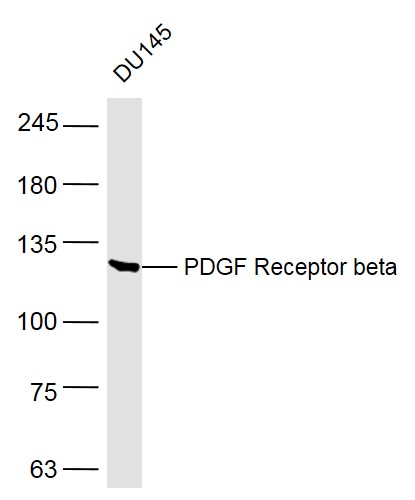
Product group Antibodies

ApplicationsImmunoFluorescence, Western Blot, ELISA, ImmunoCytoChemistry, ImmunoHistoChemistry, ImmunoHistoChemistry Frozen, ImmunoHistoChemistry Paraffin
TargetPDGFRB
- SizePrice
Product group Antibodies

Anti-PDGFR beta Antibody144-65494
ApplicationsImmunoFluorescence, Western Blot, ImmunoHistoChemistry
TargetPDGFRB
- SizePrice

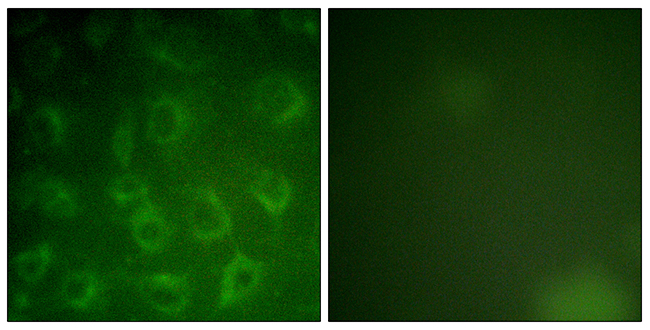
Product group Antibodies

Anti-PDGFR beta AntibodyA94537
ApplicationsImmunoFluorescence, Western Blot, ELISA, ImmunoHistoChemistry
- SizePrice
![ICC/IF analysis of NIH-3T3 cells using GTX00798 PDGF Receptor beta antibody [GT1140]. Red: Primary antibody Blue: DAPI](https://www.genetex.com/upload/website/prouct_img/normal/GTX00798/GTX00798_20191101_AP_002_35_w_23053121_180.webp)
Product group Antibodies
ApplicationsImmunoFluorescence, Western Blot, ImmunoCytoChemistry
TargetPDGFRB
- SizePrice
Product group Antibodies
ApplicationsWestern Blot, ImmunoHistoChemistry, ImmunoHistoChemistry Paraffin
TargetPDGFRB
- SizePrice
![FACS analysis of human CD140b / PDGF-RB stable transfectants using GTX80295 PDGF Receptor beta antibody [18A2].](https://www.genetex.com/upload/website/prouct_img/normal/GTX80295/GTX80295_20191028_FACS_1_w_23061322_808.webp)
Product group Antibodies
ApplicationsFlow Cytometry, ImmunoFluorescence, ImmunoCytoChemistry
TargetPDGFRB
- SizePrice