

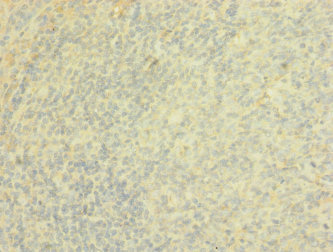
Immunohistochemistry of paraffin-embedded human tonsil tissue using CSB-PA613274ESR1HU at dilution of 1:100
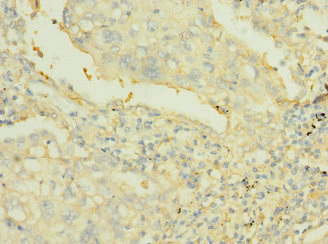
Immunohistochemistry of paraffin-embedded human tonsil tissue using CSB-PA613274ESR1HU at dilution of 1:100
PTPRJ Antibody
CSB-PA613274ESR1HU

ApplicationsELISA, ImmunoHistoChemistry
Product group Antibodies
ReactivityHuman
TargetPTPRJ
Overview
- SupplierCusabio
- Product NamePTPRJ Antibody
- Delivery Days Customer20
- ApplicationsELISA, ImmunoHistoChemistry
- CertificationResearch Use Only
- ClonalityPolyclonal
- ConjugateUnconjugated
- Gene ID5795
- Target namePTPRJ
- Target descriptionprotein tyrosine phosphatase receptor type J
- Target synonymsCD148, DEP1, HPTP eta, HPTPeta, R-PTP-ETA, R-PTP-J, SCC1, THC10, receptor-type tyrosine-protein phosphatase eta, CD148 antigen, density-enhanced phosphatase 1, human density enhanced phosphatase-1, protein tyrosine phosphatase, receptor type, J polypeptide, protein-tyrosine phosphatase eta, susceptibility to colon cancer 1, mouse, homolog of
- HostRabbit
- IsotypeIgG
- Protein IDQ12913
- Protein NameReceptor-type tyrosine-protein phosphatase eta
- Scientific DescriptionTyrosine phosphatase which dephosphorylates or contributes to the dephosphorylation of CTNND1, FLT3, PDGFRB, MET, RET (variant MEN2A), KDR, LYN, SRC, MAPK1, MAPK3, EGFR, TJP1, OCLN, PIK3R1 and PIK3R2. Plays a role in cell adhesion, migration, proliferation and differentiation. Involved in vascular development. Regulator of macrophage adhesion and spreading. Positively affects cell-matrix adhesion. Positive regulator of platelet activation and thrombosis. Negative regulator of cell proliferation. Negative regulator of PDGF-stimulated cell migration; through dephosphorylation of PDGFR. Positive regulator of endothelial cell survival, as well as of VEGF-induced SRC and AKT activation; through KDR dephosphorylation. Negative regulator of EGFR signaling pathway; through EGFR dephosphorylation. Enhances the barrier function of epithelial junctions during reassembly. Negatively regulates T-cell receptor (TCR) signaling. Upon T-cell TCR activation, it is up-regulated and excluded from the immunological synapses, while upon T-cell-antigen presenting cells (APC) disengagement, it is no longer excluded and can dephosphorylate PLCG1 and LAT to down-regulate prolongation of signaling.
- ReactivityHuman
- Storage Instruction-20°C or -80°C
- UNSPSC41116161
Related products
Product group Antibodies

Anti-CD148 [33A1_81]Ab02191-10.0
ApplicationsImmunoFluorescence, ELISA, Other Application
ReactivityHuman
TargetPTPRJ
- SizePrice
Product group Antibodies

His6-DEP-1 AntibodyABX026078
ApplicationsImmunoFluorescence, Western Blot, ELISA, ImmunoCytoChemistry, ImmunoHistoChemistry
- SizePrice

Product group Antibodies

Anti-DEP1/PTPRJ Antibody Picoband(r)A02319-2-CARRIER-FREE
ApplicationsFlow Cytometry, ImmunoFluorescence, Western Blot, ELISA, ImmunoHistoChemistry
ReactivityHuman, Rat
TargetPTPRJ
- SizePrice
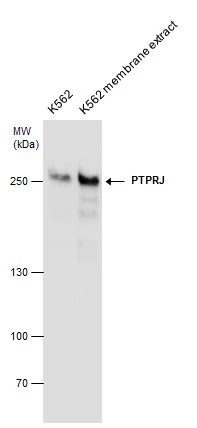
Product group Antibodies

PTPRJ antibodyGTX130904
ApplicationsWestern Blot
ReactivityHuman
TargetPTPRJ
- SizePrice
Product group Antibodies

ApplicationsWestern Blot, ImmunoHistoChemistry
ReactivityMouse
TargetPTPRJ
- SizePrice
Product group Antibodies

SPECA Polyclonal AntibodyBS-2675R
ApplicationsImmunoFluorescence, ELISA, ImmunoCytoChemistry, ImmunoHistoChemistry, ImmunoHistoChemistry Frozen, ImmunoHistoChemistry Paraffin
ReactivityBovine, Canine, Chicken, Equine, Human, Mouse, Porcine, Rabbit, Rat
TargetPTPRJ
- SizePrice
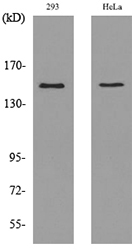
Product group Antibodies

Anti-PTPRJ AntibodyA100797
ApplicationsWestern Blot, ELISA
ReactivityHuman
- SizePrice
Product group Antibodies
PTPRJ AntibodyCSB-PA005636
ApplicationsWestern Blot, ELISA
ReactivityHuman
TargetPTPRJ
- SizePrice
Product group Antibodies

PTPRJ / CD148 AntibodyLS-C676339
ApplicationsELISA, ImmunoHistoChemistry, ImmunoHistoChemistry Paraffin
ReactivityHuman
TargetPTPRJ
- SizePrice

Product group Antibodies

Anti-PTPRJ AntibodyHPA006026
ApplicationsImmunoHistoChemistry
ReactivityHuman
TargetPTPRJ
- SizePrice