

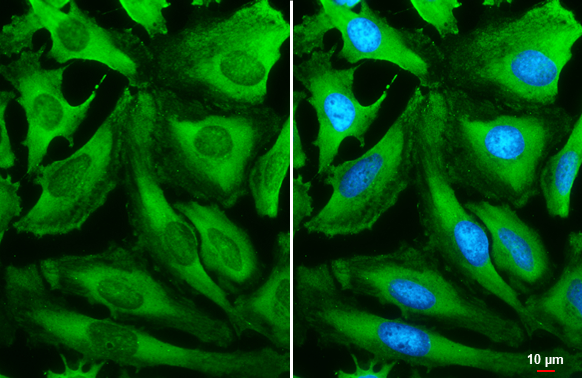
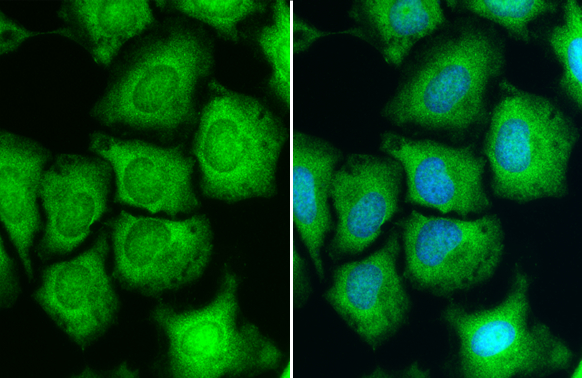
RPS6 antibody detects RPS6 protein at cytoplasm by immunofluorescent analysis. Sample: HeLa cells were fixed in 4% paraformaldehyde at RT for 15 min. Green: RPS6 stained by RPS6 antibody (GTX130450) diluted at 1:500. Blue: Fluoroshield with DAPI (GTX30920). Scale bar= 10 μm.
RPS6 antibody detects RPS6 protein at cytoplasm by immunofluorescent analysis. Sample: HeLa cells were fixed in 4% paraformaldehyde at RT for 15 min. Green: RPS6 stained by RPS6 antibody (GTX130450) diluted at 1:500. Blue: Fluoroshield with DAPI (GTX30920). Scale bar= 10 μm.
RPS6 antibody
GTX130450

ApplicationsImmunoFluorescence, Western Blot, ImmunoCytoChemistry
Product group Antibodies
ReactivityHuman
TargetRPS6
Overview
- SupplierGeneTex
- Product NameRPS6 antibody
- Delivery Days Customer9
- Application Supplier NoteWB: 1:1000-1:10000. *Optimal dilutions/concentrations should be determined by the researcher.Not tested in other applications.
- ApplicationsImmunoFluorescence, Western Blot, ImmunoCytoChemistry
- CertificationResearch Use Only
- ClonalityPolyclonal
- Concentration0.77 mg/ml
- ConjugateUnconjugated
- Gene ID6194
- Target nameRPS6
- Target descriptionribosomal protein S6
- Target synonymsS6, eS6, small ribosomal subunit protein eS6, 40S ribosomal protein S6, phosphoprotein NP33
- HostRabbit
- IsotypeIgG
- Protein IDP62753
- Protein NameSmall ribosomal subunit protein eS6
- Scientific DescriptionRibosomes, the organelles that catalyze protein synthesis, consist of a small 40S subunit and a large 60S subunit. Together these subunits are composed of 4 RNA species and approximately 80 structurally distinct proteins. This gene encodes a cytoplasmic ribosomal protein that is a component of the 40S subunit. The protein belongs to the S6E family of ribosomal proteins. It is the major substrate of protein kinases in the ribosome, with subsets of five C-terminal serine residues phosphorylated by different protein kinases. Phosphorylation is induced by a wide range of stimuli, including growth factors, tumor-promoting agents, and mitogens. Dephosphorylation occurs at growth arrest. The protein may contribute to the control of cell growth and proliferation through the selective translation of particular classes of mRNA. As is typical for genes encoding ribosomal proteins, there are multiple processed pseudogenes of this gene dispersed through the genome. [provided by RefSeq]
- ReactivityHuman
- Storage Instruction-20°C or -80°C,2°C to 8°C
- UNSPSC12352203
References
- Maiti S, Bhattacharya K, Wider D, et al. Hsf1 and the molecular chaperone Hsp90 support a 'rewiring stress response' leading to an adaptive cell size increase in chronic stress. Elife. 2023,12. doi: 10.7554/eLife.88658Read this paper
Datasheet
Related products
Product group Antibodies

Anti-RPS6 Antibody144-66044
ApplicationsWestern Blot
ReactivityHuman, Mouse, Rat
TargetRPS6
- SizePrice
Product group Antibodies

Anti-RPS6 Antibody Picoband(r)A01567-1-CARRIER-FREE
ApplicationsWestern Blot, ImmunoHistoChemistry
ReactivityHuman, Mouse, Rat
TargetRPS6
- SizePrice
Product group Antibodies
References
ApplicationsWestern Blot
ReactivityHuman, Mouse
TargetRPS6
- SizePrice
Product group Antibodies
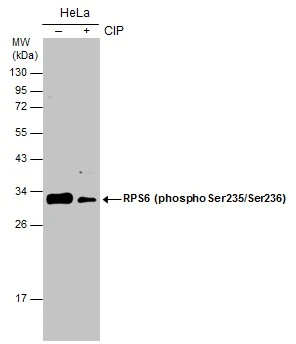
RPS6 (phospho Ser235/236) antibodyGTX130430
ApplicationsWestern Blot
ReactivityHuman, Mouse
TargetRPS6
- SizePrice
Product group Antibodies
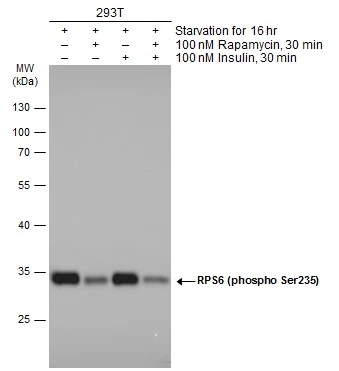
RPS6 (phospho Ser235) antibodyGTX132281
ApplicationsWestern Blot, ImmunoHistoChemistry, ImmunoHistoChemistry Paraffin
ReactivityHuman, Mouse
TargetRPS6
- SizePrice
Product group Antibodies
ApplicationsWestern Blot
ReactivityHuman, Mouse
TargetRPS6
- SizePrice
Product group Antibodies
References
RPS6 antibodyGTX113542
ApplicationsImmunoFluorescence, Western Blot, ImmunoCytoChemistry, ImmunoHistoChemistry, ImmunoHistoChemistry Paraffin
ReactivityHuman, Mouse, Zebra Fish
TargetRPS6
- SizePrice
![Untreated (–) and treated (+) 293T whole cell extracts (30 μg) were separated by 12% SDS-PAGE, and the membrane was blotted with RPS6 antibody[GT4610] (GTX633811) diluted at 1:1000.](https://www.genetex.com/upload/website/prouct_img/normal/GTX633811/GTX633811_42667_20161110_WB_FBS_w_23061202_140.webp)
Product group Antibodies
ApplicationsWestern Blot
ReactivityHuman, Mouse
TargetRPS6
- SizePrice
![Various whole cell extracts (30 μg) were separated by 12% SDS-PAGE, and the membrane was blotted with RPS6 (phospho Ser235) antibody [GT829] (GTX633823) diluted at 1:1000. The HRP-conjugated anti-mouse IgG antibody (GTX213111-01) was used to detect the primary antibody, and the signal was developed with Trident ECL plus-Enhanced.](https://www.genetex.com/upload/website/prouct_img/normal/GTX633823/GTX633823_42688_20180316_WB_M_w_23061202_590.webp)
Product group Antibodies
ApplicationsWestern Blot
ReactivityHuman, Mouse
TargetRPS6
- SizePrice
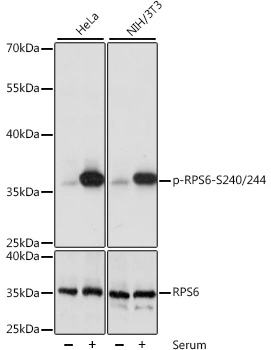
Product group Antibodies
ApplicationsImmunoPrecipitation, Western Blot
ReactivityHuman, Mouse
TargetRPS6
- SizePrice