

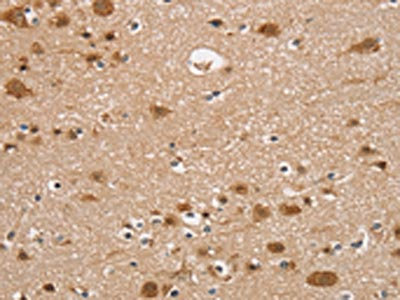
The image on the left is immunohistochemistry of paraffin-embedded Human brain tissue using CSB-PA066534(RUNX1T1 Antibody) at dilution 1/35, on the right is treated with synthetic peptide. (Original magnification: x200)
The image on the left is immunohistochemistry of paraffin-embedded Human brain tissue using CSB-PA066534(RUNX1T1 Antibody) at dilution 1/35, on the right is treated with synthetic peptide. (Original magnification: x200)
RUNX1T1 Antibody
CSB-PA066534

ApplicationsELISA, ImmunoHistoChemistry
Product group Antibodies
ReactivityHuman, Mouse
TargetRUNX1T1
Overview
- SupplierCusabio
- Product NameRUNX1T1 Antibody
- Delivery Days Customer20
- ApplicationsELISA, ImmunoHistoChemistry
- CertificationResearch Use Only
- ClonalityPolyclonal
- ConjugateUnconjugated
- Gene ID862
- Target nameRUNX1T1
- Target descriptionRUNX1 partner transcriptional co-repressor 1
- Target synonymsAML1-MTG8, AML1T1, CBFA2T1, CDR, ETO, MTG8, ZMYND2, protein CBFA2T1, RUNX1 translocation partner 1, acute myelogenous leukemia 1 translocation 1, cyclin-D related, core-binding factor, runt domain, alpha subunit 2; translocated to, 1; cyclin D-related, eight twenty one protein, myeloid translocation gene on 8q22, runt related transcription factor 1; translocated to, 1 (cyclin D related), zinc finger MYND domain-containing protein 2
- HostRabbit
- IsotypeIgG
- Protein IDQ06455
- Protein NameProtein CBFA2T1
- Scientific DescriptionThis gene encodes a member of the myeloid translocation gene family which interact with DNA-bound transcription factors and recruit a range of corepressors to facilitate transcriptional repression. The t(8;21)(q22;q22) translocation is one of the most frequent karyotypic abnormalities in acute myeloid leukemia. The translocation produces a chimeric gene made up of the 5-region of the runt-related transcription factor 1 gene fused to the 3-region of this gene. The chimeric protein is thought to associate with the nuclear corepressor/histone deacetylase complex to block hematopoietic differentiation.
- ReactivityHuman, Mouse
- Storage Instruction-20°C or -80°C
- UNSPSC41116161
Related products
Product group Antibodies

Anti-RUNX1T1/ETO Antibody Picoband(r)A01792-1-CARRIER-FREE
ApplicationsFlow Cytometry, ImmunoFluorescence, ImmunoPrecipitation, Western Blot, ELISA, ImmunoCytoChemistry, ImmunoHistoChemistry
ReactivityHuman, Mouse, Rat
TargetRUNX1T1
- SizePrice
Product group Antibodies

Anti-RUNX1T1 Antibody144-64910
ApplicationsWestern Blot
ReactivityHuman
TargetRUNX1T1
- SizePrice
Product group Antibodies

RUNX1T1 Polyclonal AntibodyCAC14564
ApplicationsWestern Blot, ELISA, ImmunoHistoChemistry
TargetRUNX1T1
- SizePrice


Product group Antibodies

Anti-RUNX1T1 AntibodyHPA049852
ApplicationsImmunoCytoChemistry
ReactivityHuman
TargetRUNX1T1
- SizePrice
Product group Antibodies

RUNX1T1 / ETO AntibodyLS-C497925
ApplicationsWestern Blot, ImmunoHistoChemistry
ReactivityHuman, Mouse, Rat
TargetRUNX1T1
- SizePrice
Product group Antibodies

ApplicationsChIP Chromatin ImmunoPrecipitation, ELISA
ReactivityHuman
TargetRUNX1T1
- SizePrice