

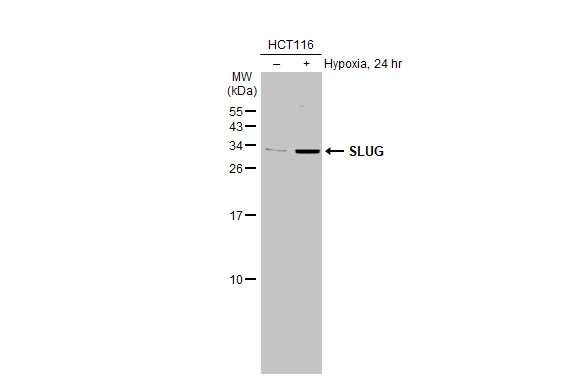
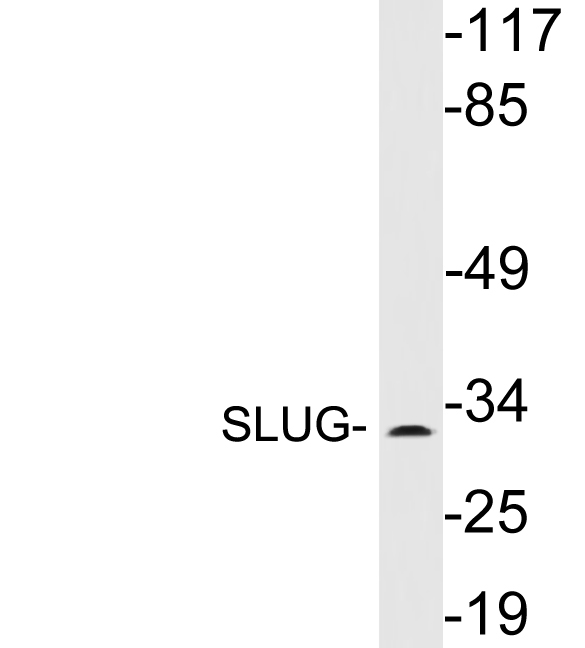
Untreated (–) and treated (+) HCT-116 whole cell extract (30 μg) were separated by 15% SDS-PAGE, and the membrane was blotted with SLUG antibody (GTX128796) diluted at 1:500. The HRP-conjugated anti-rabbit IgG antibody (GTX213110-01) was used to detect the primary antibody.
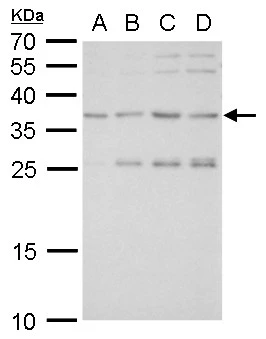
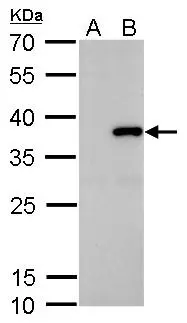
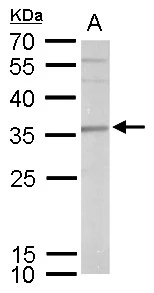
Untreated (–) and treated (+) HCT-116 whole cell extract (30 μg) were separated by 15% SDS-PAGE, and the membrane was blotted with SLUG antibody (GTX128796) diluted at 1:500. The HRP-conjugated anti-rabbit IgG antibody (GTX213110-01) was used to detect the primary antibody.
SLUG antibody
GTX128796

ApplicationsWestern Blot, ImmunoHistoChemistry, ImmunoHistoChemistry Paraffin
Product group Antibodies
ReactivityHuman, Mouse
TargetSNAI2
Overview
- SupplierGeneTex
- Product NameSLUG antibody
- Delivery Days Customer9
- Application Supplier NoteWB: 1:500-1:10000. IHC-P: 1:100-1:1000. *Optimal dilutions/concentrations should be determined by the researcher.Not tested in other applications.
- ApplicationsWestern Blot, ImmunoHistoChemistry, ImmunoHistoChemistry Paraffin
- CertificationResearch Use Only
- ClonalityPolyclonal
- Concentration1.18 mg/ml
- ConjugateUnconjugated
- Gene ID6591
- Target nameSNAI2
- Target descriptionsnail family transcriptional repressor 2
- Target synonymsSLUG, SLUGH, SLUGH1, SNAIL2, WS2D, zinc finger protein SNAI2, neural crest transcription factor SLUG, protein snail homolog 2, slug (chicken homolog), zinc finger protein, snail family zinc finger 2, snail homolog 2
- HostRabbit
- IsotypeIgG
- Protein IDO43623
- Protein NameZinc finger protein SNAI2
- Scientific DescriptionThis gene encodes a member of the Snail family of C2H2-type zinc finger transcription factors. The encoded protein acts as a transcriptional repressor that binds to E-box motifs and is also likely to repress E-cadherin transcription in breast carcinoma. This protein is involved in epithelial-mesenchymal transitions and has antiapoptotic activity. Mutations in this gene may be associated with sporatic cases of neural tube defects. [provided by RefSeq]
- ReactivityHuman, Mouse
- Storage Instruction-20°C or -80°C,2°C to 8°C
- UNSPSC41116161
Datasheet
Related products
Product group Antibodies

Anti-SLUG AntibodyA97911
ApplicationsWestern Blot, ELISA
ReactivityHuman, Mouse, Rat
- SizePrice

Product group Antibodies

Anti-SLUG Antibody144-61943
ApplicationsImmunoFluorescence, Western Blot, ImmunoHistoChemistry
ReactivityHuman, Mouse, Rat
TargetSNAI2
- SizePrice
Product group Antibodies

Legumain (LGMN) AntibodyABX334421
ApplicationsELISA, ImmunoHistoChemistry
- SizePrice
Product group Antibodies

SNAI2 / SLUG AntibodyLS-C748406
ApplicationsWestern Blot, ImmunoHistoChemistry
ReactivityHuman, Mouse, Rat
TargetSNAI2
- SizePrice
Product group Antibodies
References

SNAI2 Polyclonal AntibodyBS-1382R
ApplicationsImmunoFluorescence, Western Blot, ELISA, ImmunoCytoChemistry, ImmunoHistoChemistry, ImmunoHistoChemistry Frozen, ImmunoHistoChemistry Paraffin
ReactivityBovine, Canine, Chicken, Human, Mouse, Porcine, Rabbit, Rat
TargetSNAI2
- SizePrice
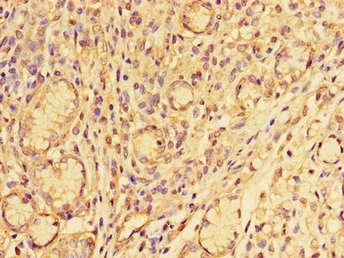
Product group Antibodies

SNAI2 AntibodyCSB-PA021869LA01HU
ApplicationsImmunoFluorescence, ELISA, ImmunoHistoChemistry
ReactivityHuman
TargetSNAI2
- SizePrice
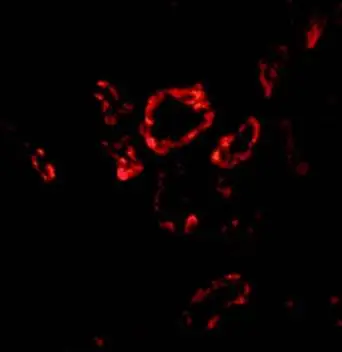
Product group Antibodies
References
SLUG antibodyGTX30813
ApplicationsWestern Blot, ImmunoHistoChemistry, ImmunoHistoChemistry Paraffin
ReactivityHuman, Mouse
TargetSNAI2
- SizePrice
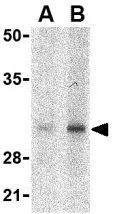
Product group Antibodies
SLUG antibodyGTX31748
ApplicationsWestern Blot, ELISA
ReactivityHuman, Mouse
TargetSNAI2
- SizePrice
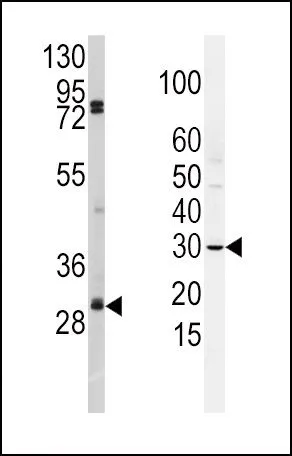
Product group Antibodies
SLUG antibody, N-termGTX82511
ApplicationsWestern Blot
ReactivityHuman
TargetSNAI2
- SizePrice