

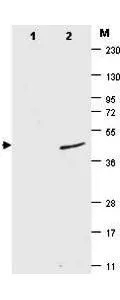
Western blot of ySUMO fusion protein. Anti-ySUMO antibody, generated by immunization with recombinant yeast SUMO, was tested by western blot against a SUMO-GFP fusion protein (lane 2). While the actual molecular weight of the fusion protein is 39 kDa, the protein migrates as a 49 kDa band (arrowhead). No reactivity is seen for lane 1 which contains His-tagged GFP protein. The membrane was blocked using BLOTTO. Primary antibody was used at a 1:1,000 dilution in BLOTTO. The membrane was washed and reacted with a 1:10,000 dilution of IRDyeR 800 Conjugated Affinity Purified Goat-anti-Mouset IgG (H&L).
![Sumo antibody [4F2.F5.G2]](https://www.genetex.com/upload/website/prouct_img/normal/GTX48824/GTX48824.Figure2_w_23060823_997.webp "Sumo antibody [4F2.F5.G2]")
![WB analysis of various recombinant proteins using GTX48824 Sumo antibody [4F2.F5.G2]. Lane 1 : His-tagged GFP Lane 2 : Sumo-GFP fusion protein Dilution : 1:1000](https://www.genetex.com/upload/website/prouct_img/normal/GTX48824/GTX48824_20240423_WB_322_24042320_701.webp "WB analysis of various recombinant proteins using GTX48824 Sumo antibody [4F2.F5.G2]. Lane 1 : His-tagged GFP Lane 2 : Sumo-GFP fusion protein Dilution : 1:1000")
Western blot of ySUMO fusion protein. Anti-ySUMO antibody, generated by immunization with recombinant yeast SUMO, was tested by western blot against a SUMO-GFP fusion protein (lane 2). While the actual molecular weight of the fusion protein is 39 kDa, the protein migrates as a 49 kDa band (arrowhead). No reactivity is seen for lane 1 which contains His-tagged GFP protein. The membrane was blocked using BLOTTO. Primary antibody was used at a 1:1,000 dilution in BLOTTO. The membrane was washed and reacted with a 1:10,000 dilution of IRDyeR 800 Conjugated Affinity Purified Goat-anti-Mouset IgG (H&L).
Sumo antibody [4F2.F5.G2]
GTX48824

ApplicationsFunctional Assay, Western Blot, ELISA, ImmunoHistoChemistry
Product group Antibodies
ReactivityYeast
TargetSMT3
Overview
- SupplierGeneTex
- Product NameSumo antibody [4F2.F5.G2]
- Delivery Days Customer9
- Application Supplier NoteWB: 1:500-1:2000. ELISA: 1:20000. IHC: 1:1000. *Optimal dilutions/concentrations should be determined by the researcher.Not tested in other applications.
- ApplicationsFunctional Assay, Western Blot, ELISA, ImmunoHistoChemistry
- CertificationResearch Use Only
- ClonalityMonoclonal
- Clone ID4F2.F5.G2
- Concentration1.9 mg/ml
- ConjugateUnconjugated
- Gene ID852122
- Target nameSMT3
- Target descriptionSUMO family protein SMT3
- Target synonymsYDR510W, SUMO family protein SMT3
- HostMouse
- IsotypeIgG1
- Protein IDQ12306
- Protein NameUbiquitin-like protein SMT3
- Scientific DescriptionCovalent modification of cellular proteins by the ubiquitin-like modifier SUMO (small ubiquitin-like modifier) regulates various cellular processes, such as nuclear transport, signal transduction, stress responses and cell cycle progression. However, in contrast to ubiquination, sumoylation does not tag proteins for degradation by the 26S proteasome but rather seems to enhance stability or modulate their subcellular compartmentalization. Ubiquitin-like proteins fall into two classes: the first class, ubiquitin-like modifiers (UBLs) function as modifiers in a manner analogous to that of ubiquitin. Examples of UBLs are SUMO, Rub1 (also called Nedd8), Apg8 and Apg12. Proteins of the second class, including parkin, RAD23 and DSK2, are designated ubiquitin-domain proteins (UDPs). These proteins contain domains that are related to ubiquitin but are otherwise unrelated to each other. In contrast to UBLs, UDPs are not conjugated to other proteins. Once covalently attached to cellular targets, SUMO regulates protein:protein and protein:DNA interactions, as well as localization and stability of the target protein. Sumoylation occurs in most eukaryotic systems, and SUMO is highly conserved from yeast to humans. Where invertebrates have only a single SUMO gene termed SMT3, three members
- ReactivityYeast
- Storage Instruction-20°C or -80°C,2°C to 8°C
- UNSPSC41116161
Datasheet
Related products
Product group Antibodies

SMT3 AntibodyCSB-PA615489HA01SVG
ApplicationsELISA
ReactivityYeast
TargetSMT3
- SizePrice

Product group Antibodies

Smt3 Polyclonal AntibodyCAC12806
ApplicationsELISA
ReactivityYeast
TargetSMT3
- SizePrice
Product group Antibodies
Sumo antibodyGTX48822
ApplicationsImmunoPrecipitation, Western Blot, ChIP Chromatin ImmunoPrecipitation, ELISA
ReactivityYeast
TargetSMT3
- SizePrice