

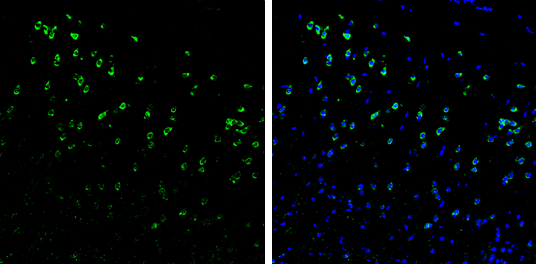
Syntenin 1 antibody [C2C3], C-term detects Syntenin 1 protein by immunohistochemical analysis. Samples: Frozen Sectioned adult mouse brain. Green: Syntenin 1 protein stained by Syntenin 1 antibody [C2C3], C-term (GTX108470) diluted at 1:250. Blue: Fluoroshield with DAPI (GTX30920).
Antigen Retrieval: Citrate buffer, pH 6.0, 10 min
![Syntenin 1 antibody [C2C3], C-term detects Syntenin 1 protein at cytosol on rat fore brain by immunohistochemical analysis. Sample: Paraffin-embedded rat fore brain. Syntenin 1 antibody [C2C3], C-term (GTX108470) dilution: 1:500.
Antigen Retrieval: Trilogy? (EDTA based, pH 8.0) buffer, 15min](https://www.genetex.com/upload/website/prouct_img/normal/GTX108470/GTX108470_39806_IHC_R_w_23060120_367.webp "Syntenin 1 antibody [C2C3], C-term detects Syntenin 1 protein at cytosol on rat fore brain by immunohistochemical analysis. Sample: Paraffin-embedded rat fore brain. Syntenin 1 antibody [C2C3], C-term (GTX108470) dilution: 1:500.
Antigen Retrieval: Trilogy? (EDTA based, pH 8.0) buffer, 15min")
![Syntenin 1 antibody [C2C3], C-term detects Syntenin 1 protein by immunohistochemical analysis. Samples: Frozen Sectioned adult mouse brain. Green: Syntenin 1 protein stained by Syntenin 1 antibody [C2C3], C-term (GTX108470) diluted at 1:250. Blue: Fluoroshield with DAPI (GTX30920).
Antigen Retrieval: Citrate buffer, pH 6.0, 10 min](https://www.genetex.com/upload/website/prouct_img/normal/GTX108470/GTX108470_41766_20171127_IHC-Fr_M_w_23060120_930.webp "Syntenin 1 antibody [C2C3], C-term detects Syntenin 1 protein by immunohistochemical analysis. Samples: Frozen Sectioned adult mouse brain. Green: Syntenin 1 protein stained by Syntenin 1 antibody [C2C3], C-term (GTX108470) diluted at 1:250. Blue: Fluoroshield with DAPI (GTX30920).
Antigen Retrieval: Citrate buffer, pH 6.0, 10 min")
![Syntenin 1 antibody [C2C3], C-term detects Syntenin 1 protein at cytosol on mouse kidney by immunohistochemical analysis. Sample: Paraffin-embedded mouse kidney. Syntenin 1 antibody [C2C3], C-term (GTX108470) dilution: 1:500.
Antigen Retrieval: Trilogy? (EDTA based, pH 8.0) buffer, 15min](https://www.genetex.com/upload/website/prouct_img/normal/GTX108470/GTX108470_39806_IHC_M_w_23060120_247.webp "Syntenin 1 antibody [C2C3], C-term detects Syntenin 1 protein at cytosol on mouse kidney by immunohistochemical analysis. Sample: Paraffin-embedded mouse kidney. Syntenin 1 antibody [C2C3], C-term (GTX108470) dilution: 1:500.
Antigen Retrieval: Trilogy? (EDTA based, pH 8.0) buffer, 15min")
![Syntenin 1 antibody [C2C3], C-term detects Syntenin 1 protein at cytosol on mouse kidney by immunohistochemical analysis. Sample: Paraffin-embedded mouse kidney. Syntenin 1 antibody [C2C3], C-term (GTX108470) dilution: 1:500.
Antigen Retrieval: Trilogy? (EDTA based, pH 8.0) buffer, 15min](https://www.genetex.com/upload/website/prouct_img/normal/GTX108470/GTX108470_39806_IHC_M_2_w_23060120_819.webp "Syntenin 1 antibody [C2C3], C-term detects Syntenin 1 protein at cytosol on mouse kidney by immunohistochemical analysis. Sample: Paraffin-embedded mouse kidney. Syntenin 1 antibody [C2C3], C-term (GTX108470) dilution: 1:500.
Antigen Retrieval: Trilogy? (EDTA based, pH 8.0) buffer, 15min")
![HeLa whole cell extracts and HeLa exosome extract (3.5 μg) were separated by 12% SDS-PAGE, and the membrane was blotted with Syntenin 1 antibody [C2C3], C-term (GTX108470) diluted at 1:250. The HRP-conjugated anti-rabbit IgG antibody (GTX213110-01) was used to detect the primary antibody.](https://www.genetex.com/upload/website/prouct_img/normal/GTX108470/GTX108470_39806_20190607_WB_Fraction_w_23060120_384.webp "HeLa whole cell extracts and HeLa exosome extract (3.5 μg) were separated by 12% SDS-PAGE, and the membrane was blotted with Syntenin 1 antibody [C2C3], C-term (GTX108470) diluted at 1:250. The HRP-conjugated anti-rabbit IgG antibody (GTX213110-01) was used to detect the primary antibody.")
![Various whole cell extracts (30 μg) were separated by 12% SDS-PAGE, and the membrane was blotted with Syntenin 1 antibody [C2C3], C-term (GTX108470) diluted at 1:1000. The HRP-conjugated anti-rabbit IgG antibody (GTX213110-01) was used to detect the primary antibody, and the signal was developed with Trident femto Western HRP Substrate. Corresponding RNA expression data are based on Human Protein Atlas program.](https://www.genetex.com/upload/website/prouct_img/normal/GTX108470/GTX108470_39806_20250912_WB_TPM_watermark_25091820_180.webp "Various whole cell extracts (30 μg) were separated by 12% SDS-PAGE, and the membrane was blotted with Syntenin 1 antibody [C2C3], C-term (GTX108470) diluted at 1:1000. The HRP-conjugated anti-rabbit IgG antibody (GTX213110-01) was used to detect the primary antibody, and the signal was developed with Trident femto Western HRP Substrate. Corresponding RNA expression data are based on Human Protein Atlas program.")
![Zebrafish tissue extract (30 μg) was separated by 12% SDS-PAGE, and the membrane was blotted with Syntenin 1 antibody [C2C3], C-term (GTX108470) diluted at 1:1000. The HRP-conjugated anti-rabbit IgG antibody (GTX213110-01) was used to detect the primary antibody.](https://www.genetex.com/upload/website/prouct_img/normal/GTX108470/GTX108470_39806_20251003_WB_Z_brain_25100823_484.webp "Zebrafish tissue extract (30 μg) was separated by 12% SDS-PAGE, and the membrane was blotted with Syntenin 1 antibody [C2C3], C-term (GTX108470) diluted at 1:1000. The HRP-conjugated anti-rabbit IgG antibody (GTX213110-01) was used to detect the primary antibody.")
Syntenin 1 antibody [C2C3], C-term detects Syntenin 1 protein by immunohistochemical analysis. Samples: Frozen Sectioned adult mouse brain. Green: Syntenin 1 protein stained by Syntenin 1 antibody [C2C3], C-term (GTX108470) diluted at 1:250. Blue: Fluoroshield with DAPI (GTX30920).
Antigen Retrieval: Citrate buffer, pH 6.0, 10 min
Syntenin 1 antibody [C2C3], C-term
GTX108470

ApplicationsImmunoFluorescence, Western Blot, ImmunoCytoChemistry, ImmunoHistoChemistry, ImmunoHistoChemistry Frozen, ImmunoHistoChemistry Paraffin
Product group Antibodies
ReactivityHuman, Mouse, Rat
TargetSDCBP
Overview
- SupplierGeneTex
- Product NameSyntenin 1 antibody [C2C3], C-term
- Delivery Days Customer9
- Application Supplier NoteWB: 1:500-1:3000. ICC/IF: 1:100-1:1000. IHC-P: 1:100-1:1000. IHC-Fr: 1:100-1:1000. *Optimal dilutions/concentrations should be determined by the researcher.Not tested in other applications.
- ApplicationsImmunoFluorescence, Western Blot, ImmunoCytoChemistry, ImmunoHistoChemistry, ImmunoHistoChemistry Frozen, ImmunoHistoChemistry Paraffin
- CertificationResearch Use Only
- ClonalityPolyclonal
- Concentration0.78 mg/ml
- ConjugateUnconjugated
- Gene ID6386
- Target nameSDCBP
- Target descriptionsyndecan binding protein
- Target synonymsMDA-9, MDA9, SDCBP1, ST1, SYCL, TACIP18, syntenin-1, melanoma differentiation associated protein-9, pro-TGF-alpha cytoplasmic domain-interacting protein 18, scaffold protein Pbp1, syndecan binding protein (syntenin), syndecan-binding protein 1
- HostRabbit
- IsotypeIgG
- Protein IDO00560
- Protein NameSyntenin-1
- Scientific DescriptionThe protein encoded by this gene was initially identified as a molecule linking syndecan-mediated signaling to the cytoskeleton. The syntenin protein contains tandemly repeated PDZ domains that bind the cytoplasmic, C-terminal domains of a variety of transmembrane proteins. This protein may also affect cytoskeletal-membrane organization, cell adhesion, protein trafficking, and the activation of transcription factors. The protein is primarily localized to membrane-associated adherens junctions and focal adhesions but is also found at the endoplasmic reticulum and nucleus. Alternative splicing results in multiple transcript variants encoding different isoforms. [provided by RefSeq]
- ReactivityHuman, Mouse, Rat
- Storage Instruction-20°C or -80°C,2°C to 8°C
- UNSPSC12352203
References
- Korvenlaita N, Gómez-Budia M, Scoyni F, et al. Dynamic release of neuronal extracellular vesicles containing miR-21a-5p is induced by hypoxia. J Extracell Vesicles. 2023,12(1):e12297. doi: 10.1002/jev2.12297Read this paper
- Haynes BA, Yang LF, Huyck RW, et al. Endothelial-to-Mesenchymal Transition in Human Adipose Tissue Vasculature Alters the Particulate Secretome and Induces Endothelial Dysfunction. Arterioscler Thromb Vasc Biol. 2019,39(10):2168-2191. doi: 10.1161/ATVBAHA.119.312826Read this paper
- Kowal J, Arras G, Colombo M, et al. Proteomic comparison defines novel markers to characterize heterogeneous populations of extracellular vesicle subtypes. Proc Natl Acad Sci U S A. 2016,113(8):E968-77. doi: 10.1073/pnas.1521230113Read this paper
Datasheet
Related products

Product group Antibodies

Anti-Syntenin/SDCBP Antibody Picoband(r)A02475-2-CARRIER-FREE
ApplicationsWestern Blot, ELISA
ReactivityHuman, Mouse, Rat
TargetSDCBP
- SizePrice
Product group Antibodies

Anti-SDCBP Antibody144-05360
ApplicationsImmunoFluorescence, Western Blot
ReactivityHuman, Mouse
TargetSDCBP
- SizePrice

Product group Antibodies

SDCBP Polyclonal AntibodyCAC14759
ApplicationsImmunoFluorescence, Western Blot, ELISA, ImmunoHistoChemistry
ReactivityMouse, Rat
TargetSDCBP
- SizePrice
Product group Antibodies

Syntenin 1 Recombinant Antibody, AbBy Fluor-555 ConjugatedBSM-61948R-BF555
ApplicationsFlow Cytometry, ImmunoFluorescence, Western Blot, ImmunoCytoChemistry
ReactivityHuman
TargetSDCBP
- SizePrice
Product group Antibodies

SDCBP AntibodyCSB-PA020893LA01HU
ApplicationsImmunoFluorescence, Western Blot, ELISA, ImmunoHistoChemistry
ReactivityHuman, Mouse, Rat
TargetSDCBP
- SizePrice

Product group Antibodies

Syntenin AntibodyABX430839
ApplicationsWestern Blot, ELISA, ImmunoHistoChemistry
- SizePrice
Product group Antibodies
Syntenin 1 antibody [3D9-G9-H4]GTX49226
ApplicationsWestern Blot
ReactivityHuman
TargetSDCBP
- SizePrice
Product group Antibodies

ApplicationsWestern Blot, ELISA, ImmunoHistoChemistry
ReactivityCanine, Human, Mouse, Rat
TargetSDCBP
- SizePrice