

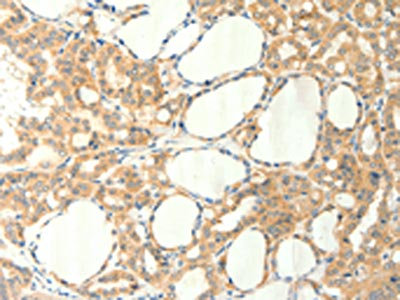
The image on the left is immunohistochemistry of paraffin-embedded Human thyroid cancer tissue using CSB-PA138687(TRPM5 Antibody) at dilution 1/60, on the right is treated with synthetic peptide. (Original magnification: x200)
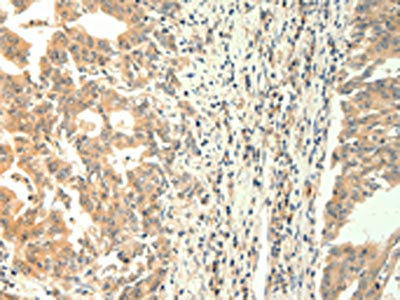

The image on the left is immunohistochemistry of paraffin-embedded Human thyroid cancer tissue using CSB-PA138687(TRPM5 Antibody) at dilution 1/60, on the right is treated with synthetic peptide. (Original magnification: x200)
TRPM5 Antibody
CSB-PA138687

ApplicationsWestern Blot, ELISA, ImmunoHistoChemistry
Product group Antibodies
ReactivityHuman, Mouse
TargetTRPM5
Overview
- SupplierCusabio
- Product NameTRPM5 Antibody
- Delivery Days Customer20
- ApplicationsWestern Blot, ELISA, ImmunoHistoChemistry
- CertificationResearch Use Only
- ClonalityPolyclonal
- ConjugateUnconjugated
- Gene ID29850
- Target nameTRPM5
- Target descriptiontransient receptor potential cation channel subfamily M member 5
- Target synonymsLTRPC5, MTR1, transient receptor potential cation channel subfamily M member 5, MLSN1 and TRP-related, MLSN1- and TRP-related gene 1 protein, long transient receptor potential channel 5
- HostRabbit
- IsotypeIgG
- Protein IDQ9NZQ8
- Protein NameTransient receptor potential cation channel subfamily M member 5
- Scientific DescriptionThis gene encodes a member of the transient receptor potential (TRP) protein family, which is a diverse group of proteins with structural features typical of ion channels. This protein plays an important role in taste transduction, and has characteristics of a calcium-activated, non-selective cation channel that carries Na+, K+, and Cs+ ions equally well, but not Ca(2+) ions. It is activated by lower concentrations of intracellular Ca(2+), and inhibited by higher concentrations. It is also a highly temperature-sensitive, heat activated channel showing a steep increase of inward currents at temperatures between 15 and 35 degrees Celsius. This gene is located within the Beckwith-Wiedemann syndrome critical region-1 on chromosome 11p15.5, and has been shown to be imprinted, with exclusive expression from the paternal allele.
- ReactivityHuman, Mouse
- Storage Instruction-20°C or -80°C
- UNSPSC41116161
Related products

Product group Antibodies

Anti-TRPM5 AntibodyA38021
ApplicationsWestern Blot, ImmunoHistoChemistry
ReactivityHuman, Mouse
- SizePrice
Product group Antibodies

TRPM5 AntibodyLS-C402832
ApplicationsWestern Blot, ELISA, ImmunoHistoChemistry
ReactivityHuman, Mouse
TargetTRPM5
- SizePrice
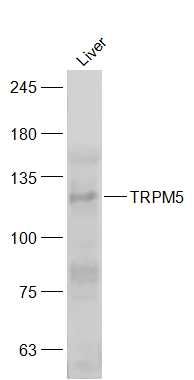
Product group Antibodies

TRPM5 Polyclonal AntibodyBS-9047R
ApplicationsImmunoFluorescence, Western Blot, ImmunoHistoChemistry, ImmunoHistoChemistry Paraffin
ReactivityBovine, Human, Mouse, Rat
TargetTRPM5
- SizePrice
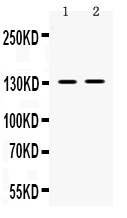
Product group Antibodies

Anti-TRPM5 Antibody Picoband(r)PB9903-CARRIER-FREE
ApplicationsWestern Blot, ImmunoHistoChemistry
ReactivityHuman, Mouse, Rat
TargetTRPM5
- SizePrice