


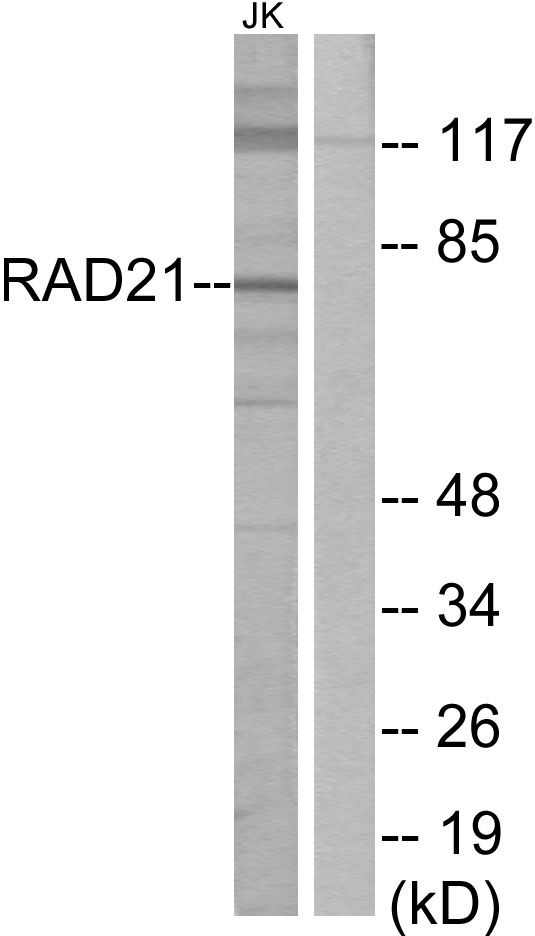
Figure 1. Western blot analysis of RAD21 using anti-RAD21 antibody (A01864-2). Electrophoresis was performed on a 5-20% SDS-PAGE gel at 70V (Stacking gel) / 90V (Resolving gel) for 2-3 hours. The sample well of each lane was loaded with 30 ug of sample under reducing conditions. Lane 1: monkey COS-7 whole cell lysates, Lane 2: human Hela whole cell lysates, Lane 3: human MOLT-4 whole cell lysates, Lane 4: human Jurkat whole cell lysates, Lane 5: human HEL whole cell lysates, Lane 6: human Daudi whole cell lysates, Lane 7: human A431 whole cell lysates, Lane 8: human T-47D whole cell lysates, Lane 9: rat brain tissue lysates, Lane 10: rat pancreas tissue lysates, Lane 11: mouse brain tissue lysates, Lane 12: mouse pancreas tissue lysates. After electrophoresis, proteins were transferred to a nitrocellulose membrane at 150 mA for 50-90 minutes. Blocked the membrane with 5% non-fat milk/TBS for 1.5 hour at RT. The membrane was incubated with rabbit anti-RAD21 antigen affinity purified polyclonal antibody (Catalog # A01864-2) at 0.5 microg/mL overnight at 4°C, then washed with TBS-0.1%Tween 3 times with 5 minutes each and probed with a goat anti-rabbit IgG-HRP secondary antibody at a dilution of 1:5000 for 1.5 hour at RT. The signal is developed using an Enhanced Chemiluminescent detection (ECL) kit (Catalog # EK1002) with Tanon 5200 system. A specific band was detected for RAD21 at approximately 72 kDa. The expected band size for RAD21 is at 72 kDa.


Figure 1. Western blot analysis of RAD21 using anti-RAD21 antibody (A01864-2). Electrophoresis was performed on a 5-20% SDS-PAGE gel at 70V (Stacking gel) / 90V (Resolving gel) for 2-3 hours. The sample well of each lane was loaded with 30 ug of sample under reducing conditions. Lane 1: monkey COS-7 whole cell lysates, Lane 2: human Hela whole cell lysates, Lane 3: human MOLT-4 whole cell lysates, Lane 4: human Jurkat whole cell lysates, Lane 5: human HEL whole cell lysates, Lane 6: human Daudi whole cell lysates, Lane 7: human A431 whole cell lysates, Lane 8: human T-47D whole cell lysates, Lane 9: rat brain tissue lysates, Lane 10: rat pancreas tissue lysates, Lane 11: mouse brain tissue lysates, Lane 12: mouse pancreas tissue lysates. After electrophoresis, proteins were transferred to a nitrocellulose membrane at 150 mA for 50-90 minutes. Blocked the membrane with 5% non-fat milk/TBS for 1.5 hour at RT. The membrane was incubated with rabbit anti-RAD21 antigen affinity purified polyclonal antibody (Catalog # A01864-2) at 0.5 microg/mL overnight at 4°C, then washed with TBS-0.1%Tween 3 times with 5 minutes each and probed with a goat anti-rabbit IgG-HRP secondary antibody at a dilution of 1:5000 for 1.5 hour at RT. The signal is developed using an Enhanced Chemiluminescent detection (ECL) kit (Catalog # EK1002) with Tanon 5200 system. A specific band was detected for RAD21 at approximately 72 kDa. The expected band size for RAD21 is at 72 kDa.
Anti-RAD21 Antibody Picoband(r)
A01864-2-DYLIGHT550

ApplicationsFlow Cytometry, ImmunoFluorescence, Western Blot, ELISA, ImmunoCytoChemistry
Product group Antibodies
ReactivityHuman, Monkey, Mouse, Rat
TargetRAD21
Overview
- SupplierBoster Bio
- Product NameAnti-RAD21 Antibody Picoband(r)
- Delivery Days Customer9
- ApplicationsFlow Cytometry, ImmunoFluorescence, Western Blot, ELISA, ImmunoCytoChemistry
- CertificationResearch Use Only
- ClonalityPolyclonal
- Concentration500 ug/ml
- ConjugateDyLight 550
- Gene ID5885
- Target nameRAD21
- Target descriptionRAD21 cohesin complex component
- Target synonymsCDLS4, HR21, HRAD21, MCD1, MGS, NXP1, SCC1, hHR21, double-strand-break repair protein rad21 homolog, NXP-1, RAD21 homolog, SCC1 homolog, kleisin, nuclear matrix protein 1, protein involved in DNA double-strand break repair, sister chromatid cohesion 1
- HostRabbit
- IsotypeIgG
- Protein IDO60216
- Protein NameDouble-strand-break repair protein rad21 homolog
- Scientific DescriptionBoster Bio Anti-RAD21 Antibody Picoband® catalog # A01864-2. Tested in ELISA, Flow Cytometry, IF, ICC, WB applications. This antibody reacts with Human, Mouse, Rat, Monkey. The brand Picoband indicates this is a premium antibody that guarantees superior quality, high affinity, and strong signals with minimal background in Western blot applications. Only our best-performing antibodies are designated as Picoband, ensuring unmatched performance.
- ReactivityHuman, Monkey, Mouse, Rat
- Storage Instruction-20°C,2°C to 8°C
- UNSPSC12352203
Related products
Product group Antibodies
References

Rad21 antibodyGTX106012
ApplicationsImmunoFluorescence, ImmunoPrecipitation, Western Blot, ChIP Chromatin ImmunoPrecipitation, ImmunoCytoChemistry, ImmunoHistoChemistry, ImmunoHistoChemistry Paraffin
ReactivityHuman, Mouse, Rat
TargetRAD21
- SizePrice
Product group Antibodies

Anti-RAD21 (C-term) Antibody102-25155
ApplicationsWestern Blot
TargetRAD21
- SizePrice
Product group Antibodies

Anti-RAD21 AntibodyA99001
ApplicationsWestern Blot, ELISA
ReactivityHuman, Mouse
- SizePrice
Product group Antibodies
Anti-RAD21 Antibody Picoband(r)A01864-2-CARRIER-FREE
ApplicationsFlow Cytometry, ImmunoFluorescence, Western Blot, ELISA, ImmunoCytoChemistry
ReactivityHuman, Monkey, Mouse, Rat
TargetRAD21
- SizePrice
Product group Antibodies

RAD21 AntibodyCSB-PA040139
ApplicationsImmunoFluorescence, Western Blot, ELISA, ImmunoHistoChemistry
ReactivityHuman, Mouse
TargetRAD21
- SizePrice
Product group Antibodies

RAD21 Antibody (C-Terminus)LS-C368680
ApplicationsImmunoFluorescence, Western Blot, ImmunoCytoChemistry, ImmunoHistoChemistry, ImmunoHistoChemistry Paraffin
ReactivityBovine, Human, Mouse, Rat, Zebra Fish
TargetRAD21
- SizePrice
Product group Antibodies

RAD21 Recombinant AntibodyBSM-61159R
ApplicationsFlow Cytometry, Western Blot
TargetRAD21
- SizePrice


Product group Antibodies

Anti-RAD21 AntibodyHPA020044
ApplicationsWestern Blot, ChIP Chromatin ImmunoPrecipitation, ImmunoCytoChemistry, ImmunoHistoChemistry
ReactivityHuman
TargetRAD21
- SizePrice