

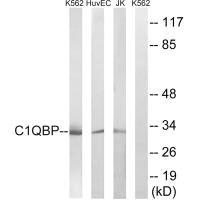
Western blot analysis of extracts from Jurkat cells, K562 cells and HUVEC cells, using C1QBP antibody.
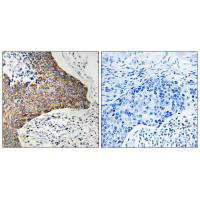
Western blot analysis of extracts from Jurkat cells, K562 cells and HUVEC cells, using C1QBP antibody.
C1QBP Antibody
CSB-PA081203

ApplicationsWestern Blot, ELISA, ImmunoHistoChemistry
Product group Antibodies
ReactivityHuman
TargetC1QBP
Overview
- SupplierCusabio
- Product NameC1QBP Antibody
- Delivery Days Customer20
- ApplicationsWestern Blot, ELISA, ImmunoHistoChemistry
- CertificationResearch Use Only
- ClonalityPolyclonal
- ConjugateUnconjugated
- Gene ID708
- Target nameC1QBP
- Target descriptioncomplement C1q binding protein
- Target synonymsCOXPD33, GC1QBP, HABP1, SF2AP32, SF2p32, gC1Q-R, gC1qR, p32, complement component 1 Q subcomponent-binding protein, mitochondrial, ASF/SF2-associated protein p32, C1q globular domain-binding protein, complement component 1, q subcomponent binding protein, glycoprotein gC1qBP, hyaluronan-binding protein 1, mitochondrial matrix protein p32, p33, splicing factor SF2-associated protein
- HostRabbit
- IsotypeIgG
- Protein IDQ07021
- Protein NameComplement component 1 Q subcomponent-binding protein, mitochondrial
- Scientific DescriptionIs believed to be a multifunctional and multicompartmental protein involved in inflammation and infection processes, ribosome biogenesis, regulation of apoptosis, transcriptional regulation and pre-mRNA splicing. At the cell surface is thought to act as an endothelial receptor for plasma proteins of the complement and kallikrein-kinin cascades. Putative receptor for C1q; specifically binds to the globular heads of C1q thus inhibiting C1; may perform the receptor function through a complex with C1qR/CD93. In complex with cytokeratin-1/KRT1 is a high affinity receptor for kininogen-1/HMWK. Can also bind other plasma proteins, such as coagulation factor XII leading to its autoactivation. May function to bind initially fluid kininogen-1 to the cell membrane. The secreted form may enhance both extrinsic and intrinsic coagulation pathways. It is postulated that the cell surface form requires docking with transmembrane proteins for downstream signaling which might be specific for a cell-type or response. By acting as C1q receptor is involved in chemotaxis of immature dendritic cells and neutrophils and is proposed to signal through CD209/DC-SIGN on immature dendritic cells, through integrin alpha-4/beta-1 during trophoblast invasion of the decidua, and through integrin beta-1 during endothelial cell adhesion and spreading. Signaling involved in inhibition of innate immune response is implicating the PI3K-AKT/PKB pathway. In mitochondrial translation may be involved in formation of functional 55S mitoribosomes; the function seems to involve its RNA-binding activity. May be involved in the nucleolar ribosome maturation process; the function may involve the exchange of FBL for RRP1 in the association with pre-ribosome particles. Involved in regulation of RNA splicing by inhibiting the RNA-binding capacity of SRSF1 and its phosphorylation. Is required for the nuclear translocation of splicing factor U2AF1L4. Involved in regulation of CDKN2A- and HRK-mediated apoptosis. Stabilizes mitochondrial CDKN2A isoform smARF May be involved in regulation of FOXC1 transcriptional activity and NFY/CCAAT-binding factor complex-mediated transcription. In infection processes acts as an attachment site for microbial proteins, including Listeria monocytogenes internalin B and Staphylococcus aureus protein A. May play a role in antibacterial defense as it can bind to cell surface hyaluronan and inhibit Streptococcus pneumoniae hyaluronate lyase. Involved in replication of Rubella virus. May be involved in modulation of the immune response; ligation by HCV core protein is resulting in suppresion of interleukin-12 production in monocyte-derived dendritic cells. Involved in regulation of antiviral response by inhibiting DDX58- and IFIH1-mediated signaling pathways probably involving its association with MAVS after viral infection. Involved in HIV-1 replication, presumably by contributing to splicing of viral RNA. Honore B., Gene 134:283-287(1993). Ghebrehiwet B., J. Exp. Med. 179:1809-1821(1994). Tye A.J., J. Biol. Chem. 276:17069-17075(2001)
- ReactivityHuman
- Storage Instruction-20°C or -80°C
- UNSPSC41116161
Related products
Product group Antibodies

Anti-C1QBP Antibody144-01883
ApplicationsImmunoFluorescence, Western Blot
ReactivityHuman, Mouse
TargetC1QBP
- SizePrice


![Various whole cell extracts (30 μg) were separated by 12% SDS-PAGE, and the membrane was blotted with C1qBP antibody [GT1250] (GTX02847) diluted at 1:1000. The HRP-conjugated anti-rabbit IgG antibody (GTX213110-01) was used to detect the primary antibody.](https://www.genetex.com/upload/website/prouct_img/normal/GTX02847/GTX02847_4000000569_20210122_WB_2_w_23053123_941.webp)
Product group Antibodies

C1qBP antibody [GT1250]GTX02847
ApplicationsWestern Blot, ImmunoHistoChemistry, ImmunoHistoChemistry Paraffin
ReactivityHuman, Mouse, Rat
TargetC1QBP
- SizePrice
Product group Antibodies

ApplicationsFlow Cytometry
TargetC1QBP
- SizePrice
Product group Antibodies

GC1q R Recombinant Antibody, Biotin ConjugatedBSM-61312R-BIOTIN
ApplicationsWestern Blot, ImmunoHistoChemistry, ImmunoHistoChemistry Frozen, ImmunoHistoChemistry Paraffin
TargetC1QBP
- SizePrice


Product group Antibodies

Anti-C1QBP AntibodyA95923
ApplicationsWestern Blot, ELISA, ImmunoHistoChemistry
ReactivityHuman, Mouse, Rat
- SizePrice

Product group Antibodies

Anti-GC1q R/C1QBP Antibody Picoband(r)PB9921-CARRIER-FREE
ApplicationsFlow Cytometry, ImmunoFluorescence, Western Blot, ImmunoCytoChemistry, ImmunoHistoChemistry, ImmunoHistoChemistry Frozen
ReactivityHuman, Mouse, Rat
TargetC1QBP
- SizePrice
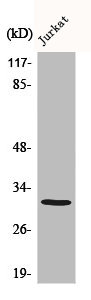
Product group Antibodies
C1QBP AntibodyCSB-PA001089
ApplicationsWestern Blot, ELISA, ImmunoHistoChemistry
ReactivityHuman, Mouse, Rat
TargetC1QBP
- SizePrice