

Chk1 antibody [C1C2-6], Internal
GTX100070

ApplicationsImmunoFluorescence, Western Blot, ImmunoCytoChemistry, ImmunoHistoChemistry, ImmunoHistoChemistry Paraffin
Product group Antibodies
ReactivityHuman
TargetCHEK1
Overview
- SupplierGeneTex
- Product NameChk1 antibody [C1C2-6], Internal
- Delivery Days Customer9
- Application Supplier NoteWB: 1:1000-1:10000. ICC/IF: 1:100-1:1000. IHC-P: 1:100-1:1000. *Optimal dilutions/concentrations should be determined by the researcher.Not tested in other applications.
- ApplicationsImmunoFluorescence, Western Blot, ImmunoCytoChemistry, ImmunoHistoChemistry, ImmunoHistoChemistry Paraffin
- CertificationResearch Use Only
- ClonalityPolyclonal
- Concentration1 mg/ml
- ConjugateUnconjugated
- Gene ID1111
- Target nameCHEK1
- Target descriptioncheckpoint kinase 1
- Target synonymsCHK1, OZEMA21, serine/threonine-protein kinase Chk1, CHK1 checkpoint homolog, Checkpoint, S. pombe, homolog of, 1, Chk1-S, cell cycle checkpoint kinase
- HostRabbit
- IsotypeIgG
- Protein IDO14757
- Protein NameSerine/threonine-protein kinase Chk1
- Scientific DescriptionRequired for checkpoint mediated cell cycle arrest in response to DNA damage or the presence of unreplicated DNA. May also negatively regulate cell cycle progression during unperturbed cell cycles. Recognizes the substrate consensus sequence [R-X-X-S/T]. Binds to and phosphorylates CDC25A, CDC25B and CDC25C. Phosphorylation of CDC25A at Ser-178 and Thr-507 and phosphorylation of CDC25C at Ser-216 creates binding sites for 14-3-3 proteins which inhibit CDC25A and CDC25C. Phosphorylation of CDC25A at Ser-76, Ser-124, Ser-178, Ser-279 and Ser-293 promotes proteolysis of CDC25A. Inhibition of CDC25 activity leads to increased inhibitory tyrosine phosphorylation of CDK-cyclin complexes and blocks cell cycle progression. Binds to and phosphorylates RAD51 at Thr-309, which may enhance the association of RAD51 with chromatin and promote DNA repair by homologous recombination. Binds to and phosphorylates TLK1 at Ser-743, which prevents the TLK1-dependent phosphorylation of the chromatin assembly factor ASF1A. This may affect chromatin assembly during S phase or DNA repair. May also phosphorylate multiple sites within the C-terminus of TP53, which promotes activation of TP53 by acetylation and enhances suppression of cellular proliferation.
- ReactivityHuman
- Storage Instruction-20°C or -80°C,2°C to 8°C
- UNSPSC12352203
References
- Yang WB, Wu AC, Hsu TI, et al. Histone deacetylase 6 acts upstream of DNA damage response activation to support the survival of glioblastoma cells. Cell Death Dis. 2021,12(10):884. doi: 10.1038/s41419-021-04182-wRead this paper
- Sun X, Wang Y, Ji K, et al. NRF2 preserves genomic integrity by facilitating ATR activation and G2 cell cycle arrest. Nucleic Acids Res. 2020,48(16):9109-9123. doi: 10.1093/nar/gkaa631Read this paper
- Hung CC, Chien CY, Chiang WF, et al. p22phox confers resistance to cisplatin, by blocking its entry into the nucleus. Oncotarget. 2015,6(6):4110-25.Read this paper
- Chen HM, Chang FR, Hsieh YC, et al. A novel synthetic protoapigenone analogue, WYC02-9, induces DNA damage and apoptosis in DU145 prostate cancer cells through generation of reactive oxygen species. Free Radic Biol Med. 2011,50(9):1151-62. doi: 10.1016/j.freeradbiomed.2011.01.015Read this paper
Datasheet
Related products

Product group Antibodies

Anti-Chk1/CHEK1 Antibody Picoband(r)A01060-CARRIER-FREE
ApplicationsFlow Cytometry, Western Blot
ReactivityHuman
TargetCHEK1
- SizePrice
Product group Antibodies

Chek1 Recombinant AntibodyCAC12088
ApplicationsImmunoFluorescence, Western Blot, ELISA, ImmunoHistoChemistry
TargetCHEK1
- SizePrice
Product group Antibodies
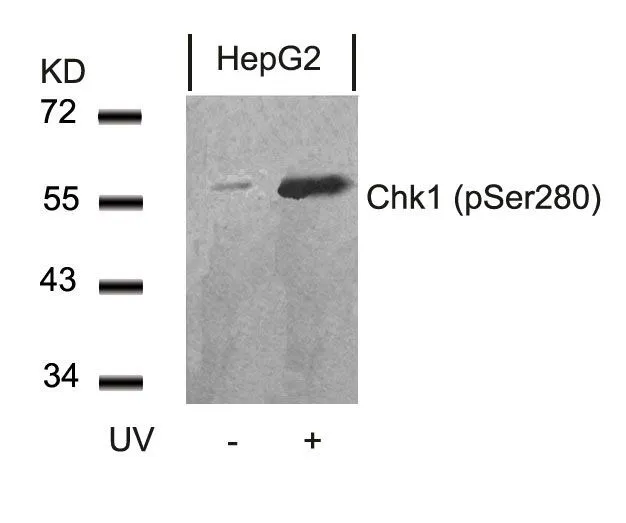
Chk1 (phospho Ser280) antibodyGTX50200
ApplicationsWestern Blot
ReactivityHuman
TargetCHEK1
- SizePrice
Product group Antibodies
References
Chk1 antibodyGTX50463
ApplicationsWestern Blot, ImmunoHistoChemistry, ImmunoHistoChemistry Paraffin
ReactivityHuman
TargetCHEK1
- SizePrice
Product group Antibodies
Chk1 antibody [6F5]GTX70303
ApplicationsImmunoFluorescence, Western Blot, ImmunoCytoChemistry
ReactivityHuman
TargetCHEK1
- SizePrice
Product group Antibodies
Chk1 (phospho Ser345) antibodyGTX79111
ApplicationsImmunoHistoChemistry, ImmunoHistoChemistry Paraffin
ReactivityHuman
TargetCHEK1
- SizePrice
![WB analysis of HEK293T cells transfected with the pCMV6-ENTRY control (1) and pCMV6-ENTRY CHK1 cDNA (2) using GTX83385 Chk1 antibody [2G1D5].](https://www.genetex.com/upload/website/prouct_img/normal/GTX83385/GTX83385_20170912_WB_1_w_23061322_728.webp)
Product group Antibodies
References
Chk1 antibody [2G1D5]GTX83385
ApplicationsImmunoFluorescence, Western Blot, ELISA, ImmunoCytoChemistry
ReactivityHuman, Mouse
TargetCHEK1
- SizePrice
Product group Antibodies

Anti-CHEK1 Antibody144-07653
ApplicationsImmunoFluorescence, Western Blot, ImmunoHistoChemistry
ReactivityHuman, Mouse, Rat
TargetCHEK1
- SizePrice

Product group Antibodies
Chk1 (phospho Ser296) antibodyGTX55053
ApplicationsWestern Blot, ImmunoHistoChemistry, ImmunoHistoChemistry Paraffin
ReactivityHuman
TargetCHEK1
- SizePrice