

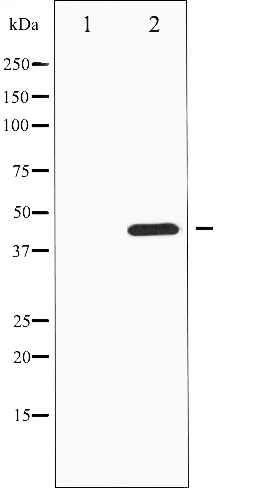
Western blot analysis of MKP-1/2 phosphorylation expression in heatshockK562 whole cell lysates,The lane on the left is treated with the antigen-specific peptide.
Western blot analysis of MKP-1/2 phosphorylation expression in heatshockK562 whole cell lysates,The lane on the left is treated with the antigen-specific peptide.
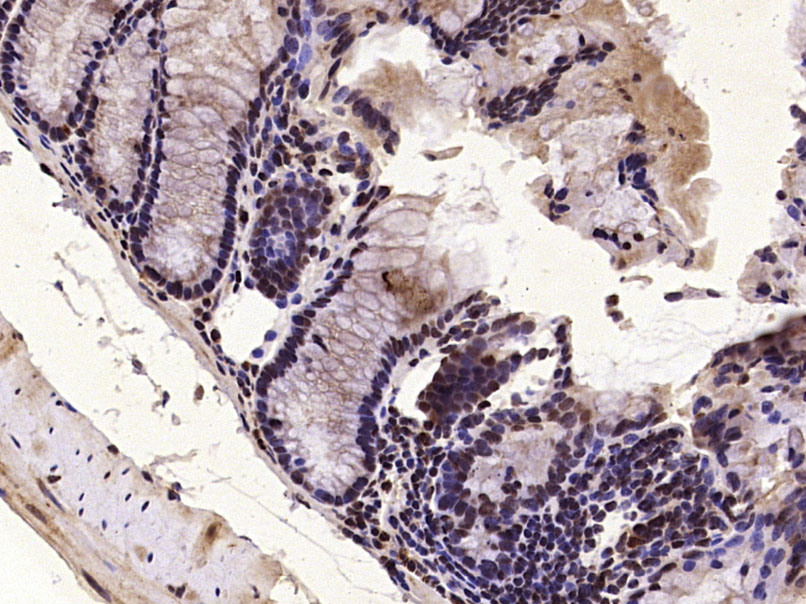
DUSP1 (phospho Ser296/Ser318) antibody
GTX52320

ApplicationsWestern Blot, ImmunoHistoChemistry
Product group Antibodies
ReactivityHuman, Mouse, Rat
TargetDUSP1
Overview
- SupplierGeneTex
- Product NameDUSP1 (phospho Ser296/Ser318) antibody
- Delivery Days Customer9
- Application Supplier NoteWB 1:500-1:2000, IHC 1:50-1:200
- ApplicationsWestern Blot, ImmunoHistoChemistry
- CertificationResearch Use Only
- ClonalityPolyclonal
- Concentration1 mg/ml
- ConjugateUnconjugated
- Gene ID1843
- Target nameDUSP1
- Target descriptiondual specificity phosphatase 1
- Target synonymsCL100, HVH1, MKP-1, MKP1, PTPN10, dual specificity protein phosphatase 1, CL 100, MAP kinase phosphatase 1, dual specificity protein phosphatase hVH1, mitogen-activated protein kinase phosphatase 1, protein-tyrosine phosphatase CL100, serine/threonine specific protein phosphatase
- HostRabbit
- IsotypeIgG
- Protein IDP28562
- Protein NameDual specificity protein phosphatase 1
- Scientific DescriptionThe protein encoded by this gene is a phosphatase with dual specificity for tyrosine and threonine. The encoded protein can dephosphorylate MAP kinase MAPK1/ERK2, which results in its involvement in several cellular processes. This protein appears to play an important role in the human cellular response to environmental stress as well as in the negative regulation of cellular proliferation. Finally, the encoded protein can make some solid tumors resistant to both chemotherapy and radiotherapy, making it a target for cancer therapy. [provided by RefSeq, Aug 2017]
- ReactivityHuman, Mouse, Rat
- Storage Instruction-20°C or -80°C,2°C to 8°C
- UNSPSC12352203
Datasheet
Related products

Product group Antibodies

Anti-MKP-1/DUSP1 Antibody Picoband(r)A02276-1-CARRIER-FREE
ApplicationsFlow Cytometry, Western Blot
ReactivityHuman
TargetDUSP1
- SizePrice
Product group Antibodies

DUSP1 Polyclonal AntibodyCAC15043
ApplicationsWestern Blot, ELISA
TargetDUSP1
- SizePrice
Product group Antibodies
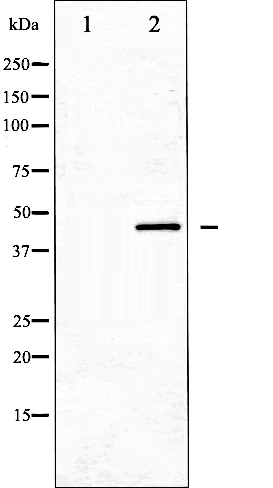
MKP 1/2 antibodyGTX52356
ApplicationsWestern Blot, ImmunoHistoChemistry
ReactivityHuman, Mouse, Rat
TargetDUSP1
- SizePrice
Product group Antibodies

Anti-DUSP1 Antibody144-02919
ApplicationsWestern Blot
ReactivityHuman, Mouse
TargetDUSP1
- SizePrice
Product group Antibodies
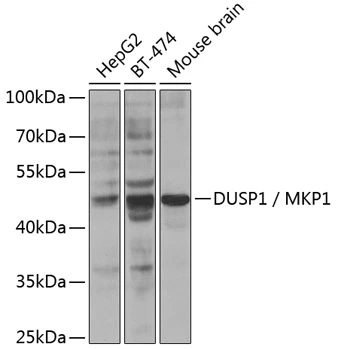
DUSP1 antibodyGTX54042
ApplicationsWestern Blot
ReactivityHuman, Mouse
TargetDUSP1
- SizePrice
Product group Antibodies

Goat anti-DUSP1 AntibodyEB05197
ApplicationsWestern Blot, ELISA, ImmunoHistoChemistry
ReactivityBovine, Canine, Human, Mouse, Rat
TargetDUSP1
- SizePrice
Product group Antibodies
DUSP1 antibodyGTX101229
ApplicationsWestern Blot
ReactivityHuman, Mouse
TargetDUSP1
- SizePrice

Product group Antibodies
References
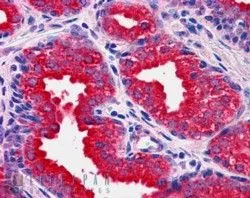
DUSP1 antibody, C-termGTX47608
ApplicationsWestern Blot, ImmunoHistoChemistry, ImmunoHistoChemistry Paraffin
ReactivityHuman, Mouse
TargetDUSP1
- SizePrice
Product group Antibodies
References

MKP1 Polyclonal AntibodyBS-1851R
ApplicationsImmunoFluorescence, Western Blot, ELISA, ImmunoCytoChemistry, ImmunoHistoChemistry, ImmunoHistoChemistry Frozen, ImmunoHistoChemistry Paraffin
ReactivityBovine, Canine, Equine, Human, Mouse, Rabbit, Rat, Sheep
TargetDUSP1
- SizePrice