

GRM1 Antibody - C-terminal region
OAAB10001

ApplicationsWestern Blot
Product group Antibodies
ReactivityHuman
TargetGRM1
Overview
- SupplierAviva Systems Biology
- Product NameGRM1 Antibody - C-terminal region
- Delivery Days Customer23
- Application Supplier NoteWB: 1:1000
- ApplicationsWestern Blot
- CertificationResearch Use Only
- ClonalityPolyclonal
- Concentration0.5 mg/ml
- FormatLiquid. PBS with 0.09% (W/V) sodium azide.
- Gene ID2911
- Target nameGRM1
- Target descriptionglutamate metabotropic receptor 1
- Target synonymsGPRC1A, MGLU1, MGLUR1, PPP1R85, SCA44, SCAR13, metabotropic glutamate receptor 1, glutamate receptor, metabotropic 1, protein phosphatase 1, regulatory subunit 85
- HostRabbit
- Protein IDQ13255
- Protein NameMetabotropic glutamate receptor 1
- Scientific DescriptionL-glutamate is the major excitatory neurotransmitter in the central nervous system and activates both ionotropic and metabotropic glutamate receptors. Glutamatergic neurotransmission is involved in most aspects of normal brain function and can be perturbed in many neuropathologic conditions. The metabotropic glutamate receptors are a family of G protein-coupled receptors, that have been divided into 3 groups on the basis of sequence homology, putative signal transduction mechanisms, and pharmacologic properties. Group I includes GRM1 and GRM5 and these receptors have been shown to activate phospholipase C. Group II includes GRM2 and GRM3 while Group III includes GRM4, GRM6, GRM7 and GRM8. Group II and III receptors are linked to the inhibition of the cyclic AMP cascade but differ in their agonist selectivities. The canonical alpha isoform of the metabotropic glutamate receptor 1 gene is a disulfide-linked homodimer whose activity is mediated by a G-protein-coupled phosphatidylinositol-calcium second messenger system. Alternative splicing results in multiple transcript variants encoding distinct isoforms; some of which may have distinct functions.
- ReactivityHuman
- Storage Instruction-20°C,2°C to 8°C
- UNSPSC41116161
Related products
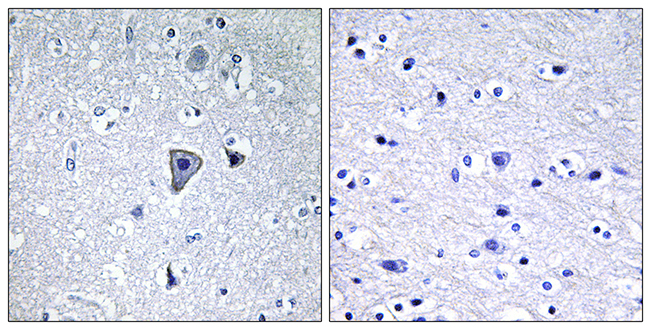
Product group Antibodies

Anti-GRM1 AntibodyA97783
ApplicationsELISA, ImmunoHistoChemistry
ReactivityHuman, Mouse, Rat
- SizePrice

Product group Antibodies

Anti-mGluR1/GRM1 Antibody Picoband(r)A03049-4-CARRIER-FREE
ApplicationsFlow Cytometry, Western Blot, ELISA, ImmunoHistoChemistry
ReactivityHuman, Mouse, Rat
TargetGRM1
- SizePrice
Product group Antibodies

Anti-GRM1 Antibody144-62066
ApplicationsWestern Blot
ReactivityHuman, Mouse, Rat
TargetGRM1
- SizePrice

Product group Antibodies

GRM1 Polyclonal AntibodyBS-1803R
ApplicationsFlow Cytometry, ImmunoFluorescence, Western Blot, ELISA, ImmunoCytoChemistry, ImmunoHistoChemistry, ImmunoHistoChemistry Frozen, ImmunoHistoChemistry Paraffin
ReactivityBovine, Canine, Chicken, Equine, Human, Mouse, Porcine, Rat
TargetGRM1
- SizePrice
Product group Antibodies

GRM1 AntibodyCSB-PA009017
ApplicationsELISA, ImmunoHistoChemistry
ReactivityHuman, Mouse, Rat
TargetGRM1
- SizePrice
Product group Antibodies

ApplicationsImmunoPrecipitation, Western Blot, ImmunoCytoChemistry, ImmunoHistoChemistry
ReactivityMouse, Porcine, Rat
TargetGRM1
- SizePrice
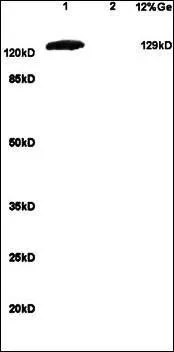
Product group Antibodies

mGluR1 antibodyGTX37416
ApplicationsWestern Blot, ImmunoHistoChemistry, ImmunoHistoChemistry Paraffin
ReactivityHuman, Mouse, Rat
TargetGRM1
- SizePrice


Product group Antibodies

Anti-GRM1 AntibodyHPA015701
ApplicationsImmunoHistoChemistry
ReactivityHuman
TargetGRM1
- SizePrice
Product group Antibodies

GRM1 / MGLUR1 AntibodyLS-C746882
ApplicationsWestern Blot
ReactivityHuman, Rat
TargetGRM1
- SizePrice