

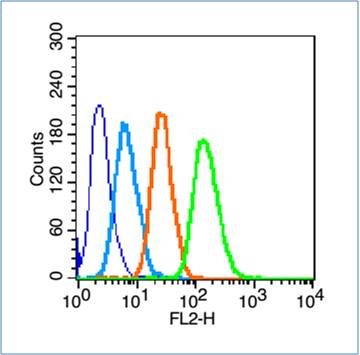
HepG2 cells(black) were incubated in 5% BSA blocking buffer for 30 min at room temperature. Cells were then stained with MRC1 Antibody(bs-4727R) at 1:50 dilution in blocking buffer and incubated for 30 min at room temperature, washed twice with 2% BSA in PBS. Acquisitions of 20,000 events were performed. Cells stained with primary antibody (green) and isotype control (orange).
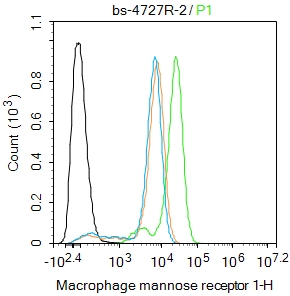
HepG2 cells(black) were incubated in 5% BSA blocking buffer for 30 min at room temperature. Cells were then stained with MRC1 Antibody(bs-4727R) at 1:50 dilution in blocking buffer and incubated for 30 min at room temperature, washed twice with 2% BSA in PBS. Acquisitions of 20,000 events were performed. Cells stained with primary antibody (green) and isotype control (orange).
MRC1 Polyclonal Antibody
BS-4727R

ApplicationsFlow Cytometry, Western Blot, ELISA
Product group Antibodies
ReactivityHuman
TargetMRC1
Overview
- SupplierBioss
- Product NameMRC1 Polyclonal Antibody
- Delivery Days Customer16
- ApplicationsFlow Cytometry, Western Blot, ELISA
- Applications SupplierWB(1:300-5000), ELISA(1:500-1000), FCM(1:20-100)
- CertificationResearch Use Only
- ClonalityPolyclonal
- Concentration1 ug/ul
- ConjugateUnconjugated
- Gene ID4360
- Target nameMRC1
- Target descriptionmannose receptor C-type 1
- Target synonymsCD206, CLEC13D, CLEC13DL, MMR, MRC1L1, bA541I19.1, hMR, macrophage mannose receptor 1, C-type lectin domain family 13 member D, human mannose receptor, macrophage mannose receptor 1-like protein 1, mannose receptor, C type 1-like 1
- HostRabbit
- IsotypeIgG
- Protein IDP22897
- Protein NameMacrophage mannose receptor 1
- ReactivityHuman
- Storage Instruction-20°C
- UNSPSC41116161
References
- Sonodynamic therapy in atherosclerosis by curcumin nanosuspensions: Preparation design, efficacy evaluation, and mechanisms analysis. Jiang L et al., 2020 Jan, Eur J Pharm BiopharmRead this paper
- Structural characterization and immunomodulatory activity of a novel acid polysaccharide isolated from the pulp of Rosa laevigata Michx fruit. Zhan Q et al., 2020 Feb 15, Int J Biol MacromolRead this paper
- A Multi-Functional Silicon Nanoparticle Designed for Enhanced Osteoblast Calcification and Related Combination Therapy. Shao N et al., 2019 Dec, Macromol BiosciRead this paper
- The effect of exposure to hypoxia on superoxide formation by alveolar macrophages is indirect. Zaloudikova M et al., 2019 Nov 1, Life SciRead this paper
- Co-Administration of Curcumin and Artepillin C Induces Development of Brown-Like Adipocytes in Association with Local Norepinephrine Production by Alternatively Activated Macrophages in Mice. Nishikawa S et al., 2019, J Nutr Sci Vitaminol (Tokyo)Read this paper
- Exploring the interactions between engineered nanomaterials and immune cells at 3D nano-bio interfaces to discover potent nano-adjuvants. Ma R et al., 2019 Jun 18, NanomedicineRead this paper
- Heat injured stromal cells-derived exosomal EGFR enhances prostatic wound healing after thulium laser resection through EMT and NF-kappaB signaling. Shi F et al., 2019 Aug, ProstateRead this paper
- GLUT12 promotes prostate cancer cell growth and is regulated by androgens and CaMKK2 signaling. White MA et al., 2018 Apr, Endocr Relat CancerRead this paper
- Highly Dispersible and Bioavailable Curcumin but not Native Curcumin Induces Brown-Like Adipocyte Formation in Mice. Nishikawa S et al., 2018 Mar, Mol Nutr Food ResRead this paper
- IL-17A induces heterogeneous macrophages, and it does not alter the effects of lipopolysaccharides on macrophage activation in the skin of mice. Nakai K et al., 2017 Sep 29, Sci RepRead this paper
Datasheet
Related products
Product group Antibodies

Anti-CD206 [6D5]Ab03382-1.1
ApplicationsELISA
ReactivityHuman
TargetMRC1
- SizePrice
Product group Antibodies

Anti-MRC1 AntibodyA101372
ApplicationsWestern Blot, ELISA
ReactivityHuman
- SizePrice
Product group Antibodies

Anti-MRC1 Antibody144-66582
ApplicationsWestern Blot, ImmunoHistoChemistry
ReactivityHuman, Mouse, Rat
TargetMRC1
- SizePrice


Product group Antibodies

Anti-MRC1 AntibodyAMAB90746
ApplicationsWestern Blot, ImmunoHistoChemistry
ReactivityHuman
TargetMRC1
- SizePrice

Product group Antibodies

Anti-Mannose Receptor/MRC1 Picoband(r) AntibodyA02285-2-CARRIER-FREE
ApplicationsImmunoFluorescence, Western Blot, ELISA, ImmunoHistoChemistry
ReactivityHuman, Monkey, Mouse, Rat
TargetMRC1
- SizePrice
Product group Antibodies

MRC1 AntibodyCSB-PA006303
ApplicationsWestern Blot, ELISA
ReactivityHuman
TargetMRC1
- SizePrice
Product group Antibodies

ApplicationsImmunoPrecipitation, Western Blot, ImmunoCytoChemistry, ImmunoHistoChemistry
ReactivityMouse
TargetMRC1
- SizePrice
Product group Antibodies

ApplicationsFlow Cytometry, Western Blot, ImmunoHistoChemistry, ImmunoHistoChemistry Frozen
ReactivityHuman
TargetMRC1
- SizePrice
![IHC-Fr analysis of human tonsil tissue using GTX42266 Mannose Receptor antibody [7-450].](https://www.genetex.com/upload/website/prouct_img/normal/GTX42266/GTX42266_4774_IHC-Fr_w_23060820_199.webp)
Product group Antibodies
References

ApplicationsImmunoHistoChemistry, ImmunoHistoChemistry Frozen
ReactivityHuman
TargetMRC1
- SizePrice